…is up, at Gravity’s Rainbow. Welcome, everyone!
Sea level rise
Forget 59 cms. Talk is of about a metre sea level rise by 2100. “Greenland alone will raise sea level by seven metres” says Stefan Rahmstorf, Potsdam Institute for Climate Impact Research. Bye bye Bangladesh. So long Myanmar.
Question: how fast can mangroves migrate?
Recuperating in Afghanistan
A new GRAIN Briefing is scathing about current efforts to “rebuild” agriculture in Afghanistan. It alleges that these are taking place with little or no reference to the “rich heritage of farmers’ varieties.” 1 First, seed aid is coming entirely from outside.
According to an ICARDA survey conducted in 2002, neither rain-fed rice varieties nor rain-fed and irrigated wheat varieties that have been supplied by the aid organisations have included any Afghan genetic materials. The authors of the survey concluded that Afghan wheat farmers are “on their own when it comes to replicating and reselecting local variety seedâ€. 2
Not that genetic material from Afghanistan is lacking. Here’s what SINGER knows about barley and wheat material from that country maintained by ICARDA 3:
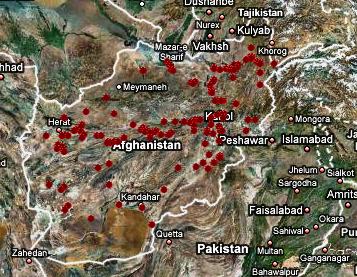
The problem was supposed to be addressed through a code of conduct for seed aid, which came out in 2002. But this has apparently been undercut by efforts to build up a local private seed industry heavily subsidized by the US Army and other donors and based on
…laws that make proprietary seed sale the norm, forcing farmers to buy rather than save or share such seeds, with little protection for farmers’ own local varieties and seed practices. 4 Thus, on 13 September 2005, by way of a process led by the FAO and the EU, the Agriculture Ministry adopted a National Seeds Policy which, while seeming to defend the seed-saving rights of farmers, endorsed monopoly rights for seed companies that would make it illegal for farmers to exchange or sell commercial seeds:
“Farmers will maintain their right to use, exchange, share or sell their farm-saved seed between themselves without any restriction and will have the right to continue using any varieties of their choice without being hampered by the system of compulsory registration provided they do not commercialise production emanating from proprietary varieties.” 5
The alternative to this is for farmers to turn to the seed supply networks run by the Taliban. The paper doesn’t say if the Taliban supply local varieties, but
[e]ither way — Taliban seed or US Army seed — the seed is certainly not “free”. Both come with heavy political agendas, backed by armed forces, that have little to do with the interests of Afghanistan’s small farmers. Getting their own seeds back into the hands of these farmers is the only real way that they will find their freedom.
While none of this is particularly surprising, the paper overall does seem a little unbalanced. There is nothing in it about what ICARDA and the other IARCs have been doing more recently, and not just in terms of seed relief but also crop improvement. 6 And of course ex situ conservation of Afghani genetic resources. It will be interesting to see how the CGIAR, FAO, USAID and others reply to this latest blast from Barcelona. If they reply at all.
Sharing and genebanks
Gathuru Mburu, coordinator of the African Biodiversity Network in Nairobi, gets interviewed by IPS about AGRA and all that. He 7 says a lot of sensible, though not particularly new, things about the Green Revolution approach to African agricultural development.
What we need to do in Africa is to promote ecological farming, promote farmer varieties of seeds and even support or pass laws that support local farmers and their indigenous plant breeding innovation.
True, if perhaps not the whole truth.
And in India, there are so many people who have realised that the way to save the population of India is not going chemical, but going back to the natural ways, the ecological farming systems. And they are reclaiming, they are recuperating the seeds and the culture around the seeds and they are bringing them back [into use] and they are sharing.
We have to bring back that culture. It’s not just the seeds but the culture around the seeds. It’s the value of sharing — in the corporate world, there is no sharing, but in Africa in our own indigenous cultures, seeds were not sold, they were shared.
Interesting that about sharing. Though I think that particular culture is alive and well in Africa. I wonder if he would extend it to the international level. Or maybe there are limits to sharing? But let’s explore further the bit about recuperating.
At the moment, what is happening in Asia is that farmers are actually going back, retracing what they have lost in terms of biodiversity. And it is an uphill task because the knowledge of managing that biodiversity is gone. Because the elders who have that knowledge are no longer there. The people who are farming today have grown up with monocultures; there are very few people who can take farmers back in Asia, back to where they came from before the Green Revolution.
An uphill task. Recuperating seeds is not an easy thing. They have to look for them, sometimes they may have to even buy the original seeds from the few people who still have the original varieties. And all this is happening because they lost their indigenous seeds to the Green Revolution, which favours monocultures of improved seeds only.
Well, what about genebanks? Recuperating seeds is what they’re there for. People may need to look no further than Muguga, where the Genebank of Kenya is located, to get back the seeds they lost. Or something like them anyway. Assuming they were shared with the genebank in the first place.
Talet for exploration
Rhizowen breaks his own rules in a long and very informative post about the hog peanut, which isn’t a peanut, but which he would fight a hog for. He prefers to call them Talet, the meso-american name for these underground beans. Amphicarpea bracteata is, Rhizowen reckons, well worth a closer look. If I had a garden, I’d do just that.