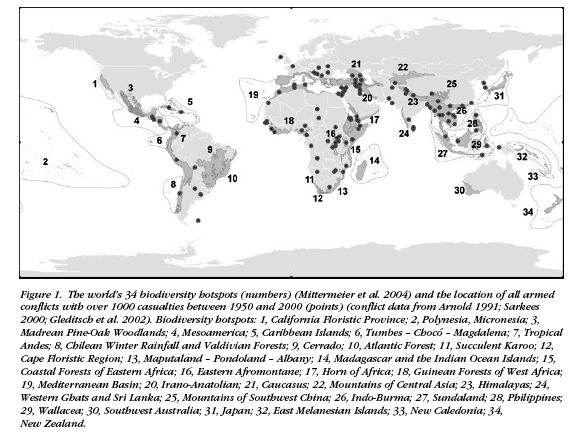
Not many biodiversity hotspots escaped conflict during the past 50 years. 1 And, I’d say, not many centres of crop diversity either.
Crops, livestock, microbes, pollinators, wild relatives, agroecosystems, foodways …
Not many biodiversity hotspots escaped conflict during the past 50 years. 1 And, I’d say, not many centres of crop diversity either.
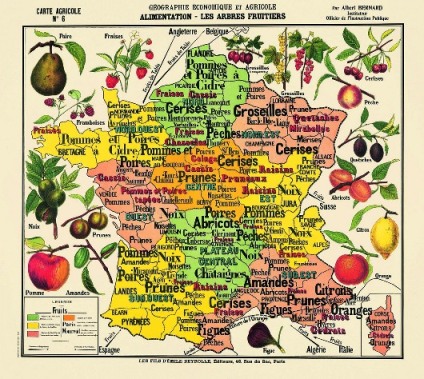
I found this great 19th agricultural map of France at Mapping the Marvelous, a feed I’ve only recently subscribed to which is proving a real find. It was linked there to a post about city orchards at a blog called Food Mapping, a “visual exploration and mapping out of the issues surrounding local food, including the associated debates regarding economics, environmentalism, geography, sustainability and taste.” That’s also gone into the feed reader.
The USDA’s ARS is apparently optimistic about two new crops they’ve been looking at. Or not so new in one case. Guayule, or Parthenium argentatum, was actually used in pre-Columbian times for its latex. It could also now be a source of bioenergy. And milkweed seems to have a lot of weird uses.
Ivo Arrey Mbongaya of the African Centre for Community and Development in Cameroon has a blog on the Eldis Community and has recently discussed threats to two different sorts of agricultural biodiversity in his country. Apparently, goat rearing is in decline, because of the disappearance of grazing land, harsh policies about strays and the lack of veterinary services. He doesn’t say if a local breed is involved, however, and does make reference to “efforts by Heifer Cameroon to distribute cheap animals.”
Also in trouble is “eru,” or Gnetum africanum, a shrub whose leaves are consumed as a green vegetable. Unsustainable harvesting and land use changes are taking their toll, and Ivo recommends taking the plant into domestication.There’s been some work on that by ICRAF and others.
Vernon Heywood on Assisting crop wild relatives:
Moving species into new environments is … a contentious issue and may involve considerable risks. It is a complex issue involving not just scientific, technical and economic but sociological and ethical considerations. It requires a sound and well thought out policy framework before it is widely undertaken as a management response to global change but might be prove to be appropriate in a number of high priority species such as CWR of major crops.
Who else is doing the thinking? And where?