You may have read that the Premio Nonino, a prestigious international literary prize, has just been awarded. I myself knew nothing of it, and only heard about it for the first time on the news a couple of days ago. The prize has an interesting, agrobiodiversity-themed history. Nonino is the name of the family-owned distillery that has revolutionized the making of grappa in the past few decades. Grappa is an Italian spirit concocted from pomace, the grape seeds, stalks and stems discarded by wine makers.
The character of Grappa changed in the 1960s, thanks, largely to the efforts of one woman РGiannola Nonino. Her Nonino distillery, in Percoto Italy, has been producing Grappa since 1897. In the early 1970s, she began making Grappa from a single grape, as opposed to the customary m̩lange of grape leftovers. She sought to make a quality drink, one to rival the great eaux-de-vie of France. It was an uphill battle. She sold very little of her first, 1973, production. Undaunted, she offered her Grappa free to journalists, restaurateurs, and asked that it be served at important commercial and government dinners. She poured the drink herself and told her story as she filled the glasses. Slowly, in this way, the charismatic Ms. Nonino created a following.
The Nonino Distillery’s first single grape Grappa was crafted from the Picolit grape. Today, over a dozen different grapes are used for single grape Grappas, called “monovitigno” Grappas, a term Ms. Nonino coined herself. In 1984, the same Nonino distillery gained government approval and began producing a higher quality Grappa made from whole fruit. They began with grapes and in the following years, produced products using cherries, pear, apricot, peach, and raspberry, among other fruits. Seeking a way to show off their new products, Nonino is also responsible for the stylish glass bottles in which Grappa today is sold, a dramatic change from the old medicinal-style bottles.
The Noninos first instituted a prize in 1975 with the aim of supporting efforts to save the ancient indigenous vines of the Friuli region of Italy. A literary prize came into being some years later “per sottolineare la permanente attualità della civiltà contadina” (to highlight the continuing relevance of rural culture). And finally an international literary prize was added. This last was won this year by, among others, the sociologist and documentary-maker Silvia Perez-Vitoria for her contribution to the “defence of farmers and spreading the values of ancestral knowledge.” One of the daughters of the redoubtable Giannola said, making the awards:
“We are proud that what started out as a project to promote the roots and traditions of Friuli has grown into a prize which honours those who cherish the roots and traditions of humanity as a whole.â€
Nice thought.
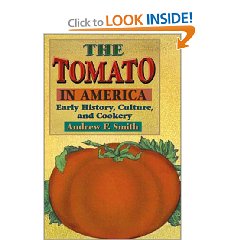 Despite the tomato’s presence along the Atlantic Seaboard and the Gulf Coast, its introduction and adoption in the interior areas of southern states appear to have been delayed. In Salem, North Carolina, tomatoes were not sown until 1833, when a gentleman from South Carolina sent seeds to an “old Mr. Holland.” At that time no one had tasted tomatoes, and scarcely any one had heard of them. Similar late arrivals were probably common for other rural areas of the South. In 1820 Phineas Thornton published a thorough inventory of the kitchen garden plants within a twenty-mile radius of Camden, South Carolina, and made no mention of the tomato. His Southern Gardener and Receipt Book, published twenty years later, included instructions for cultivating and preparing tomatoes for the table, which suggests that they were introduced in Camden sometime between 1820 and 1840.