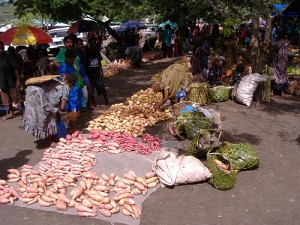
Lois Englberger of the Island Food Community of Pohnpei tells us that “Dana Lee Ling is doing some exciting work on conservation and promotion of Pohnpei banana varieties, along with his teaching at the College of Micronesia-FSM.” The College has an ethnogarden, which includes 14 banana varieties, among many other things.
Listen to the bees (and watch them)
“Imagine if one of every three cows died. The National Guard would be out.” It’s a grim premise, but a favorite of Dennis vanEngelsdorp, who in 2008 watched the same percentage of bees vanish in North America.
Another weekend coming up, another Tedtalk for your edification.
Carlos Ochoa
Carlos Ochoa — legendary potato breeder, explorer and scholar — has passed away at an age of 79 in Lima, Peru.
Born in Cusco, Peru, Ochoa received degrees from the Universidad San Simon, Cochabamba, Bolivia and from the University of Minnesota, USA. For a long time Ochoa worked as a potato breeder. He combined Peruvian with European and American potatoes to produce new cultivars that are grown throughout Peru.
Ochoa was professor emeritus of the Universidad Nacional Agraria La Molina, Peru. In 1971, he joined the International Potato Center, where he worked on the systematics of Andean cultivated and wild potatoes. His long list of publications on this topic include hefty monographs on the potatoes of Bolivia and on the wild potatoes of Peru.
His last major published work (2006) is a book on the ethnobotany of Peru, co-authored with Donald Ugent.
Ochoa was a wild potato explorer par excellence. One third of the nearly 200 wild potato species were first described by him.
Carlos Ochoa received many international accolades, including Distinguished Economic Botanist, the William Brown award for Plant Genetic Resources, and, together with long time collaborator Alberto Salas, the Order of Merit of the Diplomatic Service of Peru.
Here is Ochoa’s own story about some of his early work, including his search for Chilean potatoes described by Darwin and his thoughts on potato varieties: “[they] are like children: you name them, and in turn, they give you a great deal of satisfaction”.
¡Muchas gracias, professor!
Underutilized plants policies unpacked
Agrobiodiversity policy wonks will be delighted that the recently-morphed Global Facilitation Unit for Underutilized Species (GFU), in cooperation with the Genetic Resources Policy Initiative (GRPI), has just come out with the snappily titled “An overview of the international regulatory frameworks that influence the conservation and use of underutilized plant species.” You can download it from the Bioversity International publications pages, along with a separate publication, “The role of policy in the conservation and extended use of underutilized plant species: a cross-national policy analysis.” Other, country-specific GFU policy studies are also available.
Colonial farming brought to life
Slate reporter does stint as historical re-enactor at the living museum that is the Claude Moore Colonial Farm in Virginia — and waxes lyrical about some of her colleagues:
I was particularly entertained by the turkeys. These were not the tasteless, denatured modern grotesques bred to be so short-legged and heavy-breasted that they can no longer mate, but a heritage breed, Black Spanish.