I think I was a bit too gnomic in the last Brainfood. What I was trying to do was arrange a bunch of recent papers on the pipeline from diverse farm landscapes to better health and nutrition outcomes. But I could have been more explicit about it, I agree. So here goes.
First, Global spatial co-variation between crop diversity and landscape heterogeneity shows that in areas with a moderate extent of cropland, landscape diversity is associated with crop diversity. Ok, fine, but so what? Well, next, The role of farm production diversity in enhancing dietary diversity and food security in Southern Bangladesh links that crop diversity — the diversity that farming families grow — with the diversity of the food that they eat: farms growing a wider range of crops tend to support more varied and nutrient-rich diets. Ok, but, again, so what? Hang in there, we’re almost there. The next paper, Linking species and functional crop diversity in South Asia: a spatial assessment of agrobiodiversity for nutrition-sensitive agriculture, sharpens up the focus by showing that what matters nutritionally is not just more crops, but crops that differ in traits, nutrients and uses. And finally, the pièce de résistance, Food biodiversity and its association with diet quality and health outcomes – A scoping review, connects the dots at the consumption end, associating higher food biodiversity with improved micronutrient adequacy and a better overall diet. So the arc is: conserving and deploying species diversity in fields and landscapes is not merely an ecological virtue, but a nutritional strategy, one that translates more diverse seeds in the soil to more nutrients on plates to fewer people in hospitals.
Better now?
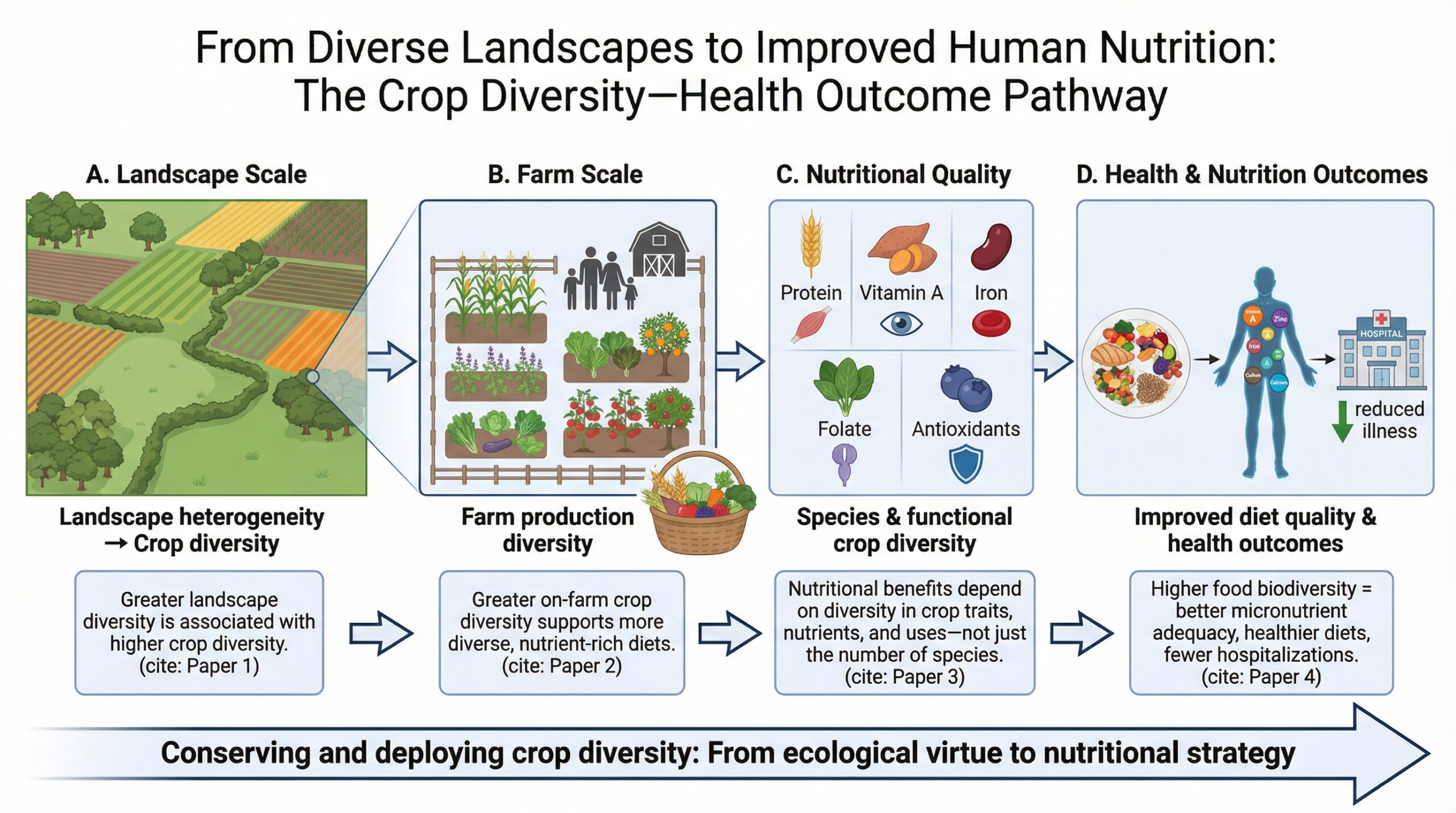
The South Asia paper’s focus on crops that differ in traits, nutrients and uses makes crop counts alone seem like a poor target for nutrition policy. A programme could increase the number of crops grown without doing much to fill the gaps in people’s diets. I’d also be cautious about the final leap to fewer people in hospitals: the associations with micronutrient adequacy and diet quality support the nutritional case, but don’t by themselves establish that downstream health outcome.