Protect and survive; building better-defended wheats

The United States Department of Agriculture broke ground yesterday on a new facility at the University of Minneapolis in St Paul, for studying stem rust and other fungal diseases in wheat.

“By expanding our commitment to research that targets crop diseases like Ug99, we can strengthen food security and reduce hunger and poverty in countries like Afghanistan, Bangladesh, Ethiopia and Pakistan,” said Robert Bertram, head of USAID’s Office of Agriculture, Research and Technology. “This research concurrently helps U.S. scientists protect America’s wheat crops.”

The groundbreaking ceremony was part of a four-day research conference sponsored by the Borlaug Global Rust Initiative. Not coincidentally, a report from a recent wheat-rust meeting at ICARDA is winging its way towards the experts attending the conference. You can download your own copy direct from ICARDA.

Nibbles: Cattle affected, Conservation, Wildfires, Grains, Sudan’s PGR, Sunflowers

What’s cooking Uncle Sam?

Wcus logoI just listened this morning to a fascinating report from What’s cooking Uncle Sam? — a new exhibit at the National Archives in Washington DC. Broadcast on National Public radio, it gave a series of glimpses into what I guess would be a very worthwhile visit. My plan was to Nibble the story, make a fatuous comment wondering why the US never took to the jujube, and why the exhibit curator hadn’t done a little more work on that specific topic, and leave it at that. Fortunately, The Scientist Gardener, keen as ever, was able to visit the National Archive and report in detail. So I don’t have to.
No mention in the exhibit of the plate that ate the pyramid, though The Scientist Gardener’s gf gets it.

And a throwaway “almost ” in the broadcast made me revisit a cherished story. And no, best beloved, the Reagan administration did not reclassify ketchup as a vegetable. Damn.

Sheath blight misidentified?

This is why I love the internets.

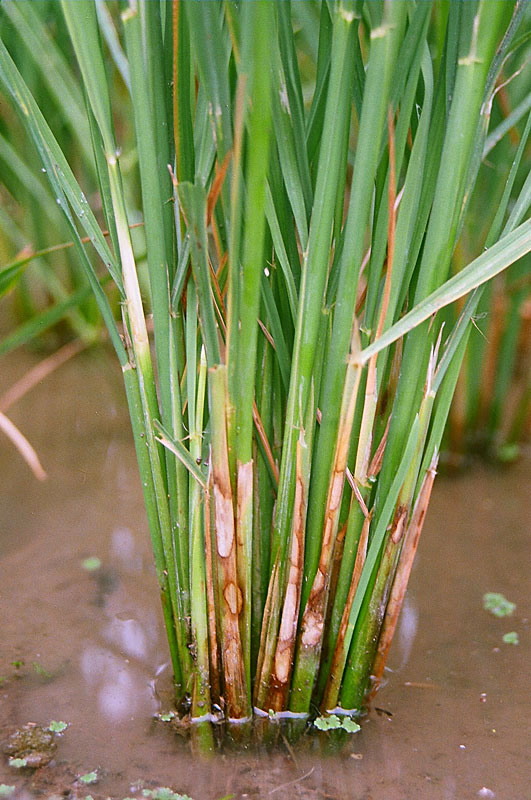
A week ago, my compadre Luigi blogged about an interesting study by scientists at IRRI. They used plant architecture as a proxy for disease susceptibility, specifically to Rhizoctonia solani, the fungus that causes sheath blight in rice. 1 Luigi illustrated the post with an IRRI photograph of sheath blight symptoms. He then drew the attention of all and sundry to the post, which is when the fun began.

Quick as winking, someone at IRRI pointed out:

“The photo is not at all about sheath blight, but it does not matter!”

They were informed that the photo had been tagged “sheathblight2 on IRRI’s photostream at flickr, which is where Luigi had found it. It could be changed.

“Yes,” said the person responsible for IRRI’s photos. “Tell us what it is and we can fix it.”

Back came the reply.

“I cannot tell you with any certainty what this is supposed to represent. What I am really sure is that this is not sheath blight.”

To which bystanders could only add “Photographs also in database hell?”

IRRI has done the right thing; the offending photo is not currently visible. Luckily we had downloaded it ourselves, rather than relying on its continued availability. And in case you were wondering, this is sheath blight.

I think … We got it from the American Phytopathological Society, and they surely know, right?

FAO says Save and Grow

The Food and Agriculture Organization of the United Nations has launched Save and Grow, “a major new initiative” that calls for “sustainable crop production intensification”. Read the book, watch the video, then stand back as food production doubles by 2050 in developing countries.

The new approach calls for targeting mainly smallholder farmers in developing countries. [It] will enable them to maximize yields and invest the savings in their health and education. … In order to grow, agriculture must learn to save. … [T]he Save and Grow toolkit include[s] precision irrigation … and “precision placement” of fertilizers. … Integrated pest management … is yet another key element. Such methods help adapt crops to climate change and … [a]verage yields from farms practicing the techniques in 57 low-income countries increased almost 80 percent, according to one review.

And there you have it.