- How trees can alleviate poverty.
- How trees can help fight climate change. And how they cannot.
- How trees can contribute to diverse sustainable landscapes.
- How wild fruit trees (among other things) helped in the Covid-19 crisis.
- Not entirely sure if there are any trees among the burgeoning community seedbanks of China.
Brainfood: Plant services, Ornamental conservation, Cinnamon, Avocado, Apricot double, Apple, Date palm, Bambara groundnut, Amaranth, On farm research, Fertilizer subsidies
- A global database of plant services for humankind. 13% of over 13,000 plant genera have been recorded as human food. But twice as many are described as “ornamentals.”
- Horticultural plant use as a so-far neglected pillar of ex situ conservation. Something we can do about those ornamentals. But not only ornamentals, surely.
- “Ceylon cinnamon”: Much more than just a spice. But not, alas, an ornamental.
- Exploring genetic diversity of lowland avocado (Persea americana Mill.) as a genetic reservoir for breeding. Plus it’s a handsome tree.
- Population genomics of apricots unravels domestication history and adaptive events. Separate Chinese and European genepools, deriving from independent domestications from distinct populations. No word on which is more ornamental.
- Diversity and Relationships among Neglected Apricot (Prunus armeniaca L.) Landraces Using Morphological Traits and SSR Markers: Implications for Agro-Biodiversity Conservation. Get farmers to grow varietal mixtures for maximum ornamental value — and conservation.
- Unraveling a genetic roadmap for improved taste in the domesticated apple. No evidence of selection for increased sugar content. And ornamental value?
- Molecular clocks and archaeogenomics of a Late Period Egyptian date palm leaf reveal introgression from wild relatives and add timestamps on the domestication. Ancient hybrid origin for the coincidentally ornamentally and otherwise valuable food crop, followed by introgression from both wild close congeneric relatives.
- Genetic diversity and population structure analysis of bambara groundnut (Vigna subterrenea L) landraces using DArT SNP markers. 3 groups: W Africa, Central Africa, E + S Africa. No word on which would make the most attractive ornamentals.
- A chromosome-level Amaranthus cruentus genome assembly highlights gene family evolution and biosynthetic gene clusters that may underpin the nutritional value of this traditional crop. Yeah, but where are the genes that make it ornamental too?
- How accurate are yield estimates from crop cuts? Evidence from smallholder maize farms in Ethiopia. More accurate than estimates of horticultural attractiveness, I suspect.
- The unintended consequences of the fertilizer subsidy program on crop species diversity in Mali. Spoiler alert: they’re bad. Fortunately, ornamentals don’t attract subsidies.
Genebanks and the post-2020 biodiversity framework
There’s been a lot happening lately, so hang on for a quick roundup. I may be able to follow-up in greater depth should work allow.
First, the draft post-2020 biodiversity framework is out from the CBD. You may have been following here efforts to make sure that genetic diversity was properly addressed, but the omens have not been particularly good, based on country reports.
Well, this is what is in the draft document, under the very first of four goals, Goal A:
by 2030: Milestone A.3 Genetic diversity of wild and domesticated species is safeguarded, with an increase in the proportion of species that have at least 90% of their genetic diversity maintained.
And among the indicators, at either the Goal or Target level, we can find the following:
A.0.4 The proportion of populations within species with a genetically effective population size > 500
4.0.2 Number of plant genetic resources for food and agriculture secured in medium or long-term conservation facilities
This does not look like much of an improvement over what we have now, but it is at least good to see ex situ conservation of crop diversity keep its profile. 1
Which leads me to the second thing I wanted to point to, a paper just out in Global Food Security, by Dr Fiona Hay and a whole bunch of genebank managers 2: “CGIAR genebank viability data reveal inconsistencies in seed collection management.” Analysis of 833,364 data points from seven CGIAR genebanks confirmed that high seed viability has been maintained for up to almost 40 years for a very wide range of crops and forage species.
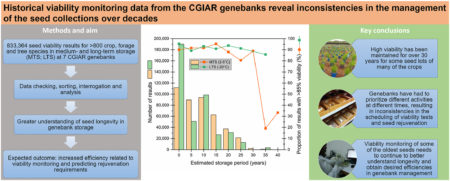
Nevertheless, improvements are possible, and the study suggests the following are needed to make sure they happen:
- Adequate and consistent data and effective data management systems designed for long-term data gathering, storage and analysis;
- Tools to facilitate the oversight and forward planning of collection management at a higher level, allowing managers to analyse the age of seed lots, patterns of their viability in storage, user demand and other factors that should feed into both annual planning of genebank activities such as regeneration but also the adaption of processes and monitoring regimes according to evident needs;
- Documented and regularly audited and reviewed processes that capture any necessary temporary deviations and facilitate staff succession;
- A culture, capacity and community that encourages active critical review and refinement of genebank operations and specialised research tailored to specific crops, collections and circumstances.
But those collections need to be used, right? Right. And, not so coincidentally, the third thing on my list is a blog post by Dr Alison Bentley summarizing the results of an online workshop that addressed how CGIAR genebanks can best serve current, emerging and future demands.
Genetic characterization serves as a first step to uncover value and can be combined with smart phenotyping and analytics approaches. Continuous engagement with diverse end-users is a necessity for ensuring relevance and application into impact. This will serve as a key to unlock the potential of genebanks as both conservators and promoters of the vast diversity they hold.
So, basically: genotype everything in your genebank, phenotype subsets of the collection carefully chosen on the basis of all the relevant data at your disposal, share the resulting information in ways that diverse genebank clients can make sense of and act on, and actively engage with as wide a range of users as possible to make sure you know what they need.
The eventual aim of all this, of course — or one of them anyway — is to “diversify the range of publicly bred crop varieties available to smallholder farmers and increase varietal turnover through commercial channels.” And yes, there is a white paper on that as well.
The White Paper expands on recommendations for how One CGIAR may want to adjust its approaches and collaboration with National Breeding Programs and private sector entities to (i) be more successful in developing and deploying newly developed varieties, and (ii) support the evolution towards a more effective, sustainable local seed sector, with appropriate public and regulatory capacities and a vibrant entrepreneurial sector. The White Paper makes recommendations for how to streamline handover to commercialization and the steps needed.
Which will no doubt lead to an agriculture that is not only more diverse and sustainable itself but also more protective of biodiversity. 3 Which I think is where we came in.
Nibbles: Payment for services, Spud pix, Botanical paintings, Local food, Wild Malus
- Paying for the conservation of quinoa varieties.
- Not sure I’d pay for some of these potato photos.
- Would definitely pay for some of these botanical illustrations.
- Local food pays, just not necessarily in emissions.
- Why it pays to save wild apples despite the fact that they taste like crap.
Brainfood: Food groups, Fruit & nutrition, Cereal micronutrients, Sorghum mini core, Aquaculture, Perennial sunflower, Hybrid potato, Phenotyping, Spanish Neolithic
- GAIN Discussion Paper 9: Food group diversity and nutrient adequacy. Eat a diverse diet…
- Can Underutilized Tropical Fruits Meet the Nutritional Requirements of Rural Indonesia? …which includes fruits, of course.
- The nutritional quality of cereals varies geospatially in Ethiopia and Malawi. And cereals, though it depends where they’re growing.
- Variation for Photoperiod and Temperature Sensitivity in the Global Mini Core Collection of Sorghum. Less than 10% are sensitive to neither. And yes, there’s another paper on the nutrient quality of the same subset. Though not on how that varies geographically.
- Habitat value of bivalve shellfish and seaweed aquaculture for fish and invertebrates: Pathways, synthesis and next steps. Eat more bivalves and seaweed too, it can be good for the environment too.
- Measurements of lethal and nonlethal inbreeding depression inform the de novo domestication of Silphium integrifolium. Always good to have a new oil crop, especially a perennial one, but careful what you cross to get it, and how.
- Genome design of hybrid potato. Re-inventing the potato as a seed-propagated crop could be good for nutrition, sure, why not.
- High Throughput can produce better decisions than high accuracy when phenotyping plant populations. As you make better and more nutritious crops, keep in mind it may be better to phenotype more plants in more environments than obsess about accuracy and precision. What does that mean for mini-cores?
- Insight into the introduction of domestic cattle and the process of Neolithization to the Spanish region Galicia by genetic evidence. But is any of this worth the hassle? After all, the early domesticated cattle of Galicia are similar to modern breeds…