- Panel discussion on cryopreservation in genebanks on 25 June, save the date!
- Forget cryo, what about a network of European network for the conservation and sustainable use of plant genetic resources, in cultivation and in the wild? See who is interested. And express interest yourself.
- Germans launch Legacy Landscape Fund for biodiversity hotspots. European in situ PGR conservation network unavailable for comment. Let alone cryo genebanks.
- I wonder if that European on-farm conservation network will include the Completer grape, ideally in a monastery.
- Decolonizing coffee. Somebody want to write about religion and crops?
- Using wild plants in south and southeast Asia. Maybe they need a network too.
- Plant breeders say plant breeding is really important.
The value of seeds
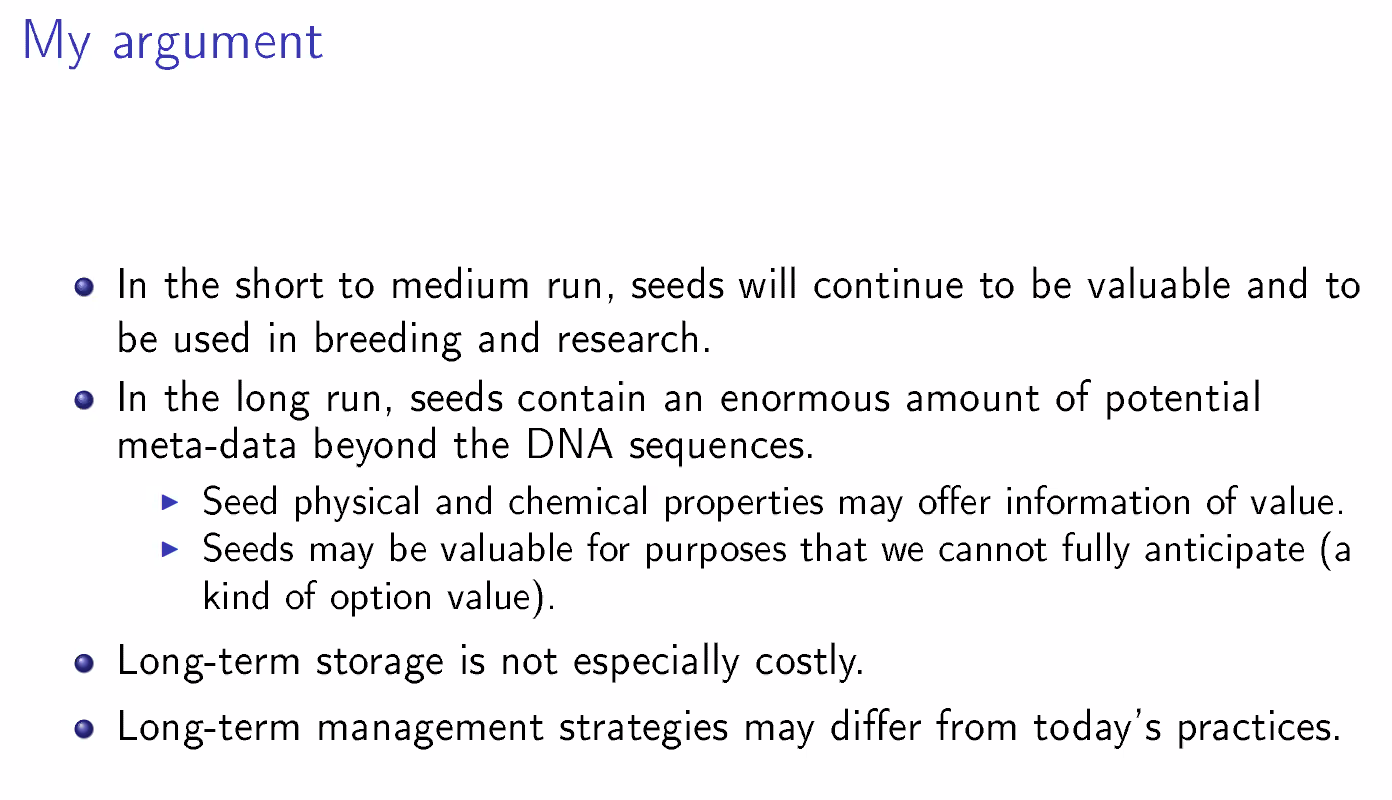
Douglas Gollin, Professor of Development Economics at the University of Oxford will speak about genebanks tomorrow, and you really mustn’t miss it. The talk’s title? “In Praise of Seed Morgues.” See what I mean?
LATER: The recording is on the GROW webpage. And here’s a spoiler…
Nibbles: Western grapes, Mapping pastoralists, Difficult species
- Grafting the Grape Virtual Lecture Series: Missouri Vines and Wines: Then and Now. Wait, that’s today!
- Mapping for Pastoralists, On-line Seminar. Phew, it’s next week.
- APPS Special Issue Call for Papers: “Meeting the Challenge of Exceptional Plant Conservation: Technologies and Approaches.” Relax, you have until June. Wait…
Brainfood: Wind, Strawberry breeding, Species concept, Apple domestication, Potato breeding, Organic cereals, Feed the Future, Kiribati diets, Mexican June, Armenia genebank, Maori kumara
- Global wind patterns shape genetic differentiation, asymmetric gene flow, and genetic diversity in trees. The wind is blowing the answer, my friend.
- Social network analysis of the genealogy of strawberry: retracing the wild roots of heirloom and modern cultivars. Some 1500 contributors to the current, quite diverse cultivated genepool, from numerous species.
- Is Domestication Speciation? The Implications of a Messy Domestication model in the Holocene. They could have used the above as an additional example. But the answer to the question in the title seems to be that it doesn’t matter much, and I’m there for that.
- Phenotypic divergence between the cultivated apple (Malus domestica) and its primary wild progenitor (Malus sieversii). Oh, look, you don’t need fancy genotyping to tell that wild and cultivated apples are different species. No word on the role of global wind patterns though.
- Genetic diversity and population structure of advanced clones selected over forty years by a potato breeding program in the USA. Going from 214 to 43 clones doesn’t seem a game worth the candle, but someone will no doubt set me right.
- The Adoption of Landraces of Durum Wheat in Sicilian Organic Cereal Farming Analysed Using a System Dynamics Approach. Follow the money.
- Rediscovering ‘Mexican June’: a nearly extinct landrace maize (Zea mays L.) variety. Yes, there is money in organic systems.
- Modeling impacts of faster productivity growth to inform the CGIAR initiative on Crops to End Hunger. Following the money.
- Nutritional diversity and community perceptions of health and importance of foods in Kiribati: a case study. Local foods are seen to be healthier than imported, but nobody cares. Maybe because people are following the money?
- Governing crop genetics in post-Soviet countries: lessons from the biodiversity hotspot Armenia. Any progress that has been made is due to committed individuals. There’s a lesson there for us all.
- Archaeological science meets Māori knowledge to model pre-Columbian sweet potato (Ipomoea batatas) dispersal to Polynesia’s southernmost habitable margins. Archaeology confirms traditional oral history. A lesson there too.
- Factors influencing household pulse consumption in India: A multilevel model analysis. Households that grown more pulses, eat more pulses. There endeth the lesson.
Nibbles: Social science, Berry call, Oz bank, Prior art
- 5 suggestions for scientists on social: see & be seen, select & specialize, serve, socialize, strategize.
- Open call to berry breeders.
- Another genebank for Australia makes a splash.
- How to avoid a repeat of the whole Enola bean story.