- Food Access Deficiencies in Sub-saharan Africa: Prevalence and Implications for Agricultural Interventions. Income doesn’t necessarily translate into better nutrition, but keeping livestock does. Happy New Year.
- The commonness of rarity: Global and future distribution of rarity across land plants. Rare species are especially vulnerable to climate and land use change.
- Exploring on-farm agro-biodiversity: a study case of vegetable landraces from Puglia region (Italy). High vegetable landrace diversity may be linked to poor soils and distance from urban centres.
- Measuring Forest Biodiversity Status and Changes Globally. Combines biodiversity significance and intactness, and comes up with not that many places.
- Escaping the perfect storm of simultaneous climate change impacts on agriculture and marine fisheries. Business as usual means 90% of world’s population will see declines in both agricultural and fisheries production.
- Potential for smart food products in rural Myanmar: use of millets and pigeonpea to fill the nutrition gap. 2 weeks of inclusion had positive effect on wasting, stunting and underweight.
- Super-Pangenome by Integrating the Wild Side of a Species for Accelerated Crop Improvement. Add up species pangenomes for a whole genepool. Would be cool to grow it.
- Plant Pest Impact Metric System (PPIMS): Framework and guidelines for a common set of metrics to classify and prioritise plant pests. Host crop value, market access, feasibility of management and reversibility are the most important ones.
- A new source of root-knot nematode resistance from Arachis stenosperma incorporated into allotetraploid peanut (Arachis hypogaea). You have to cross it with another wild relative first.
- The impact of sample selection strategies on genetic diversity and representativeness in germplasm bank collections. Different approaches to making cores tested with maize data from Seeds of Discovery.
- Affordability of the EAT–Lancet reference diet: a global analysis. US$2.84 per day, or more than household per capita income for at least 1.58 billion people.
- Allelochemicals targeted to balance competing selections in African agroecosystems. Levels of tannins in sorghum correlated with taste receptor variant in humans and presence of sparrows.
- Genetic Architecture of Chilling Tolerance in Sorghum Dissected with a Nested Association Mapping Population. Chilling tolerance associated with low tannin and short stature. No word on the role of sparrows.
- Characterization of Genetic Diversity Conserved in the Gene Bank for Dutch Cattle Breeds. Almost optimized, at least for bulls.
Brainfood: Food system, Fish cryo, Bromeliad maps, Ag risk, Grass pollination, Gendered cassava, Sorghum salinity, Soybean subsetting, Reverse speciation, Legume data, Livestock diseases, Buckwheat diversity, Wild barley genome, Wild sorghums, Wheat gap
- Impacts of Global Food Systems on Biodiversity and Water: The Vision of Two Reports and Future Aims. It’s all connected, and not in a good way.
- On‐Site Capabilities of a Mobile Laboratory for Aquatic Germplasm Cryopreservation. Not so easy for plants, alas.
- Biogeography and conservation status of the pineapple family (Bromeliaceae). The Atlantic Forest, the northern Andes and Central America.
- A review of types of risks in agriculture: What we know and what we need to know. Very few studies look beyond production risk, largely ignoring four other types of risk, and the prevalence of multiple risks.
- Visual and olfactory floral cues related to ambophilous pollination systems in Poaceae. Insects can facilitate pollination in some grasses.
- Cassava Trait Preferences of Men and Women Farmers in Nigeria: Implications for Breeding. Women select on quality, men on agronomy.
- Phenotypic and physiological responses to salt exposure in Sorghum reveal diversity among domesticated landraces. Salinity tolerance was acquired early in domestication and then maintained or lost depending on prevalent soil conditions.
- Combining Focused Identification of Germplasm and Core Collection Strategies to Identify Genebank Accessions for Central European Soybean Breeding. Pre-core FIGS subset based on adaptation to high-latitude cold regions, followed by coring using genotype data: from >17,000 to 366 accessions.
- Adaptive introgression during environmental change can weaken reproductive isolation. Reverse speciation is upon us.
- The future of legume genetic data resources: Challenges, opportunities, and priorities. Centralize and standardise. Good luck with that.
- Application of Mixed Methods to Identify Small Ruminant Disease Priorities in Ethiopia. National disease controls programmes may be on the wrong track.
- Tartary buckwheat (Fagopyrum tataricum Gaertn.) landraces cultivated by Yi people in Liangshan, China. 13 landraces, but not very well differentiated as to use.
- The draft genome of a wild barley genotype reveals its enrichment in genes related to biotic and abiotic stresses compared to cultivated barley. More genes, more alleles in known genes.
- The endemic ‘sugar canes’ of Madagascar (Poaceae, Saccharinae: Lasiorhachis) are close relatives of sorghum. Closer than some actual Sorghum spp.
- Large genetic yield potential and genetic yield gap estimated for wheat in Europe. Long way to go to match the potential, modelled yield of ideotypes.
Brainfood: Diversification, Chefs, African rice breeding, Sustainable livestock, Miscanthus origin, Sweetpotato diversity, Wild banana seeds, Olive diversity, Tilapia diversity, Half Earth, Food access, Speedy pigeonpea, Peanut allergy, Colombian seed saving
- Modelling crop diversification and association effects in agricultural systems. Intercrop, people!
- Cooking up Diverse Diets: Advancing Biodiversity in Food and Agriculture through Collaborations with Chefs. Yeah, yeah, chefs are great. Now show me the data.
- Multivariate analysis and selection criteria for identification of African rice (Oryza glaberrima) for genetic improvement of indica rice cultivars. Go for high number of productive tillers and early maturity.
- Strategies for Sustainable Use of Indigenous Cattle Genetic Resources in Southern Africa. Not just genetic improvement: also need better nutrition, healthcare, marketing, and infrastructure; integration and empowerment of women and youth; and capacity building, regulatory, and policy frameworks. Not unlike crops, really.
- Population structure of Miscanthus sacchariflorus reveals two major polyploidization events, tetraploid-mediated unidirectional introgression from diploid M. sinensis, and diversity centred around the Yellow Sea. The centre of origin in under water.
- Remote sensing for agricultural applications: A meta-review. Yeah, yeah. Call me when you have a way of distinguishing landraces from modern varieties.
- Genetic Diversity of Sweet Potato (Ipomoea batatas L. Lam) Germplasms Collected Worldwide Using Chloroplast SSR Markers. 500 is not enough.
- Seed germination and storage studies in seed-fertile Musa indandamanensis and its conservation. Intermediate.
- Cultivated olive diversification at local and regional scales: evidence from the genetic characterization of French genetic resources. Areas with unexpected frosts have been, paradoxically, good for olive diversity.
- Genetic diversity of Nile tilapia (Oreochromis niloticus) throughout West Africa. Corresponds to river basins. Well there’s a shocker.
- Protecting half of the planet could directly affect over one billion people. Add lowest-footprint pixels to PAs until you get to 50% coverage of each ecoregion, then count how many people live in PAs, for good or ill.
- Food Access Deficiencies in Sub-saharan Africa: Prevalence and Implications for Agricultural Interventions. Livestock helps, higher income not necessarily.
- Can a speed breeding approach accelerate genetic gain in pigeonpea? I’m going to guess yes.
- Hypoallergen Peanut Lines Identified Through Large-Scale Phenotyping of Global Diversity Panel: Providing Hope Toward Addressing One of the Major Global Food Safety Concerns. Lots of diversity to play with.
- Revolturas: resisting multinational seed corporations and legal seed regimes through seed-saving practices and activism in Colombia. Everybody’s at it.
Wild millet superstar
A recent paper has identified interesting diversity in the wild pearl millet relative Pennisetum violaceum. Out of 305 accessions, a few were found to have resistance to blast (caused by Magnaporthe grisea) and a few others to rust (caused by Puccinia substriata var. indica). Plants from only one accession were resistant to both diseases: IP 21711 from the ICRISAT genebank. It was originally collected in Chad in 1988. It’s the one in red on the map, which you’ll be able to see better if you click on it.
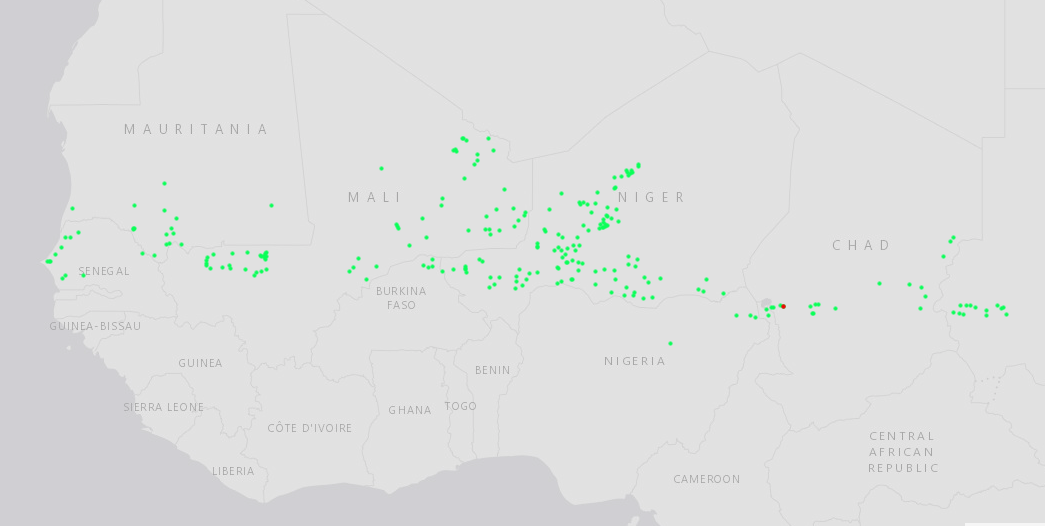
Sometimes it really is like searching for a needle in a haystack. And that’s only the beginning. Pennisetum violaceum is in the tertiary genepool of the crop, so will be tricky to work with.
Nibbles: Cheese history, RethinkX, Cosmopolitan Chicken, Natural capital accounting, Supply chains, Healthy policies, NordGen
- Fruit flies facilitated the birth of the hybrid yeast that made cheese possible. Thanks, fruitfly!
- Ah, but an upgrade is coming: precision fermentation.
- How business can track its effects on biodiversity. Should it want to.
- How to make it easier, more profitable and more sustainable to bring healthy foods to market. Someone mash it up with the above?
- How to design policies for countries seeking to provide healthy diets. Someone mash it up with the above?
- 40 years of NordGen. Happy birthday! Then someone mash it up with the above…
- Celebrating poultry diversity through art. No need for mashing, just celebrate the weirdness.