- The ever-dependable Roads & Kingdoms on a very special Swiss cheese.
- The ever-dependable Mongabay on Kyrgyz apple forests.
- The ever-dependable Simran Sethi on how the California pistachio industry got it’s start.
- The ever-dependable Bioversity with a global strategy for the conservation of coconut genetic diversity.
- The ever-dependable Twitter…no wait. Thread on why farmers with a bigger share in their output produce more.
- A cow wild relative in Myanmar.
- Carolina Sansaloni of CIMMYT on genotyping genebank collections.
- Are chickens “rescuing mute, passive non-Western women”?
- Blueberries are in all kinds of trouble.
Google hosts Food Forever Experience
Crickets, algae and unusual edible plants will be on the menu today as chefs and leaders from business and politics get together to taste the future of food at Google’s office in New York City.
What I’d personally like most to taste is what Pierre Thiam is able to concoct with fonio. How about you?
Nibbles: Lathyrus project, Vegetables review, Aztec linguistics, Tree seeds, Ancient booze
- Grasspea gets some love.
- Hundreds of veggies still don’t, though.
- Deconstructing chocolate. The word, that is.
- Networking tree seeds in Rwanda.
- Drinking in Neolithic Britain.
Brainfood: NUS crackers, Genomic prediction, Chicken double, Wild German celery, Cretan sheep, Boricua papaya, Sorghum breeding, Wheat breeding, Italian carrots, Mining barley, Onion review, Fertilizers
- Development of value-added nutritious crackers with high antidiabetic properties from blends of Acha (Digitaria exilis) and blanched Pigeon pea (Cajanus cajan). Putting orphan crops to work.
- A deep convolutional neural network approach for predicting phenotypes from genotypes. Artificial intelligence applied to genomic selection. Sexy enough for you?
- Genomic diversity dynamics in conserved chicken populations are revealed by genome-wide SNPs. Gotta watch those effective population sizes.
- Chicken semen cryopreservation and use for the restoration of rare genetic resources. Maybe a way to help with the above?
- Patterns of Genetic Diversity and Implications for In Situ Conservation of Wild Celery (Apium graveolens L. ssp. graveolens). 15 Most Appropriate Wild Populations out of 78. Still seems like a lot.
- Challenges for local breed management in Mediterranean dairy sheep farming: insights from Central Greece. Conservation through cross-breeding. But how long can it last?
- Genetic Diversity of Puerto Rican Farmer-held Papaya (Carica papaya) Using SSR Markers. I wonder how many are left after Maria.
- Breeding Sorghum for Diverse End Uses: Genetic Improvement of Grain Sorghum. More germplasm could be used.
- Harnessing genetic potential of wheat germplasm banks through impact-oriented-prebreeding for future food and nutritional security. Getting impact from “exotic” germplasm is possible. To be clear, I think that just means wild stuff.
- BiodiverSO: A Case Study of Integrated Project to Preserve the Biodiversity of Vegetable Crops in Puglia (Southern Italy). Saving the Polignano carrot.
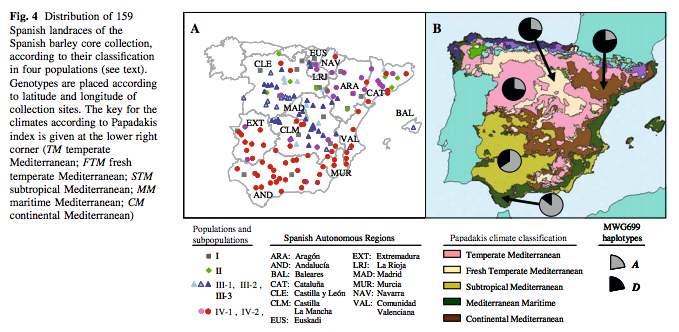
- Genomics Approaches to Mining Barley Germplasm Collections. Management, cores, history. But we knew that.
- Allium Genetic Resources. Significant progress in data availability, cryopreservation protocols, health status and levels of evaluation. Maybe acquisition and exchange could be increased?
- Review: Taking stock of Africa’s second-generation agricultural input subsidy programs. 80 studies from 7 countries show that helping smallholders obtain fertilisers gives rapid but short-term and lower-than-expected increases in production. One reason is that yields don’t respond to fertilisation as much as they should. Is it because it’s mainly landraces?
First Annual Crop Wild Relatives Week kicks off
That’s thanks to the Crop Science Society of America.
The Crop Science Society of America is proud to host Crop Wild Relatives Week on September 22 – 29, 2018, to celebrate the contribution that these humble and hearty plants have made to increasing food security around the world. The collections of plants; the work being done to collect, conserve, characterize, and use them; and the importance of continuing to do so will be highlighted in blogs, web stories, and infographics. Online resources for anyone interested in learning more crop wild relatives can be found (https://www.crops.org/crop-wild-relative). In addition, new stories and resources will be added to the site on an ongoing basis, including educational materials for educators and parents of K-12 kids, our future scientists.
Let the fun begin!