- Cannabis Domestication, Breeding History, Present-day Genetic Diversity, and Future Prospects. The traditional landraces are being contaminated and need urgent collection and evaluation by dedicated professionals.
- Cold sweetening diversity in Andean potato germplasm from Argentina. 5 out of 48 Andigena landraces make good chips.
- Considering cost alongside the effectiveness of management in evidence-based conservation: A systematic reporting protocol. Here comes the metadata. No excuse now.
- Self-compatibility is over-represented on islands. 66% vs 41% in Asteraceae, Brassicaceae and Solanaceae. Any crop wild relatives in the list?
- Cereals, calories and change: exploring approaches to quantification in Indus archaeobotany. Millet may not have been as important as is generally thought.
- High-Throughput Phenotyping of Sorghum Plant Height Using an Unmanned Aerial Vehicle and Its Application to Genomic Prediction Modeling. A near-infrared, green and blue (NIR-GB) camera on a drone gives pretty good results compared to a person with a tape measure, and is much more fun.
- Asian wild rice is a hybrid swarm with extensive gene flow and feralization from domesticated rice. No such thing as completely wild Asian rice.
- The dispute over wild rice: an investigation of treaty agreements and Ojibwe food sovereignty. Not wild rice at all, but what’s been happening to it might be a violation of the White Pine Treaty with the Ojibwe.
- Quantifying pearl millet response to high temperature stress: thresholds, sensitive stages, genetic variability and relative sensitivity of pollen and pistil. The problem is the pistils.
- Effect of environmental change on yield and quality of fruits and vegetables: two systematic reviews and projections of possible health effects. Bad for yield, good for nutritional quality.
Nibbles: Australian, US, ILRI genebanks, Species movements
- Oz genebanks to the rescue.
- Loving the USDA genebanks to death?
- More on the new ILRI genebank.
- One of the reasons why we need genebanks.
Everything about size
Whizz-bang websites in support of data-dense papers seem to be all the rage.
Remember “Farming and the geography of nutrient production for human use: a transdisciplinary analysis,” published in the inaugural The Lancet Planetary Health a couple of weeks back? We included it in Brainfood, and linked to an article by Jess Fanzo which summarizes the main findings. This is probably the money quote:
Both small and large farms play important roles in ensuring we have enough food that is diverse and nutrient-rich. While industrialised agriculture suggests domination of food systems, smallholder farms play a substantial role in maintaining the genetic diversity of our food supply, which results in both benefits and risk reductions against nutritional deficiencies, ecosystem degradation, and climate change. Herrero and colleagues argue that if we want to ensure that the global food supply remains diverse and generates a rich array of nutrients for human health, farm landscapes must also be diverse and serve multiple purposes.
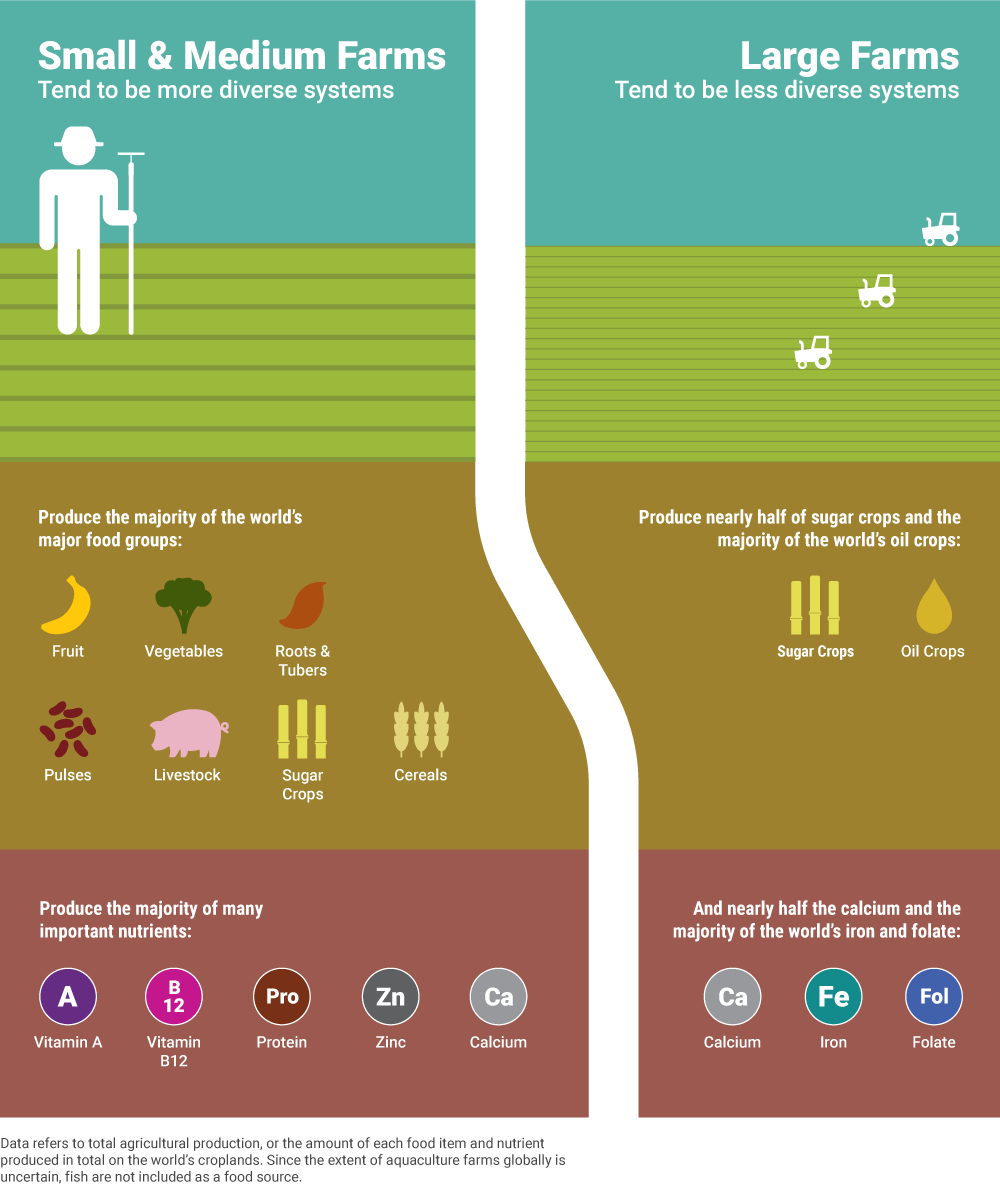 Well, there’s also a graphics-rich website now, “Small Farms: Stewards of Global Nutrition?” The infographic at the left here puts it in the proverbial nutshell (click to embiggen).
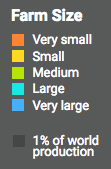
But what you really want to know is on what kinds of farms are grown those Canadian and Indian peas we talked about yesterday in connection with other fancy websites. Well, unfortunately, the data are only available for “pulses” here, but, perhaps unsurprisingly, those are grown mainly on large(ish) farms (blue) in North America, and small(ish) farms (orange) in South Asia. Each square is 1% of global production.
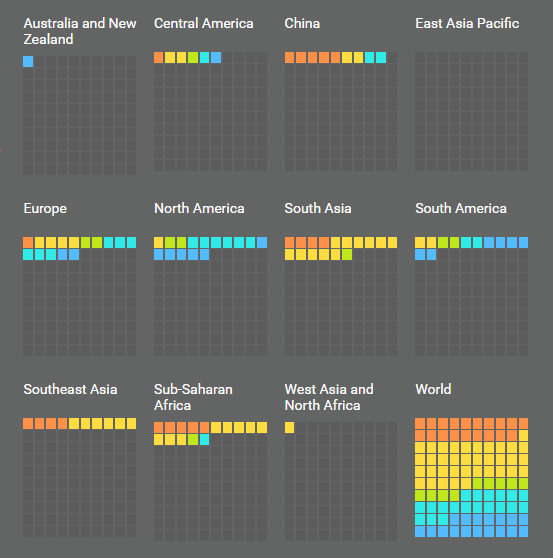
 You can get similar breakdowns for different food groups (cereals, oils, etc.), and for a bunch of different nutrients: Calcium, Calories, Folate, Iron, Protein, Vitamin A, Vitamin B12, and Zinc. For all of these last you can also see global maps of nutritional yields, or “the number of people who can meet their nutritional needs from all of the crops, livestock, and fish grown in an area.” Here’s the one for Vitamin A.
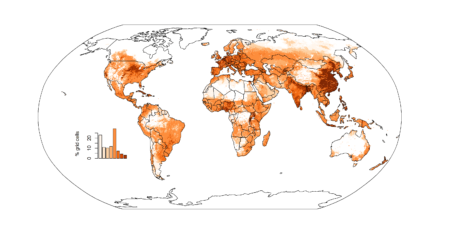
Which I’m sure will be of use in targeting the promotion of homegardening, say, or the roll-out of things like orange sweet potatoes. There is Biofortification Priority Index already, but only at a fairly coarse, country level. As far as I know, anyway.
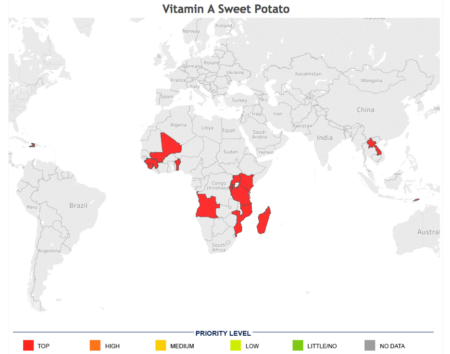
Of course, those countries could always import sweet potatoes…
Featured: Wheat disease
Tom Payne of CIMMYT was a bit worried about that Global Crop Loss Survey:
The wheat data suggests that a preponderance of responses came from Europe (where the trio of disease septoria tritici-yellow rust-fusarium head blight are prevalent). Interestingly, the emerging threats of “Ug99 types” of stem rust and wheat blast are not revealed though they may have far more dramatic impacts on a global basis.
But Andy Nelson has it covered:
Around 30% of wheat responses came from Europe, with the rest fairly well distributed in wheat growing areas around the rest of the world. Stem rust and wheat blast are in the complete list of response with numbers and locations that reasonably reflect their emerging threat status. They’re just not in the top five that we included in this preliminary report to the ISPP. More analysis and details will come though.
Featured: Functional landraces
Clem has the answer to the question: But do we really want to promote a landrace as a functional food? And it is: Why the hell not. Me, I’m not so sure.