It’s clearly the season for major reports. Hot on the heels of AGRA’s status report on African agriculture, and IFPRI’s look at agricultural reasearch in Africa, both of which we Nibbled recently, there’s an IDS-Oxfam study into the effects of the global food crisis and, from the Global Alliance for the Future of Food, the aptly named The Future of Food: Seeds of Resilience, A Compendium of Perspectives on Agricultural Agrobiodiversity from Around the World. I hope someone is joining up the dots.
The deep history of barley breeding

A recent paper reported on the discovery of a bit of the barley genome where an allele from the wild relative, when homozygous, confers a 30% yield advantage over a popular German variety under saline conditions. 1 That of course is very interesting in its own right, but I want here to delve a bit into the methods, rather than the results.
The main tool used by the researchers at the King Abdullah University of Science and Technology in Saudi Arabia was a “nested association mapping population” of barley called HEB-25. That stands for ‘Halle Exotic Barley 25’. The Halle bit refers to the site of the German plant breeding institute where the population was made. Following the trail of references from the KAST paper takes you to a 2015 paper which describes the history of HEB-25:
The population results from initial crosses between the spring barley elite cultivar Barke (Hordeum vulgare ssp. vulgare, Hv) and 25 highly divergent exotic barley accessions, contributing an ideal instrument to study biodiversity. The exotic donors comprise 24 wild barley accessions of H. vulgare ssp. spontaneum (Hsp), the progenitor of domesticated barley, and one Tibetian H. vulgare ssp. agriocrithon (Hag) accession. Barke was selected since it was also used as a parent of a barley high-resolution mapping population and as a genetic stock for mutation screening.
To generate HB-25, F1 plants between Barke and those 25 diverse barley samples were backcrossed to Barke and then selfed three times to make a total of 1,420 lines, each with a mainly Barke background, but different bits of genome from the 25 other samples. The researchers in Saudi Arabia then “simply” identified which bits of whose genome are associated with increased tolerance to salinity.
A lot of work. But we can take the story even further back. How were those 25 diverse barleys chosen? Again, following the trail of references takes you to a 1999 paper:
The exotic donors were selected from Badr et al. to represent a substantial part of the genetic diversity that is present across the Fertile Crescent, where barley domestication occurred.
Badr et al. (1999) was a very academic study of the origins of barley using molecular markers that would now be sneered at, but were all the rage back then:
The monophyletic nature of barley domestication is demonstrated based on allelic frequencies at 400 AFLP polymorphic loci studied in 317 wild and 57 cultivated lines.
So there you have it, 17 years from basic work on the geographic distribution and history of wild barley diversity to the identification of a particular, tiny bit of that diversity that confers a yield advantage to the crop under salinity stress. It would probably be a lot faster now, but you can see why using crop wild relatives in breeding is a bit of an acquired taste. And also that basic diversity research is needed for successful applied breeding.
Nibbles: Turkish seeds, KBA, Wild ginger, ICARDA, AGRA, Weird agrobiodiversity, Coffee journey
- Ancient seeds put on life support. Not holding my breath.
- Key Biodiversity Areas to be mapped. Agrobiodiversity also? Not holding my breath.
- Botany on reality TV? Not holding my breath. No, wait…
- More on the ICARDA story. Holding my breath.
- Kofi Annan on that “uniquely African Green Revolution.” Not holding my breath, but here’s the latest report on how AGRA is doing. Oh, and there’s more on Africa, from IFPRI this time.
- A caterpillar on the Silk Road. Now, that I’d like to see.
- But not before coffee.
The recent history of summer squashes
So you’re telling me 2 that sixteenth century Italian gardeners selected long, thin squashes from among those brought back to Europe from the Americas (actually two different places in the Americas) in conscious imitation of the bottle gourds they had used for centuries? And somehow kept them separate from other cucurbits so that they bred true? And that the word zucchini shifted to the former from a particular, Tuscan form of the latter in the 1840s? Which is 50 years earlier than originally thought? Oh boy, I think I’m going to need some help navigating through this. Fortunately, Jeremy had the bright idea to ask the authors for directions.
Home is where conservation begins
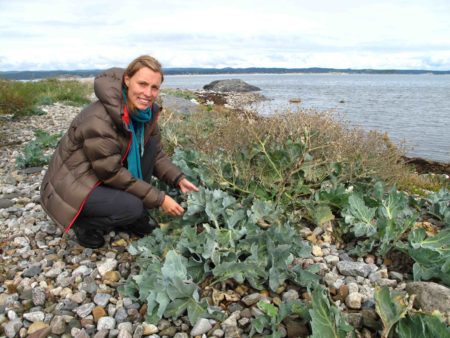
Thanks to Jade Philips (see her on fieldwork below) and Åsmund Asdal, two of the authors, for contributing this post on their recent paper on the conservation of crop wild relatives in Norway.
Norway may be an unlikely spot in which to look for agrobiodiversity, but seek and ye shall find. A recent paper discusses the development and implementation of an in situ and ex situ conservation strategy for priority crop wild relatives (CWR) in the country. 3 Some 204 taxa were prioritized, which included forage species, berries, vegetables and herbs. Distribution data collected from GBIF and species distribution modelling software including MaxEnt and the CAPFITOGEN tools were used to identify conservation priorities.
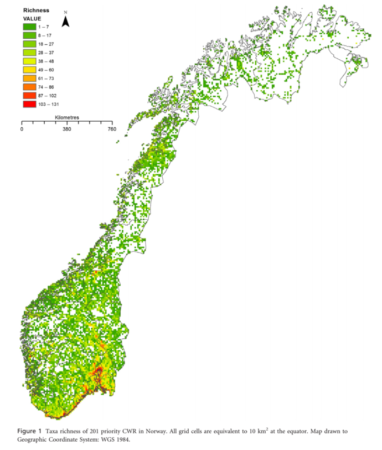 A proposal was made for a network of in situ genetic reserves throughout Norway to help capture the genetic diversity of priority CWR and allow them to evolve along with environmental changes. Some 10% of priority species do not seem to be found in existing protected areas.
Complementary ex situ priorities were also set out in the paper to ensure the full range of ecogeographic diversity across Norway, and hence genetic diversity, was captured within genebanks and therefore easily available for plant pre-breeders and breeders to utilise. Some 177 species have no ex situ collections at all. The priority CWR identified and the methodology used within Norway are applicable both in other countries and internationally. We hope that now the scientific basis for the conservation of these vital resources within Norway has been identified, integration of these recommendations into current conservation plans will begin. This will take us one step closer to the systematic global protection and use of our wild agrobiodiversity, a need which is growing increasingly urgent each day.