Clem has the answer to the question: But do we really want to promote a landrace as a functional food? And it is: Why the hell not. Me, I’m not so sure.
Nibbles: ICARDA genebank, Mexican honeys, NWFP news, Schisandra, Swimming camels, Barley genome, Silly video, Tasty breeders, Tall maize, Praying for the prairie, Rosaceous breeding, Millet fair, Sesame entrepreneurs, Thai gardens, Apple resistance, Native Californians
- Latest on the ICARDA genebank from the author of The Profit of the Earth.
- Honey diversity in Mexico.
- Speaking of which, did we already point to the new, improved Non-wood Forest Products Newsletter?
- The schisandra berry is apparently helping save the panda. Yeah, I never heard of it either, but more power to its elbow.
- Make your day better by looking at pictures of aquatic camels.
- Oh, here we go, cue the endless stream of stories about how genomics will save beer.
- “In the last century, 94% of the world’s seed varieties have disappeared.” No, they bloody haven’t. Only linking to this for completeness.
- Breeders get into flavour. Because celebrity chefs.
- That’s one tall maize plant. No, but really tall.
- The Great Plains are in Great Trouble: “Hundreds of species call the prairie home… A cornfield, on the other hand, is a field of corn.”
- A project dedicated to the genetic improvement of US rosaceous crops. Love that word. Rosaceous.
- Eat those millets!
- Sesame opens doors in Tanzania. See what I did there?
- WorldVeg empowers women through gardening. I know how they feel. Well, kinda.
- Want a Forbidden Apple? You know you do. #resist
- “Accustomed to seeing crops planted in straight rows featuring one or a few different varieties, Muir and his European predecessors were not prepared to recognize this subtler form of horticulture. And so they viewed California Indians as lazily gathering the fat of a landscape they had hardly touched.”
Canadian peas in India
Speaking of nifty websites, I’ve just come across resourcetrade.earth, from Chatham House, which enables
…users to explore the fast-evolving dynamics of international trade in natural resources, the sustainability implications of such trade, and the related interdependencies that emerge between importing and exporting countries and regions.
That of course includes agricultural trade, with the data coming mainly from FAO and USDA. Which means you can do interesting mash-ups with the global diets data we blogged about a couple of days back.
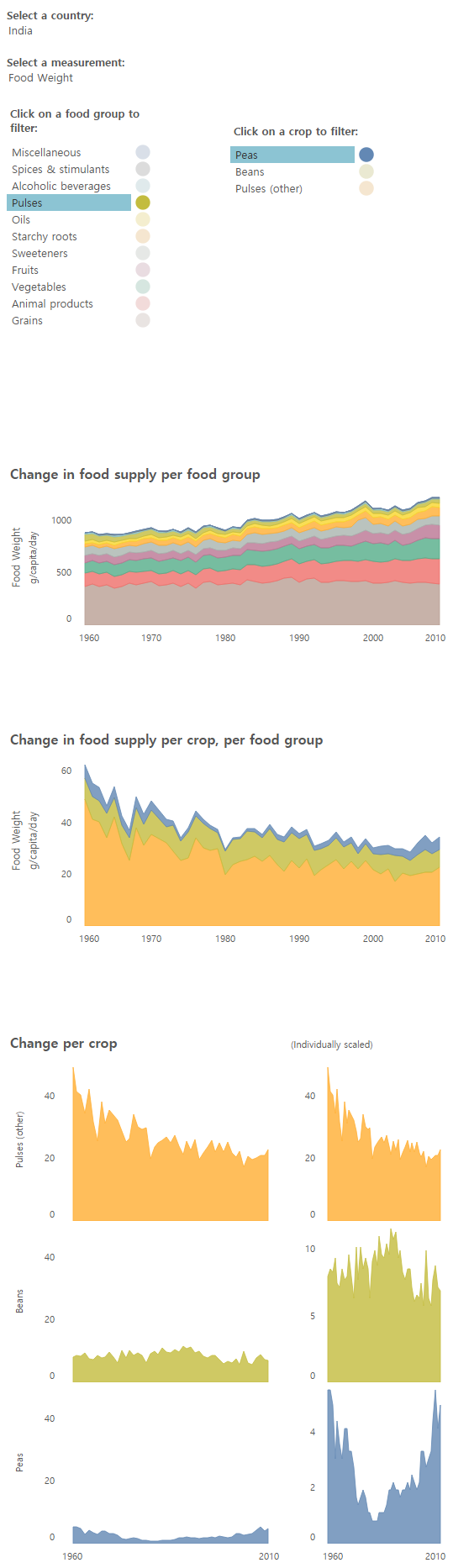 For example, here on the left are the data on the contribution of pulses to total food weight in the Indian diet, courtesy of that fabulous CIAT website. Note the steady increase in pea consumption over the past 30 years or so (click on the image to make it bigger, it’s the plot in the bottom right hand corner).
A lot of those peas, it turns out, now come from abroad, Canada mostly (as you can see on the map below). It’s a $500 million market, up from $30 million in 2000.
Now, I don’t know what proportion of Indian pea consumption is down to Canadian imports, but it should be possible to figure it out. I’m betting a fair bit of the aloo mutter you have in Amritsar is made in Canada.
Mapping “flourishing” genebanks
The Atlas for the End of the World is a collection of maps and infographics covering two important subjects: the first is the amount of protected area in the world’s biodiversity hotspots and how these regions are tracking in regard to meeting 2020 United Nations (Aichi) protected area targets; the second is an assessment of which cities in these hotspots are growing on collision courses with remnant habitat and endangered species.
Nice idea, of course. And given their first aim, as described above, they didn’t really need to do anything on genebanks or botanic gardens. But they did, and here is the resulting map (click to enlarge).
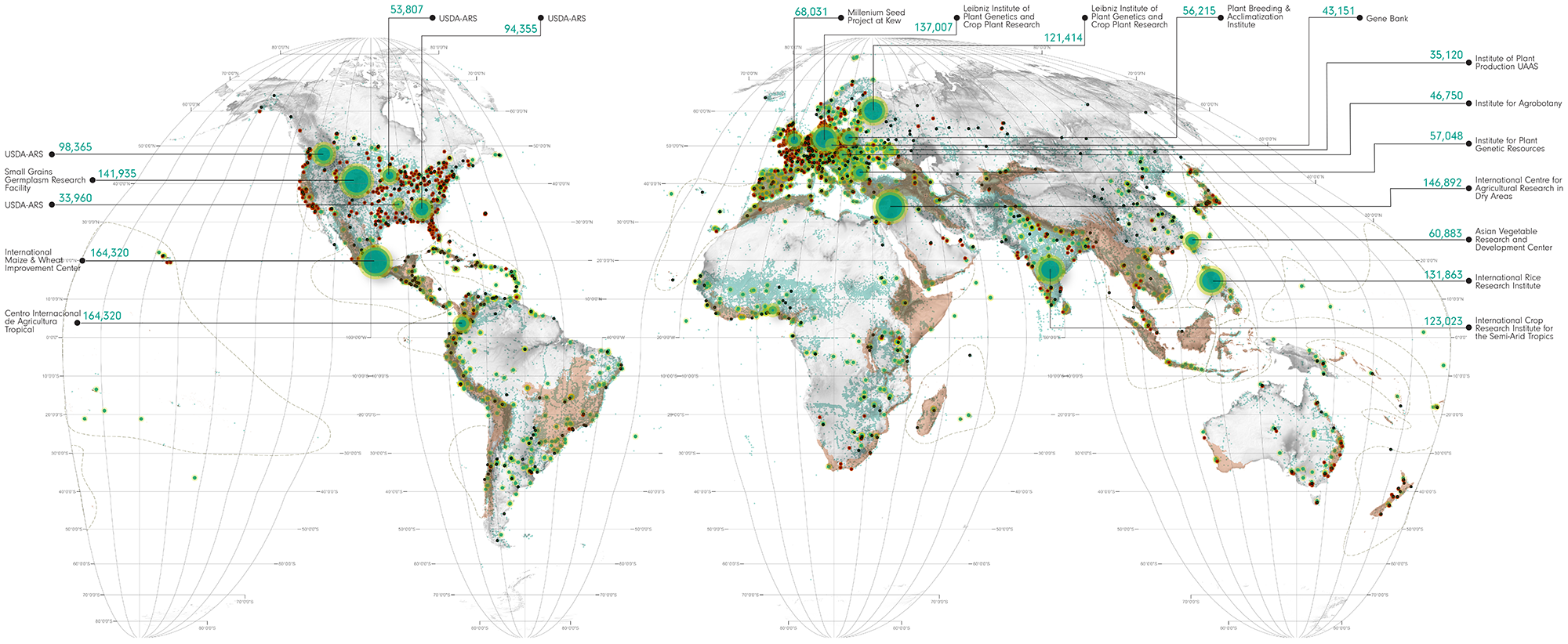
And this is what they say about it:
Even at a glance this map shows the disturbing fact that while the hotspots are being drained of life, small zoological and botanical gardens seem to be flourishing.
Well, I don’t think you can see that, at a glance or otherwise. Plus the choice of genebanks to display is eccentric. And the Vavilov Institute is mislabelled.
Here’s the WIEWS map of genebanks with more than 10,000 accessions.
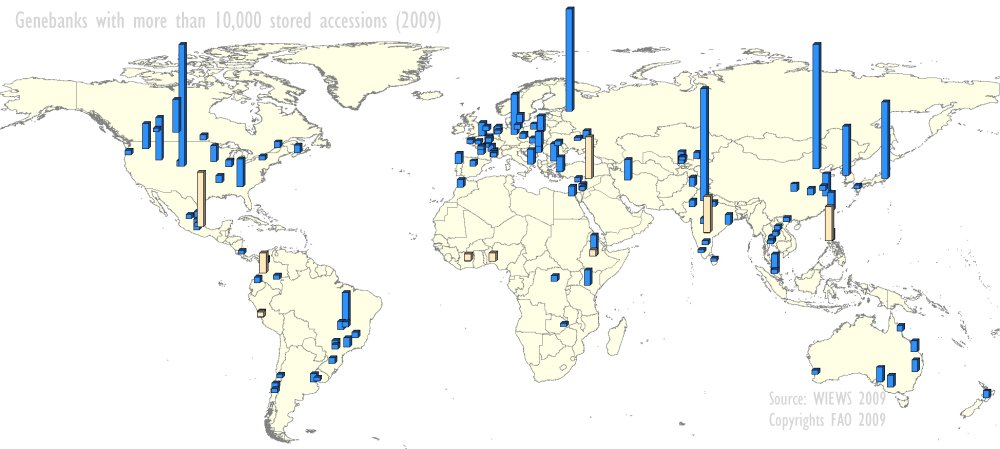
Can you tell, at a glance, which ones are flourishing?
Nibbles: Investing in food, Henna botany, Buckwheat promotion, Mapping India, Optimism, Genetic diversity, Forest cocktails
- Psst, you have any examples of investments for healthy food systems? What do you mean, you don’t.
- Paint it henna.
- Pleading for pseudocereals. In Switzerland?
- Mapping India’s trees. Among other things.
- To save biodiversity, look on the bright side. Easy for you to say.
- The genetic level of biodiversity makes important contribution to ecosystem services. In birds. Right.
- Taste the forest. In cocktails.