- VIR on Atlas Obscura, with pic goodness courtesy of yours truly. And on the same site, something Vavilov would have approved of: a very diverse Tajik apple orchard.
- A new avocado to conjure by.
- Urban agriculture won’t cut the mustard.
- Trees that named Fragrant Harbour disappearing.
- The downside of coffee. But never fear, there’s a strategy coming!
- The beernome!
- Happy birthday Sir Hans Sloane, for many botanical reasons!
- Chinese pollinators in trouble. Enough of the exclamation marks.
- Do you have any examples of “plant or animal breeding that has successfully incorporated gender considerations into its strategies and end products”? Contact these people.
- Can seeds learn from meds, policy-wise?
- Bioversity DG lobbies for genebanks.
- Get your fill of quinoa, courtesy of Jeremy.
- Sustainable pot. ‘Cause that’s the California Way, man.
Brainfood: Bean drought, Tree ranges, Lao rice landrace, Japanese wheat core, Japanese rice quality, Brassica diversity, Prosopis variety, Teff diversity, Agroecosystem diversity & resilience, Grassland spp adaptation
- Physiological traits associated with drought resistance in Andean and Mesoamerican genotypes of common bean (Phaseolus vulgaris L.). Maybe more common in the Mesoamerican genepool, and associated with pod harvest index.
- Estimating potential range and hence climatic adaptability in selected tree species. It’s better if you have trial results.
- Genetic diversity and population structure of ‘Khao Kai Noi’, a Lao rice (Oryza sativa L.) landrace, revealed by microsatellite DNA markers. More variation between than within accessions of same landrace, three genetic groups, and a possible origin in Vietnam.
- Characterization of a mini core collection of Japanese wheat varieties using single-nucleotide polymorphisms generated by genotyping-by-sequencing. Core collection of 96 accessions based on passport and pedigree data turns out to reflect geography and breeding history.
- Variation in cooking and eating quality traits in Japanese rice germplasm accessions. Mainly down to one gene.
- Population genomic analysis reveals differential evolutionary histories and patterns of diversity across subgenomes and subpopulations of Brassica napus L. Spring (SP), winter Europe (WE), and winter Asia (WA) groups, enriched genetic diversity within the WA group, different geographic origins for the C (WE) and A (WA) subgenomes.
- Molecular markers to distinguish ‘Thar Shoba’, a variety of khejri [Prosopis cineraria (L.) Druce], from trees in natural populations. Since the thing has a great morphological marker in being spineless, I don’t really see the point of going all molecular on it, but anyway.
- Assessment of the genetic relationship of tef (Eragrostis tef) genotypes using SSR markers. Molecular markers confirm distinctness of agronomically distinct varieties.
- Linkage between crop diversity and agro-ecosystem resilience: Nonmonotonic agricultural response under alternate regimes. Crop diversity increases productivity during normal conditions, decreases it in adverse conditions, increases the likelihood of staving off an adverse regime.
- Genetic differentiation and regional adaptation among seed origins used for grassland restoration: lessons from a multispecies transplant experiment. Local is best. At least in Germany.
Plant Breeding Matters!
Thanks to Mike Ambrose of the John Innes Centre for pointing us in the direction of a new series of videos from the British Society of Plant Breeders (BSPB) with the above title. He — and his genebank — feature in this first one…
…and no doubt also in some of the others.
LATER: And if you still harboured doubts… Cheers!
Getting schooled in GRIN-Global
Everything in between, you say? How about information management? That’s at the beginning, at the end, and in between.
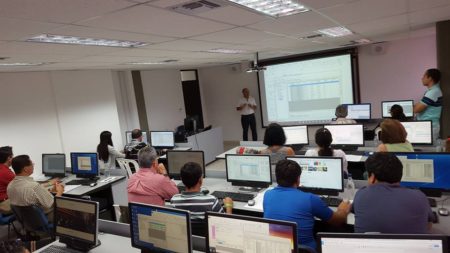
This GRIN-Global course is taking place at CIAT, another CGIAR centre. I told you there’s a lot going on in those international genebanks.
Genebanks from lab to field
Today provides a great opportunity to show the great range of activities that the international genebanks of the CGIAR centres are engaged in.
First, look at IRRI. Their new Genetic Resources Seed Processing Laboratory (GRSPL) was just opened by the German Ambassador to the Philippines.
https://twitter.com/RiceResearch/status/720193902225920001
The $2-million facility was funded by Germany’s Federal Ministry for Economic Cooperation and Development (BMZ). Since 1974, Germany’s support to research and development at IRRI stands at $62 million, most of that coming from the BMZ.
The new facility will increase the processing and storage capacity of the International Rice Genebank by 40 percent.
With German support, IRRI has also improved the conservation of rice genetic resources through new accessions as well as research to improve seed longevity in storage, streamline the seed management process and enhance data management.
The GRSPL now upgrades the seed processing function of IRRI’s T.T. Chang Genetic Resources Center which handles the conservation of global rice diversity through the International Rice Genebank and provides germplasm for rice research and breeding programs at IRRI and rice research institutes worldwide.
The genebank is nearing its maximum capacity, said Ruaraidh Sackville Hamilton, Head of the International Rice Genebank. “Our next step is to try to increase capacity.”
And at the other end of the pipeline, have a look at what Ruaraidh’s colleague at CIMMYT, Denise Costich, has just posted on Facebook.
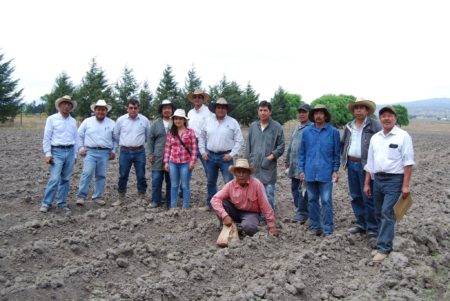
How a video leads to a collaboration… Some of you might remember that I posted a video earlier this year that was made for the Global Crop Diversity Trust “Crops In Color” campaign. I was interviewed, as was a gentleman named Misael Gonzalez Avila, who is the leader of a farmers’ group in the town of Temoaya, not far from Toluca, where we have been regenerating our highland maize collection for the past two years. I had never seen him before I watched the video for the first time. His group works with another project at CIMMYT, called “MasAgro,” and when the photographer was visiting, he was taken out to photograph the group by one of the assistants of that project, who I also did not know. Once I saw Misael and heard him speak, I commented to one of my assistants: “You know, we really should work with this guy…” Well, long story short, now we are! Today we planted a trial with Misael, and his group, including the 12 most popular materials that were selected by the farmers who attended our field day in 2014, which we incremented in 2015. They looked great in the station, so now we need to see how they behave in farmers’ fields… Keep you posted on that later this year… A few pictures of our day in Temoaya…
And of course, there’s everything in between too.