- Counting on saffron in Afghanistan.
- Counting on GRIN-Global in genebanks.
- Counting on teff as the new super grain.
- Counting on heirlooms.
IP for smallholder farmers
Thanks a lot to Susan Bragdon for summarizing her latest paper for us.
The Quaker United Nations Office has released a paper by Chelsea Smith and myself looking at the relationship between intellectual property (IP) and small scale farmer innovation. The paper will also be available in Chinese, French and Spanish shortly.
IP systems are an attempt to incentivize innovation in agriculture and ensure its availability to the public. The familiar mantra holds that breeders and scientists need incentives to create. However, the majority of innovation in agriculture happens in absence of IP rights — on the farm, by small-scale farmers. And what they’re doing is important.
While small-scale farmers themselves are typically not driven to conserve, develop, adapt, invent and otherwise display their immense ingenuity for the ends of attaining exclusionary rights to commercialize their “products”, some kinds of IP tools have the potential to actively support their efforts. Or at the very least leave farmers to do what they do in peace. The paper discusses how alternative or sui generis plant variety protection systems (as opposed to UPOV-style PVP systems), collective and certification trademarks, and geographical indications may support on-farm innovation — when carefully selected and adapted to suit the realities of domestic agricultural sectors.
On the other hand, IP tools that are more conventionally believed to incentivize innovation in agriculture (i.e. patents, UPOV-style PVP systems, and less commonly trade secrets) may actually impede farmers’ innovation.
The paper is part of QUNO’s work to build mutual understanding of the importance of small scale farmers and agrobiodiversity across treaty bodies of relevance. There is quite a complex international legal architecture relating to small-scale farmers, innovation and IP, including the CBD, Nagoya Protocol, ITPGRFA, WTO TRIPS Agreement, UPOV and the WIPO IGC. Unfortunately, we have very little, if any real collaboration going on among the secretariats of these treaties to try to establish some coherence: coordination tends to be limited to formal reports sent from one governing body to another. We’re going to need to do a lot better in order to meet SDG 2 relating to food security.
Nibbles: New grape variety, Irish food, LegumeCHOICE, Arabica diversity, Breadfruit summit
- Bronx Seedless finally hits the shops.
- The Irish Iron Age Diet.
- Choosing the right legume. But where’s the tool?
- The answer to better coffee is Ethiopia.
- Pacific Global Breadfruit Summit honours Diane Ragone. In other news, there’s a breadfruit summit.
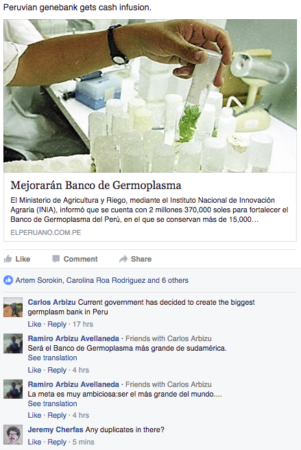
Peruvian genebank to get bigger, but how much?
There’s much excitement over on my Facebook page about the announcement of a cash infusion for the Peruvian genebank.
I’ll be here, holding my breath.
Eat this newsletter
Jeremy’s latest Eat This Podcast newsletter is out, chock full of tasty tidbits. As for the podcast itself, the most recent is about Elkstone Farm in Colorado, and asks the question: How do you grow food when the growing season is less than three months long? Spoiler alert: bears are an issue too.