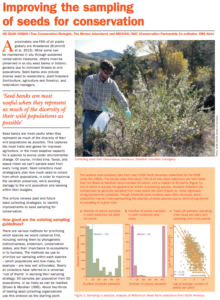
 Attentive readers may remember a two-part post from about a year ago from Dr Sean Hoban, on how to maximize genetic diversity in seed collections. Well, Sean has a piece in the latest Samara magazine from Kew on much the same topic, but with better illustrations. Plus you get a bunch of other articles as well.
Finger on the pulse in Rio
 My latest from the work blog:
There seems to be a bit of an issue over at the Olympics with fast food marketing, but if athletes in Rio, or indeed spectators, want a simple, cheap meal that’s also healthy, and hopefully sourced more sustainably, they could do a lot worse than tucking into the Brazilian staple of rice and beans (but don’t forget the vegetables and the tropical fruit juice). This is such an established part of Brazilian life that EMBRAPA, the country’s agricultural research organization, has a whole research unit called Arroz e Feijão – Rice & Beans.
Unfortunately, the level of attention beans get in Brazil is not typical around the world, even in other places that eat a lot of them, and the situation is even worse for other pulses – the general term often used to refer to the dry seeds of members of the plant family Leguminosae (technically, it’s now called the Fabaceae, but life is too short as it is), crops like chickpeas, lentils, peanuts, cowpeas and a host of others. That, at least, is the contention of a paper just published in Nature Plants 1, which also sets out to show that this relative neglect has been bad for global food and nutritional security.
Table 1 from the paper, which I discuss in the post, is also available as a website listing various resources for each pulse species.
Brainfood: Ryegrass genome, Pest distributions, German oregano, Pápalos distribution, Chinese pea, Dutch cattle, Animal biobanking, Legumes everywhere, Crop diversification in China, Asian fermentation
- An ultra-high density genetic linkage map of perennial ryegrass (Lolium perenne) using genotyping by sequencing (GBS) based on a reference shotgun genome assembly. Zzzzzzz.
- Future Risks of Pest Species under Changing Climatic Conditions. We’re doomed.
- Antioxidant capacity variation in the oregano (Origanum vulgare L.) collection of the German National Genebank. It’s huge. Fantastic. The best variation you’ve ever seen, I guarantee it.
- The distribution of cultivated species of Porophyllum (Asteraceae) and their wild relatives under climate change. New one on me.
- Biodiversity analysis in the digital era. Using the Atlas of Living Australia as an example.
- Large-scale evaluation of pea (Pisum sativum L.) germplasm for cold tolerance in the field during winter in Qingdao. 214 out of 3672, mainly coming from, wait for it, the winter production regions.
- Conservation priorities for the different lines of Dutch Red and White Friesian cattle change when relationships with other breeds are taken into account. 5 out of 7 genetic lines don’t need to be conserved.
- Domesticated Animal Biobanking: Land of Opportunity. “…journals should apply the same standard to samples and associated data, as they currently apply to molecular data, in terms of storage in formalized repositories prior to publication.”
- Neglecting legumes has compromised human health and sustainable food production. Includes nice summary of genebank holdings, using Genesys as a source of information.
- Crop Diversity and Land Simplification Effects on Pest Damage in Northern China. Diversity to the rescue. But…
- Ethnic Fermented Foods and Alcoholic Beverages of Japan. Just one chapter in a whole book on fermentation in Asia.
Sailing to Byzantium
Futurefarmers has been collecting, growing and distributing a selection of “ancient grains” in Oslo since 2013. The selection of seeds to be taken on Seed Journey have been “rescued” from various locations in the Northern Hemisphere — from the very formal (seeds saved during the Siege of Leningrad from the Vavilov Institute Seed Bank) to the informal (experimental archaeologists discovering Finnish Rye between two wooden boards in an abandoned Rihii in Hamar, Norway).
And now, they’re going back home, by boat. It all kicks off this Saturday, with a meal, of course.
Bananas everywhere
National Geographic have just published the first of a three-part series on the history of the banana. It’s been done before, several times, but you can usually count on NatGeo to get it right, and it looks like it’s off to a good start. Coincidentally, I blogged about the crop just a couple of weeks ago over at the work place. And I’m sure Colin would like me to remind everyone that the banana is eaten in 192 countries.