- It’s been a while since we linked to CATIE’s genebank.
- Boffins take next step in spoiling wine for us all.
- The olive is another thing the Romans have done for us.
- The international germplasm collections are at the root of the CGIAR’s breeding programs.
- Marketing mate.
- Let them eat breadfruit.
- The amble is down to a single medieval mutation.
Brainfood: Drones, Taxonomy, Nigerian diets, Chinese mung bean & millets, Indian chickpea, Polyploidy, Oca seed system, Agroforestry sequestration
- A direct comparison of remote sensing approaches for high-throughput phenotyping in plant breeding. Drones are best.
- Intraspecific taxonomy of plant genetic resources — Important for differentiation of medicinal and aromatic plants? It depends.
- Effects of development on indigenous dietary pattern: A Nigerian case study. Teenagers are rebellious.
- Nutritional composition and antioxidant activity of twenty mung bean cultivars in China. Good news for hipsters everywhere.
- Production and genetic improvement of minor cereals in China. And they’re good for you too. But will the rest of the world benefit from them?
- Characterization of chickpea germplasm conserved in the Indian National Genebank and development of a core set using qualitative and quantitative trait data. 1,103 are representative of 14,651, if you pick them right.
- Whole-genome duplication as a key factor in crop domestication. Comparing within genera, 54% of crops are polyploids on average, versus 40% of the wild species.
- Effect of the management of seed flows and mode of propagation on the genetic diversity in an Andean farming system: the case of oca (Oxalis tuberosa Mol.). Richer farmers conserve and exchange more.
- Global Tree Cover and Biomass Carbon on Agricultural Land: The contribution of agroforestry to global and national carbon budgets. Almost half of agricultural land has a significant number of trees on it, which sequester a lot of C.
Agroforestry around the world
I’ve been looking for an excuse to play around with the Database of Places, Language, Culture and Environment (D-PLACE), which “contains cultural, linguistic, environmental and geographic information for over 1400 human ‘societies’”. It finally arrived today, in the form of a monumental study of carbon sequestration on farmland in Nature. The authors used remote sensing and fancy spatial modelling to work out the amount of tree cover, and hence the levels of biomass carbon, on agricultural land around the world. This is the global map they got for % tree cover in 2000 and 2010.
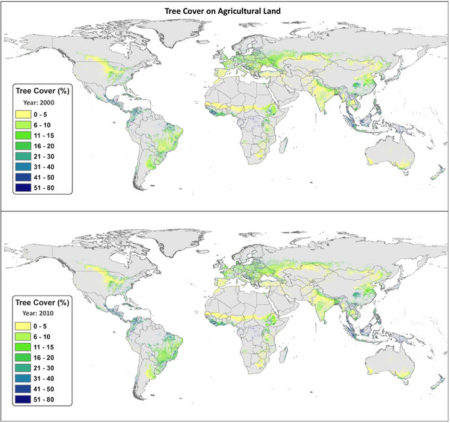
I was curious to see whether one could predict the areas of highest tree cover (or highest biomass C) from the much coarser data on agriculture that D-PLACE brings together from ethnographic studies. This is what the distribution of “major crop type” looks like, from D-PLACE.
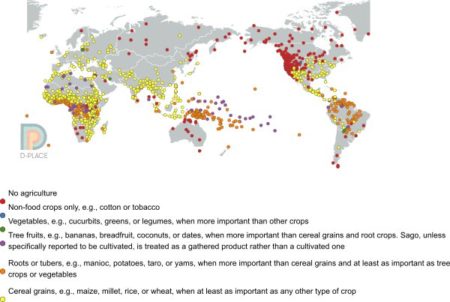
So the answer is no, I guess. It’s difficult to see any association between the amount of trees on farms and the main types of crops grown there, at least just by eyeballing the maps. There may be a hint of a preference for roots and tubers, but nothing really jumps out. I’ll keep playing though, there’s a whole range of cultural and ecological variables you can tweak.
Nibbles: Better diets trifecta, Arhar, Beer double
- Getting away from the single nutrient approach to healthy diets. Also in Bangladesh.
- But which diet is best for the Earth too?
- Pigeonpea being used as a political jibe in India. But it is good for you? And there are some cool new varieties out there.
- Better beer through better hops and better yeast. Does it go with pigeonpea, though?
Brainfood: Myrciaria value chains, Finger millet WTP, Italian olive choice, Resilience, Rural livelihoods, Ganja conservation strategy, Sorghum erosion
- Building value chains for indigenous fruits: lessons from camu-camu in Peru. It’s the local markets, stupid.
- Assessing the potential for niche market development to contribute to farmers’ livelihoods and agrobiodiversity conservation: Insights from the finger millet case study in Nepal. What they said.
- Agro-biodiversity of Mediterranean crops: farmers’ preferences in support of a conservation programme for olive landraces. See above.
- Is resilience a useful concept in the context of food security and nutrition programmes? Some conceptual and practical considerations. Yes, because it integrates a lot of stuff. But it’s difficult to measure.
- The Changing Nature of Agricultural Livelihoods along a Peri-urban to Rural Gradient in Eastern Madagascar. Rural people farm less if they can. Wonder what that means for crop diversity.
- A Belated Green Revolution for Cannabis: Virtual Genetic Resources to Fast-track Cultivar Development. Oh my.
- On-farm diversity of sorghum [Sorghum bicolor (L.) Moench] and risks of varietal erosion in four regions of Burkina Faso. 73% of lost varieties were found.