- Domestication made the tomato run slower.
- Domestication saved the pumpkin from climate change, which had messed up its cozy relationship with megafaunal poop.
- Domestication may (or may not) have happened twice in the olive. No word on role of poop.
- Papaya trashing the Amazon.
- Orphan crops: their day is coming. But not yet?
- You mean like kernza?
- Grafting 101.
- Tasmanian forage collection joins the club.
- CIMMYT’s seed distribution operation in pix.
- How the French cereals genebank maintains quality.
- Medicinal plants in NYC.
- Yes, donors, rice improvement makes a difference.
- Biodiversity especially important when times are tough. Well, in microbial communities anyway.
NBPGR’s genebank dashboard takes a bow
Good to hear 1 that the National Bureau of Plant Genetic Resources in India has a new online “dashboard” summarizing data from its genebank, one of the largest in the world. 2
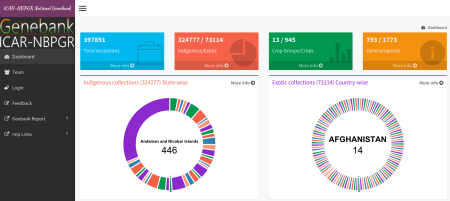
There is a separate PGR Portal for searching the collection, though apparently only on basic characterization data so far. Except for wheat, that is, where you can search for a long list of phenotypic characters.
Clearly lots of work going on lately at NBPGR on getting their data out there. But when will we see them on Genesys?
The trouble with Ipomoea
I think we may have mentioned in a recent Brainfood a “foundation monograph” of the genus Ipomoea in Bolivia, 3 without actually explaining what that is. Well, I’ll let one of the authors do that:
‘We wondered if we might be able to combine some of the speed of a Flora approach with some of the rigour of a Monograph,’ explains Dr Scotland. ‘And we’ve ended up with what we call “foundation monographs”.’ The new approach combines the time-limited approach and short descriptions of the Flora approach with the genetic analyses and fieldwork of Monographs, enabling species to be uncovered quickly, but accurately. Crucially, it borrows content like drawings and genetic analyses, where they exist, from existing studies, in order to avoid duplicating work.
Such work — whether floras or monographs — is largely based on existing herbarium specimens, of course, and a complementary study led by Zoë Goodwin, on which Dr Scotland is also a co-author, has just come out which sets out some of the problems associated with that.
…the team…scoured the records of Ipomoea — a large and diverse genus which includes the sweet potato — on the Global Biodiversity Information Facility database. Examining the names found on 49,500 specimens from the Americas, they found that 40% of these were outdated synonyms rather than the current name, and 16% of the names were unrecognisable or invalid. In addition, 11% of the specimens weren’t identified, being given only the name of the genus. 4
The work of the crop wild relatives mapper is never done.
Brainfood: Camel diversity, Livestock vs wildlife, Tunisian fig diversity, In vitro artichokes, Habanero diversity, Sorghum diversity double, Greek cherry diversity, Barley domestication, Omani bananas, IBPGR collecting, Buckwheat flow
- Molecular characterization of camel breeds of Gujarat using microsatellite markers. The two sympatric camel breeds Kachchhi and Kharai are genetically distinct.
- Beefing Up Species Richness? The Effect of Land-Use on Mammal Diversity in an Arid Biodiversity Hotspot. Livestock and wildlife can co-exist.
- Analysis of genetic diversity of Tunisian caprifig (Ficus carica L.) accessions using simple sequence repeat (SSR) markers. Diversity low and mixed up.
- A validated slow-growth in vitro conservation protocol for globe artichoke germplasm: A cost-effective tool to preserve from wild to elite genotypes. Sounds promising.
- Synthesis of a base population of Habanero pepper. That’s an equal mixture of F2 seeds from all crosses obtained among 31 accessions. Now go crazy, breeders!
- ISSR-based analysis of genetic diversity among sorghum landraces growing in some parts of Saudi Arabia and Yemen. Differentiates some white from dark-grained landraces, and among some geographic areas.
- Assessment of sorghum germplasm from Burkina Faso and South Africa to identify new sources of resistance to grain mold and anthracnose. Breeders book flight to Ouagadougou.
- Diversity of morpho-physiological traits in worldwide sweet cherry cultivars of GeneBank collection using multivariate analysis. The national and international material from the Greek genebank falls into 3 groups. Apparently that will be useful to breeders. Who are unavailable for comment.
- Barley domestication: the end of a central dogma? Non-centres, not centres.
- Distribution and diversity of banana (Musa spp.) in Wadi Tiwi, northern Oman. An unfavourable environment at a crossroads of trade routes makes for interesting diversity.
- Plant genetic resources collections and associated information as a baseline resource for genetic diversity studies: an assessment of the IBPGR-supported collections. IBPGR collecting missions in 136 countries between 1975 and 1995 collected over 200,000 samples: here comes the data.
- Social and environmental influences on tartary buckwheat (Fagopyrum tataricum Gaertn.) varietal diversity in Yunnan, China. Lots of exchange of material among farmers, which needs to continue.
A LandMark that could leave more of a mark
“…these maps do us no good unless they become public knowledge and indigenous rights are recognized by all who have ambitions to grab our lands.”
That’s Abdon Nababan of the Indonesia’s Indigenous Peoples’ Alliance, on LandMark, “a new tool launched today by a broad partnership including the World Resources Institute (WRI), …the first online, interactive platform for mapping lands managed by native communities.” And I would add that such maps will remain of limited usefulness even when they’re in the public domain if they cannot be manipulated, combined and shared much more easily than is currently the case.
Here’s Exhibit A. It is possible, with a little (well, a lot) of techie fiddling (no, not by me), to superimpose an image of what’s in Genesys (the green dots) with an image of what’s in LandMark (the brown polygons showing officially community-managed lands).
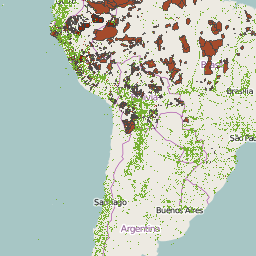
But it’s not pretty, I think you’ll agree: it gets even uglier when you zoom in, which is why I’ve decided not to let you do it. And you can’t do much with it anyway, apart from eyeball it. Plus it may well be against the terms of use of either or both Genesys and LandMark.
Well, we’ll see how LandMark develops, maybe a Google Earth export is in its future, in which case people like Abdon Nababan will be able to get the most out of it. And also the national plant genetic resources programme in Brazil, say, which may well be interested in supporting indigenous communities in protecting their crop diversity more than is perhaps occurring now. That would be a win-win. A triple win, in fact, if you add me.