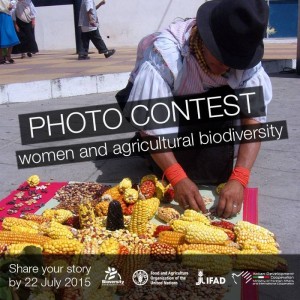
 I may have already mentioned that Bioversity are running a photo competition and that I want to win it. So by all means send in your pic, before it’s too late. But then vote for mine.
Sequence everything — but not only
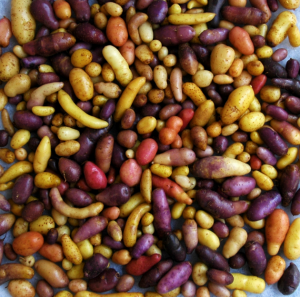 The contents of a potato genebank? Nope: “…a maximum of two alleles per locus contributed to this variation.” That’s because this tuberous cornucopia is what the authors of a recent essay in the American Journal of Botany 1 got when they selfed a diploid potato clone which was itself derived from a cross between a completely homozygous parent and one that was very nearly so.
 What does this mean for genebanks? Basically, that they can’t rely on morphological variation, in even a whole set of traits, as a proxy for overall genetic diversity. So long, old-fashioned core collections. What you really need to do is sequence everything. Music to DivSeek ears, I’m sure. But that’s not all. You also have to make sure that the resulting better diversity information gets to farmers in a way that helps them support the processes that “create and maintain useful variation for functional traits and to develop strategies to identify and select valuable phenotypes.” Or on-farm conservation, to you and me.
Nibbles: Coffee crop to cup, Pig love/hate, School lunches, Arctic life pix, Rubber sole, Ethiopian genebank
- Making a cup of “coffee.” Well, it is for Dunkin’ Donuts.
- Pigs: yum or yuch?
- FAO wants to know about how to teach healthy living in schools.
- You’d have thought it difficult to have a healthy life in the Arctic, but people manage it.
- Our rubber supply is in jeopardy. The raw material, not the product.
- Ethiopian genebank in the development news.
Brainfood: Grassland diversity, Potato diversity, English CWR, Genetic rescue, Saffron diversity, Lac, Cereal domestication, Turkish pea, Pathogen genomes, Rose fragrance, African cheese
- Worldwide evidence of a unimodal relationship between productivity and plant species richness. Grassland richness maximal at intermediate productivity levels.
- Cytoplasmic genome types of European potatoes and their effects on complex agronomic traits. Interesting relationships between cytoplasmic type on one hand and tuber starch content and resistance to late blight on other.
- Enhancing the Conservation of Crop Wild Relatives in England. 148 priority species, half of them not in ex situ at all. But there’s no excuse for that now.
- Genetic rescue to the rescue. Meaning an increase in population fitness, especially of rare species, owing to new alleles. Genomics will help by choosing the new alleles better, and monitoring the results.
- Diversity and relationships of Crocus sativus and its relatives analysed by IRAPs. No variation in the allotriploid cultigen, lots in the closely related species. Let the resynthesis begin.
- Economic analysis of Kusmi lac production on Zizyphus mauritiana (Lamb.) under different fertilizer treatments. That would be the scarlet resin secreted by some insects. NPK needed. No word on genetic differences.
- Parallel Domestication of the Heading Date 1 Gene in Cereals. Same QTL in sorghum, foxtail millet and rice, but different alterations of it. Multiple domestication for sorghum, single for foxtail millet.
- DNA based iPBS-retrotransposon markers for investigating the population structure of pea (Pisum sativum) germplasm from Turkey. No geographic structure for the landraces.
- The two-speed genomes of filamentous pathogens: waltz with plants. Fungi and oomycetes quite different genetically, but both have regions of genome which change rapidly to make them good pathogens. Bastards.
- The flowering of a new scent pathway in rose. Can we have our nice-smelling roses back now, please?
- AFLP assessment of the genetic diversity of Calotropis procera (Apocynaceae) in the West Africa region (Benin). Not just a weed, used in cheese-making, of all things.
Digital filmmakers (and others) tackle African leafy greens
I came across this cool video about African indigenous vegetables via the Horticulture Innovation Lab newsletter. Made by a student at Rutgers University’s Center for Digital Filmmaking, it describes work led by Jim Simon of Rutgers and Steve Weller of Purdue University in Kenya and Zambia on growing and marketing plants like African nightshade (Solanum scabrum?), amaranth (Amaranthus spp), and spider plant (Cleome gynandra).
There’s another video on the website too. Well worth watching both, and indeed following the blog.
And if you want more video on African leafy greens, they feature in several episodes of Shamba Shapeup, Kenya’s version of Extreme Makeover: Farm Edition.
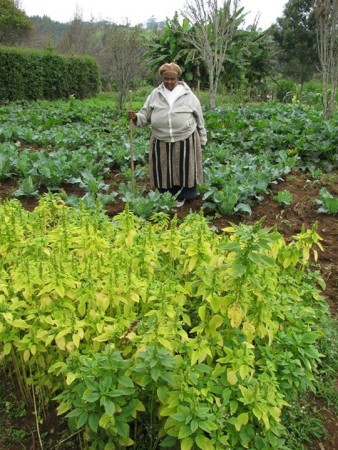 Oh, and BTW: vote for me!!! I’m only about a thousand or so “likes” behind the leader. Ok, it’s a mere photo rather than a video, but still…