- China’s crop wild relatives: Diversity for agriculture and food security. 871 wild species related to crops important in China, some of them endemic and endangered.
- Black-bone goat: An investigation report on new genetic resource of farm animal. Out of China…
- Effects of agricultural biodiversity and seasonal rain on dietary adequacy and household food security in rural areas of Kenya. More dietary diversity is better for your kids’ nutrition, and so is rain.
- Farmers’ rice knowledge and adoption of new cultivars in the Tillabéry region of western Niger. The landrace is hippopotamus-resistant.
- An invasive non-native mammal population conserves genetic diversity lost from its native range. Same for some crop wild relatives?
- Diversifying mechanisms in the on-farm evolution of crop mixtures. Diversity within mixture of 4 French wheat landraces changes in different ways in different places.
- The Role of Local Sheep and Goat Breeds and Their Products as a Tool for Sustainability and Safeguard of the Mediterranean Environment. Cheese made from local breeds is better. Well, at least different.
- Saving seeds: The Svalbard Global Seed Vault, Native American seed savers, and problems of property. “…the Svalbard Global Seed Vault is unique in its potential ability to cross the political and cultural divide over the ownership and conservation of seeds and thereby promote the vital ecological need for both ex situ and in situ seed preservation.”
- Genetic Diversity among Wheat Accessions from the USDA National Small Grains Collection. Geography is a good basis on which to base a core collection.
- Food sovereignty, food security and fair trade: the case of an influential Nicaraguan smallholder cooperative. They can all be integrated, but food security is the difficult one.
- Maize migration: key crop expands to higher altitudes under climate change in the Andes. 10m a year.
Nibbles: Chontaduro, Pandanus, African seeds, Bangladesh veggie seeds, Black locust, Agroecology, Food security research, Deforestation, Ancient Caribbean
- Colombia plants a bunch of peach palms. Hope they had some genetic diversity in there.
- Crop wild relative can tell you where diamonds are.
- Africa might need better seeds.
- Bangladesh certainly does.
- The black locust made America. The tree, not the insect.
- Another pean to agrobiodiversity.
- Towards a Research Agenda for Global Food and Nutrition Security: meeting at Expo 2015 organized by the EU. It’s today, though, and this is the first we hear of it. Sorry. Will genebanks even get mentioned? Well, if this tweet is from that meeting, it seems not.
- Cutting down forest bad for more than trees. How many crop and livestock wild relatives endangered by deforestation?
- Cubans ate cultivated plants a thousand years earlier than thought.
Nibbles: Food supplies, Food fotos, Forest foods, Diverse foods, Caribbean cassava, Wild foods, Expo 2015, Gates & SDGs, Nanoparticles
- What the World Eats: The Infographic.
- What the World Eats: The Photo Competition.
- What the World Doesn’t Eat: Forest Foods.
- What the World Should Eat More Of: The Presentation.
- What Grenada Eats: Cassava
- What Christopher McCandless Should Not Have Eaten: Not ODAP After All?
- Gulf states big stars in Milan. So that’s all right then.
- Gates Foundation really doesn’t like the SDGs.
- Boffins find promiscuous Phytophthora killer. Breeders surrender.
The end of chocolate is nigh!
Readers with a longish memory may remember a somewhat hyperbolic piece about the existential threats to chocolate that we linked to late last year. There was a lot of that sort of talk going around at the time, for some reason. Perhaps a ploy by greedy multinationals to justify price increases? Anyway, there’s a fun video out now, showcasing CATIE’s role in the whole saving chocolate thing.
Dam the genetic resources, full speed ahead
Global Forest Watch now has a dam dataset, covering 50 major river basins. Here’s what it looks like:
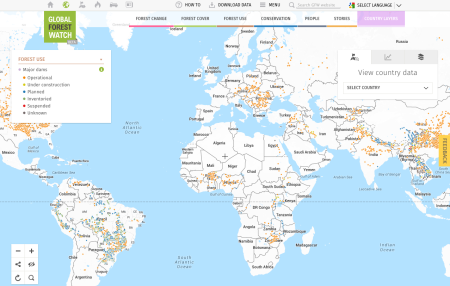
You can mash it up online with various forest datasets, but you can also download it as a kml. Which of course means you can mash it up with your own dataset. That’s what I’ve done here with wild rice from Cambodia. The white arrows are dams, most of them either planned or under construction, the yellow dots samples of wild Oryza according to Genesys.
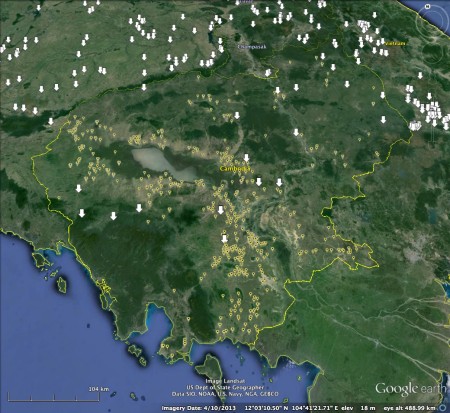
You’ll notice a few dams with few or no nearby specimens. Off the top of my head, those would seem to be places where collecting might be in order, before the disruption goes too far. But what do the rice experts out there think?
LATER: Seems I might be on to something…
@AgroBioDiverse @RiceResearch @BrianFLloyd And not just rice of course. Yes, I would expect a serious consequence.
— Mike Jackson OBE (@mikejackson1948) May 5, 2015