- CIMMYT pushes its newly-bred water-efficient maize in Africa.
- AGRA not mentioned in the above but surely they were involved? If only in the extension part.
- African universities also not mentioned, but probably less likely to have been involved. Alas.
- Register for the next class of the European Plant Breeding Academy, which starts in October 2015. Not at an African university. At a US university.
- ICRISAT pivots towards millets. Will probably involve breeding. And maybe universities.
- As for genebanks, I’ve given up expecting namechecks in any of the above.
Plant breeding for sustainable agriculture
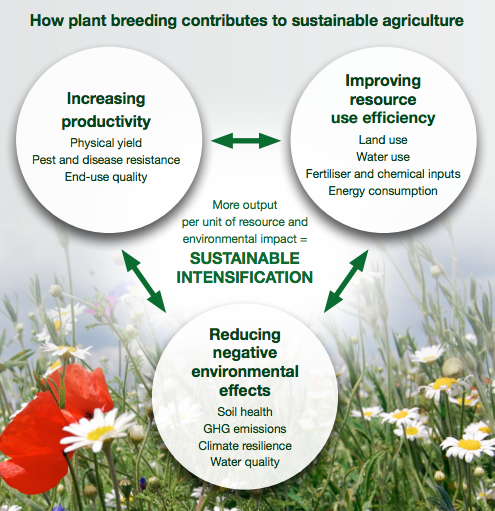 From a useful public awareness pamphlet on the importance of plant breeding, courtesy of the British Society of Plant Breeders.
Nibbles: Fertile Crescent, Hawaii taro, Purple spud, Caribbean yams, UNESCO wine & rice, VIR rye, Diverse barley
- Video of Robin Allaby on that find of underwater Mesolithic wheat DNA off England. Well, that’s just the intro. Most of the rest is about the movement of flax north through Europe.
- There’s a great Facebook group on the taros (or kalos) of Hawaii.
- Weird coloured potato could be a hit Down Under.
- New yams for Guadeloupe. No news on their colour.
- Nice scenery and wine. Sign me up.
- Also on the UNESCO heritage list: China’s rice terraces.
- The Russian rye is coming! The Russian rye is coming!
- Learn about the Oregon Wolfe Barley population. Thanks to Trust Me, I Am a Seed “Scientist”, another Facebook group worth following.
Featured: Diversity
Matthew parses “diversity,” as used by Secretary Vilsack:
I wasn’t there, but I have heard him speak about “diversity” several times before and he usually brings diversity up in the context of types (organic, conventional, biotech) and scales of farming systems. I’ve also heard him bring it up in terms of racial and gender diversity in farming.
So, probably NOT crop diversity? Seems a pity.
Nibbles: Blueberry genebank, Reviving millets, Alternative rubber, Agave fuel, Breeding coffee, Poisonous plants
- Gorge on blueberries.
- Lunch on millets.
- Bet on guayule.
- Run on agave.
- Pray for coffee.
- Watch out for Sandy Knapp.