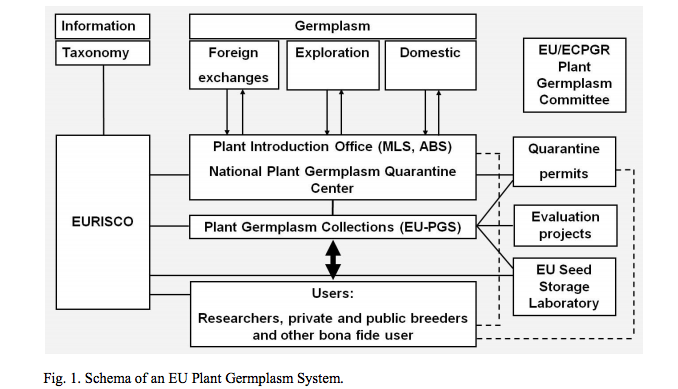
A couple of days ago we blogged about a study by European genebankers which recommended the establishment of a “European Plant Germplasm System” (EPGS) along the lines of the US National Plant Germplasm System (NPGS). Let’s see how far the analogy can be pushed.
Some of the key features illustrated in the diagram of the “EPGS” provided in the paper, and reproduced in our post, are: active germplasm collections, a central seed storage laboratory, a system-wide information system and a plant germplasm committee. There are some interesting differences between the European and US versions of each of these. The constituent European germplasm collections, for example, would be the national collections, which tend to have a very wide range of species; whereas in the US some at least of the individual germplasm repositories are fairly focused on a crop or group of similar crops. That makes for efficiencies. Or would all the “small grains” in Europe end up in one national genebank, and all the apples in another, as in the US?
Another difference, as we discussed in the previous post, is the nature of that European plant germplasm committee. There is supposed to be only one of these in Europe, whereas in the US there is one per crop, to provide guidance and advice from germplasm users to the crop curator. That to me makes more sense.
As for information systems, Eurisco is not at the moment comparable to GRIN. The NPGS uses GRIN (GRIN-Global in the near future) to both manage workflows within the genebank and make some of the resulting data available for searching on the internet. Eurisco does only the latter at the moment (and, incidentally, like GRIN, serves its data up to Genesys). But then I expect the individual European genebanks are quite happy with their various data management systems and don’t necessarily need to share a single, standardized system. Or do they?
Perhaps the biggest difference, however, is with the central seed storage laboratory. There is at present no European Ft Collins at all to provide safety duplication of seed accessions. It would have to be built from scratch. Or perhaps one of the bigger national genebanks could suck in safety duplicates and morph into a regional genebank? But is a single central repository really necessary at all? What if, instead, you had different national genebanks taking regional responsibility for safety duplication of different crops? This would not be a new idea by any means, though I don’t think it’s ever been implemented anywhere in the world. Might it be an option in Europe?
Then there’s the stuff that’s not on the diagram. Take coordination mechanisms. The NPGS has biennial face-to-face meetings of all genebank curators, with teleconferences in the “off-years.” Plus there’s national–level coordination by the ARS Office of National Programs. The National Plant Germplasm Coordinating Committee coordinates and communicates information among federal, state and other funding entities. A related issue is administrative structure. NPGS genebanks are budgeted in a ARS Research Project, which is funded by an annual Congressional appropriation. This in turn contributes to ARS National Program 301 (Plant Genetic Resources, Genomes, and Genetic Improvement). Every five years, each National Program and its constituent Research Projects undergo external reviews. After that, each Research Project writes a new Project Plan for the next five years for review. What would European coordination and administration on crop genetic resources look like? Some is already provided by the European Cooperative Programme for Plant Genetic Resources (ECPGR), of course. Would ECPGR’s processes and structures — not to mention funding — be sufficient for a European Plant Germplasm System?
So. I guess the bottom line is that it’s easy to say that it would be nice to have a European version of the US National Plant Germplasm System. But then you start to drill down into what that would actually mean, and lots of options open up at each turn. And, at each turn, whether it makes sense to do it in Europe exactly like they do it in the US will, as they say, depend.