Some bad news from Tony Jansen, via Facebook. He has kindly given us permission to reproduce his post here. This comes after more sad news from the Pacific just a few weeks ago.
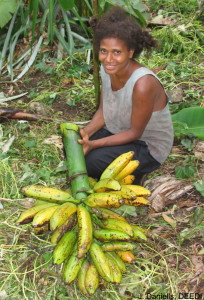 I’m very sad to hear the tragic news that my very good friend Dorothy Tamasia has died. I dont know the hows or whats, only that she was too young. She was the true embodiment of the barefoot curator and lived out her life in very basic conditions with her people in the highlands of central Makira and passionately collected, protected and shared across her island and throughout the Solomon Islands over 108 varieties of bananas that she took part in collecting with Kastom Gaden Association. She was trained in morphological descriptors and management of germplasm collections despite having little formal education. Her work in documenting and maintaining her banana collection led to Solomon Islands being recognised as holding one of the largest remaining and least documented collection of banana diversity in the world – and she was a leading figure in a revival in banana diversity and its cultural connections in Makira through diversity fairs and other events.
Banana is the staple food in Makira. Dorothy was a hero for conservation in use of plant genetic resources and she dedicated much of her too short life to that purpose. She took part in pioneering work to test and promote high vitamin A fei banana varieties. A poster from that work can be seen here and she was part of banana diversity work supported variously by ACIAR, the SPC Centre for Pacific Crops and Trees (CePaCT) and Seed Savers Network.
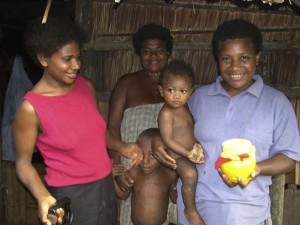 I last saw her in late 2011 after making the 4 hour walk to her village from the coast — which has no roads and is one of the most remote parts of a remote country. She was happy, and had recently started a bush early-childhood pre-school in a leaf house in a remote riverside location where she lived on her own with her children. The room was full of brightly coloured creations from nearby village children who came to her school — and surrounded by her bananas and her cacao farm. She was excited to be studying early childhood education. She was also busy duplicating, on her own, the banana collection she had maintained for almost a decade — back breaking work with no reward other than the custodianship that she treasured. She had a deep grasp of the issues including the controversy around crop genetic resources. She chose to keep above all of it and just continue her humble work that she knew was the right thing and a useful thing to do.
Dorothy was a beautiful person and a kind hearted and generous soul. I hope that in her death her life work and commitment to the Solomon Islands indigenous plant genetic resources and to food security for her people will be acknowledged and that the collections she had maintained will be supported to continue.