- Developer of super broccoli reflects on his career. With photo of collectors in NSFW shorts.
- Touring the commons of the world. Thankfully no tight shorts in sight.
- Video explaining Rothamsted’s Park Grass experiment. Apparel entirely acceptable, don’t worry.
- Ten million-year-old genome duplication finally came good when ancient farmers domesticated maize.
- Training materials for African breeders to be developed.
- Fungal diversity to the rescue of plants, for a change.
- Africa’s black soap.
- Improving teff. That’s a low bar, I suspect.
- A genome I’m sure we can all get behind.
- Oh dear, that organic meta-analysis “flawed” after all. Will it ever end?
- Rethinking sunflower domestication. An oldie but goldie, which re-surfaced today for some reason. Does anyone know where we are with this now?
- The Deliverance of tomatoes.
Yam secrets revealed
I ran across an interesting article in The National newspaper last week in PNG, but I can’t find it online, so I’m posting a scan of it below. You should be able to read it ok if you click on it. It’s worth it. How can anything with the title “Secret Abelam yam initiation exposed” not make for fascinating reading.
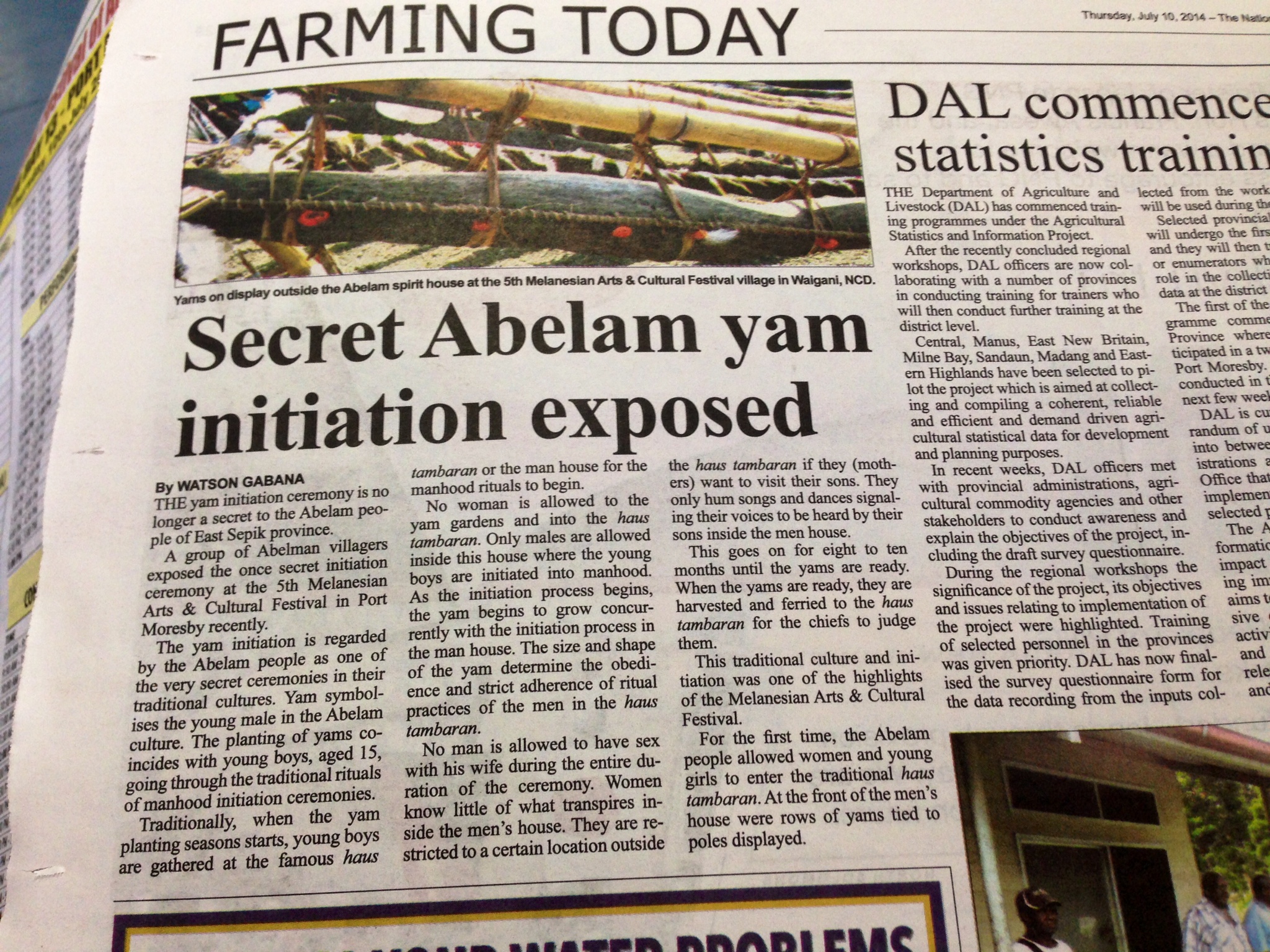
The Abelam people are from East Sepik province and their life — especially the life of the men — revolves around yams:
Among the Abelam, the yam cult is a unique cultural institution and the focus of male existence. It involves men striving to produce long tubers (up to a length of 6 feet/180 cm or more), in intense competition with a long term partner in a neighbouring village. There are two major ritual cycles in Abelam life, both centred on this cult — initiation ceremonies which instruct young men in the magic and skills required to grow the prized long yams, and yam growing ceremonies and rituals designed to ensure the success of the current crop.
There are also yam festivals after harvest:
The actual yam displays are very festive occasions. Yam growers from rival villages generally arrive together on the morning of the event. When they are all gathered, the yams, which have been concealed behind barriers and decorated with shell, feather, and basketry ornaments, are carried onto the ceremonial ground. Each waapi is attached to a pole, and carried by two men, one at each end. As the yams are paraded, guests show their approval of their rivals’ efforts by putting special leaves (naarendu) or lime on particularly good specimens. Subsequently the waapi are lined along wooden frames in front of the ceremonial houses where they are carefully inspected and measured by ritual exchange partners. Following the inspection, rivalrous songs, particularly on the themes of yam exchanges and warfare, are sung by individuals. Groups and individuals may claim victory in these song contests by virtue of “evidence” and superior oratory.
It all sounds very spectacular. And extremely important:
…ceremonial yams have an important political function: to a large extent, male status, prestige, and power are dependent on the size and quality of ceremonial yams grown.
In addition to their importance in the political arena, “long yams” have considerable expressive content. Since all yams are propagated vegetatively, yams also form a link between living Abelam men and their ancestors, who planted genetically identical yams. Abelam often invoke their ngwaalndu (clan ancestral spirits) when growing and tending yams. The link between a man, his ceremonial yams, and his ngwaalndu is very close. Yams are of paramount social, symbolic, and religious importance to the Abelam people.
The species involved are Dioscorea alata (waapi) and D. esculenta (jaambe). These are under pressure in some parts of Papua New Guinea, being replaced by recently introduced African species, which seem to withstand pests, diseases and drought somewhat better, I was told. This doesn’t yet seem to be the case for the Abelam, but I wonder for how long. Maybe aeroponics is the answer?
Surviving Typhoon Rammasun
There’s sad news of much damage, and some loss of life, in the wake of Typhoon Rammasun as it travels across the Philippines. You may or may not be able to see this set of photos from Facebook (I don’t understand how permissions work on Facebook) showing some of the effects of the storm on the campus of the University of the Philippines at Los Baños. The area is home to both the national genebank of the Philippines, already much damaged in a previous typhoon, and also the International Rice Research Institute and its global collection. Both collections are substantially duplicated in Svalbard, should anything bad happen. But of course we hope it doesn’t. Our thoughts are with the people of the Philippines.
Botany on the Beeb
I’m sure we’re all excited about the new BBC series, “Plants: From Roots to Riches,” which begins on Radio 4 on Monday, 21 July. You can even subscribe to a podcast, so there’s really no excuse for missing any of it. We’ll try to provide regular recaps, replete with spoilers.
Bananas galore
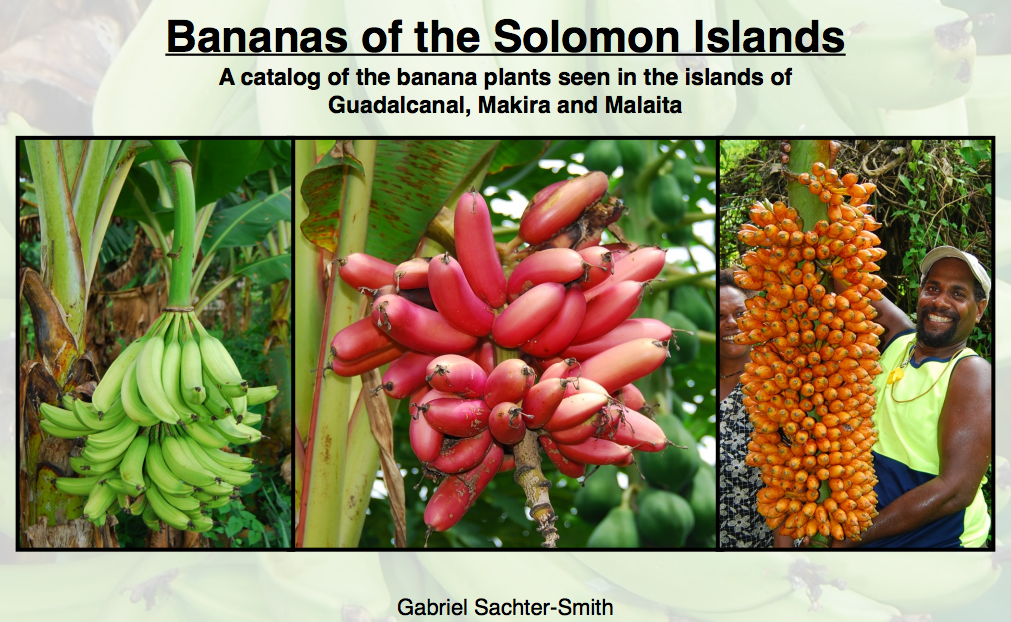
Rosa would certainly have welcomed a great new 1 catalogue of some 50 banana varieties from the Solomon Islands by Gabriel Sachter-Smith, put out by ProMusa. The varieties on the cover are Broken Heart, Ruhuvia Chichi and Ba’u Lalao.
Oh, and there’s also a new wild subspecies from India.