- First, find your custodian farmers.
- Sure, they can farm wild species too.
- Then, get them to produce something cool, sell it, and use the money to preserve some nearby temples.
- Oh yeah, but better make sure there’s no GMOs around.
- Organic helps. No, really.
- Ok, so maybe you have to help them out by breeding for higher boron tolerance or something.
- Something like tomatoes that don’t rot. And in French, but with photo.
- Make sure the taxonomy is right, though.
- And if in doubt, use barcoding.
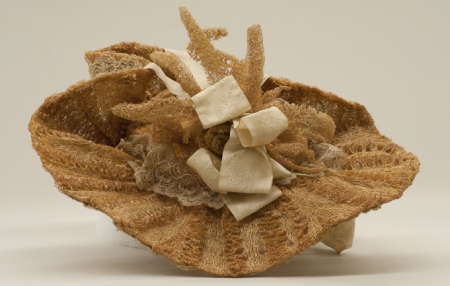
Featured: Bonnet gourd
Eve comes up trumps on those “bonnet gourds”:
There is one from Jamaica in the Economic Botany collection at the Field Museum in Chicago. One can search their database, but I’ll provide a couple of links.
Definitely worth a look.
Remembering Rosa Kambuou
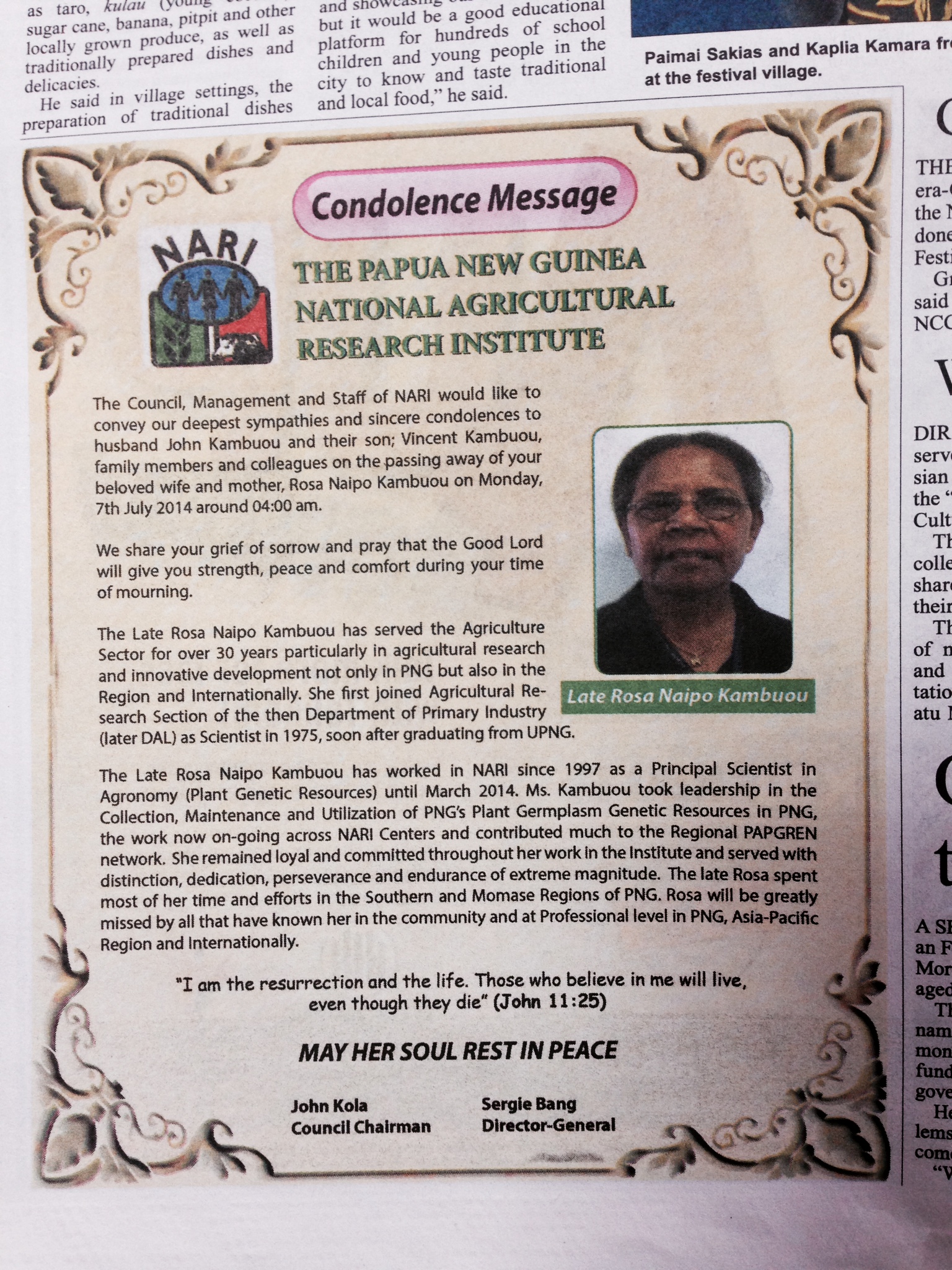 It was with enormous sadness that I learned last week of the passing away of my friend and colleague Rosa Kambuou. 1 Rosa was for many years the leader of Papua New Guinea’s plant genetic resources programme. She had a particular interest in banana, and managed, more recently with Janet Paofa, the country’s largest collection of that perhaps most diverse of PNG’s crop, but she knew a great deal about all of the traditional crops of the Pacific. She shared that knowledge freely, with generosity and humility. She taught me pretty much all I know about Pacific crops.
Dr Mary Taylor, who worked with Rosa much longer than I did, contributed this dedication to the Biodiversity for Food and Nutrition online group:
Rosa Kambuou died in hospital on 7th July in Port Moresby. Those of you who had the privilege of meeting and knowing Rosa will remember a quiet, yet at the same time, a very strong woman, who was a pleasure to be with. She knew everything there was to know about PNG plant diversity — and that is a lot of knowledge. She first joined the agricultural research section of the then Department of Primary Industry (later DAL), PNG as a Scientist in early 1980s, soon after graduating from UPNG. Since 1997 Rosa worked for NARI as a Principal Scientist in Agronomy (Plant Genetic Resources) until March 2014. Rosa was totally committed to PGR and her work in NARI leading the PGR work, conserving, describing and documenting large collections was impressive.
Rosa also shared her knowledge and expertise with the region. She was one of the authors of the Pacific Plant Genetic Resources Framework which set the stage for the establishment of PAPGREN — the Pacific Plant Genetic Resources Network — and was present at all the PAPGREN meetings until she became unwell. Her knowledge and expertise was a huge resource to the network, especially knowledge of bananas and the root and tuber crops — every member of that network learnt from Rosa. She was a guiding light and mentor to so many people in the region — she showed what is possible with dedication and perseverance and throughout she remained humble.
The Pacific and the world has lost a great PGR champion, and many of us have lost a dear and wonderful friend.
Dr Danny Hunter, the facilitator of that list, who also worked with Rosa for some years, added this:
I had the good fortune to meet and get to know Rosa while working in the Pacific region for 12 years and she taught me a great deal, she continued to even when I left that part of the world. I continued to collaborate with her right up to submitting papers to the forthcoming IHC meeting in Brisbane next month. Rosa championed plant genetic resources in PNG, the Pacific and globally. She did much to raise the level of PGR conservation and use including efforts to safeguard CWRs and promote better diets and nutrition using local biodiversity. She was gentle and wise and uninterested in self-promotion. This together with her drive, commitment and energy is a an example to us all.
The following is from Douveri Henao via a posting on Facebook, reacting to a notice on PNGLoop. Douveri is a lawyer who has worked extensively on genetic resources issues in PNG and the Pacific region:
A truly amazing women. Regarded as the banana woman, many knew Rosa as the face of PNG agriscience. She had so much passion to bring smart ways of bringing food security not only to PNG but the region as well. She once told me that a new variety of banana developed by her team was been tested in the fields for lowland farmers that had drought resistance features. A flood was approaching the Laloki station and so she carefully removed them and cared for them in her living room until the waters subsided. Her efforts made many in the lowlands access this tree crop. A wonderful warm soul that radiated passion for the betterment of her people. An inspiration for many who are challenged that the public sector is a decaying sector. Rest well my sister, enjoy happiness in eternity.
Rosa leaves a huge void. She will be much missed. And always remembered.
Nibbles: Coffee processing, British liquorice, Livestock maps, Chicken semen, Global Nutrition Report, Plant booze, Cuban urban ag, Forests & nutrition, Sustainable cacao, Climate-smart ag, Modelling landuse, Mapuche up in arms, Rothamstead experiment
- Touring the world’s coffee processors.
- Liquorice next? Starting in the UK?
- India has 30% of the world’s cattle. Which you might not be able to guess from these very cool ILRI maps. Including one on chickens, in which the Nordic countries feature perhaps less than they should.
- The Global Nutrition Report will have these indicators at country level. Some stuff there on fruit and vegetable consumption, but why nothing specifically on dietary diversity? Anyway, if you’d like to make suggestions, you can.
- Wait, why is there nothing on alcohol consumption? And is diversity in alcohol-producing plants a good thing? I mean, nutrition-wise.
- Uhm, nothing on urban agriculture either. I bet you that’s an indicator of something or other, nutrition-wise.
- Maybe Amy Ickowitz of CIFOR will suggest some indicators. She has interesting data on forest cover and child nutrition.
- How to make cacao cultivation more sustainable.
- Andy Jarvis on how to scale up climate-smart agriculture without necessarily sacrificing goats. Nor, presumably, nutrition.
- Model says environment can support subsistence hunting and agriculture only up to a point, and no more. Still no cure for cancer. But did someone tell the Mapuche?
- Well, what do you know, genes come, and genes go.
What does a bonnet gourd look like?
Tucker on 'Bonnet Gourds', 1874: "the women in the Southern States split it and made up very pretty and useful head coverings or bonnets"
— Kew Gardens Library and Archives (@Kew_LAA) July 14, 2014
This 2 seems to refer to Luffa, but does anyone have photos? I’d love to see what these bonnets look like, but unfortunately Google is not being very helpful. Gourds are inevitably much on my mind after my trip to PNG…
LATER: And here it is, thanks to Eve Emshwiller: