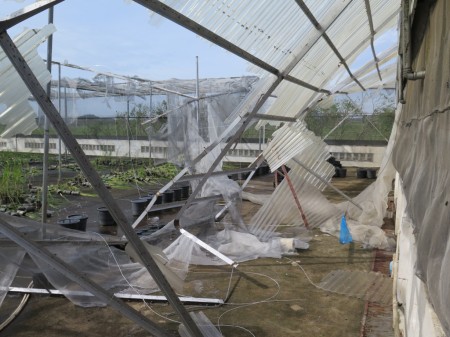
- How to keep seeds dry. Don’t do this at home, folks! No, wait…
- Don’t get trapped in the yield gap, researchers told.
- Diana Buja breaks down banana brewing.
- Night temperatures cross important threshold for rice.
- Cultural change does not have to mean genetic erosion and loss of agrobiodiversity knowledge.
- Getting youth back into agriculture. Not just about the money.
- Latest from the tragic ICARDA situation
Pigeon Foot sorghum unmasked
You may remember my quandary over the meaning of the name of the sorghum variety Gadam El Hamam. Well, I had the opportunity of asking real experts at the ICRISAT office in Nairobi yesterday. They confirmed, first of all, that the Gadam sorghum that is being so successfully used in beer brewing in Kenya is indeed a selection from the Sudanese variety Gadam El Hamam. And after a quick email to their Sudanese sorghum breeder colleague based in Addis Ababa, we solved the mystery of the name. It turns out the correct transliteration is Gadam Elhmam, which means “Pigeon Foot” in Arabic. This is apparently a trope that is used in Sudanese poetry and songs to describe a beautiful lady. So I more or less had the bits, but I could not put them together. Thanks to all at ICRISAT in Nairobi for helping me do that at last.
Incidentally, the photo is of a beautiful Faidherbia albida tree on the ICRAF campus in Nairobi, which is where the ICRISAT regional office is housed. You may be able to make out from that the Napier grass and mulberries are taller and more lush just under the tree as compared to further back. They don’t call Faidherbia the cornerstone of “evergreen agriculture” (big PDF) for nothing.
The Queen of Crop Breeding
Yes, I know blogging has been slow the past week or so, but I’ve been on leave and Jeremy way too busy with work for everyone’s good, though mostly his. But look, you got couple of big fat Brainfoods to keep you going, no? 1 Anyway, thought you might be interested in this piece in Kenya’s Saturday Nation newspaper a couple of days back. It’s a profile of AGRA plant breeder Dr Jane Ininda. The illustration is a (poor quality, alas) photo of the actual newspaper, which I took because it was such a treat to see a crop breeder splashed all over a major national newspaper. And the effect is just not the same in the digital version.
Brainfood: Ethiopian coffee, Kenyan climate change, Biofortification, Pasture legume adoption, Moroccan veggies, Economics of pests, Grassland diversity & fire, Seed storage, Resistant beans, Maize OPVs, Low P tolerance in NERICA, Brazilian beans
- Prospects for forest-based ecosystem services in forest-coffee mosaics as forest loss continues in southwestern Ethiopia. Coffee agroforests provide about half to two thirds of the ecosystem services of plain old forests.
- Social Process of Adaptation to Environmental Changes: How Eastern African Societies Intervene between Crops and Climate. Your seeds may not be able to cut it in the future.
- Bioavailability of iron, zinc, and provitamin A carotenoids in biofortified staple crops. Focus on breeding varieties with elevated micronutrient concentrations is justified. Phew.
- The future of warm-season, tropical and subtropical forage legumes in sustainable pastures and rangelands. Those who cannot remember the past are condemned to repeat it. And the past, in this case, was full of mistakes.
- Wild leafy vegetable use and knowledge across multiple sites in Morocco: a case study for transmission of local knowledge? The Rif Mts are a hotspot of weed diversity. Not that kind of weed, settle down. No, wait…
- Agricultural Trade, Biodiversity Effects and Food Price Volatility. Pests are damaging to neat economic models. Pesticides fix that but damage the environment. No word on the economics of natural enemies, integrated pest management, varietal diversity etc.
- Annual burning drives plant communities in remnant grassland ecological networks in an afforested landscape. In the southern Afromontane region, annual burning does not reduce the species diversity of grassland patches, but does make these patches look more and more alike. Add heavy cattle grazing though and that does reduce diversity.
- Responses to fire differ between South African and North American grassland communities. Decreasing fire frequency increased species diversity in Kansas, decreased it in Kwa-Zulu Natal. It’s because of the rhizomatous species in America. What does this and above mean for crop wild relatives?
- Prolonging the longevity of ex situ conserved seeds by storage under anoxia. Remove oxygen to make seeds last longer in genebanks.
- Identification of Sources of Bacterial Wilt Resistance in Common Beans (Phaseolus vulgaris L.). Only 1 resistant accession out of 500 in the USDA collection. And it’s a wild one.
- Evaluation of Evolution and Diversity of Maize Open-Pollinated Varieties Cultivated under Contrasted Environmental and Farmers’ Selection Pressures: A Phenotypical Approach. OPVs are diverse and change over time. Still no cure for cancer.
- A novel allele of the P-starvation tolerance gene OsPSTOL1 from African rice (Oryza glaberrima Steud) and its distribution in the genus Oryza. Kasalath comes to the rescue of NERICA. Must be the only sativa gene NOT in NERICA.
- Agronomic potential of genebank landrace elite accessions for common bean genetic breeding. Yeah, but are they in the Brazilian genebank? Doesn’t look like it.
Brainfood: Niche and range limits, Grassland diversity drivers, Pollinator research bias, Livestock systems, Seed longevity gene, Apple origins, Amaranthus in Mexico, Chinese medicinal orchids, Seed longevity, Fitness tradeoffs, Lentil evaluation
- Are species’ range limits simply niche limits writ large? A review of transplant experiments beyond the range. Meta-analysis shows dispersal constrains geographic distribution but extends altitudinal. Biotic interactions important at low elevations and latitudes.
- Herbivores and nutrients control grassland plant diversity via light limitation. Nutrients bad, herbivores good for grassland diversity.
- Economic and ecological implications of geographic bias in pollinator ecology in the light of pollinator declines. Half the data come from 5 countries. Nuff said.
- Integrated crop and livestock systems in Western Europe and South America: A review. Market logic has driven crops and livestock apart, but it should drive them back together again.
- ARABIDOPSIS THALIANA HOMEOBOX25 Uncovers a Role for Gibberellins in Seed Longevity. Seed longevity gene found. No word on whether giberellin treatment can prolong seed life in genebanks. Yet.
- Molecular-level and trait-level differentiation between the cultivated apple (Malus×domestica Borkh.) and its main progenitor Malus sieversii. Status of M. sieversii as main progenitor confirmed. Always good to have more data.
- Adaptation of Cultivated Amaranth (Amaranthus spp.) and Their Wild Relatives in Mexico. One of the wild species could be a source of adaptation for the cultivated under climate change.
- Eat your orchid and have it too: a potentially new conservation formula for Chinese epiphytic medicinal orchids. Nature reserves and cultivation on farms not enough. What you need is “restoration-friendly cultivation.”
- A continental-scale study of seed lifespan in experimental storage examining seed, plant, and environmental traits associated with longevity. Australian seeds are somewhat longer-lived than those from other regions. But there’s plenty of variation, some of which can be explained by different features of the seeds, plants and the specific environment where they grow.
- Inclusive fitness in agriculture. Plants and their root symbionts can get along even better together, with a little help from human selection.
- Genetic diversity analysis for quantitative traits in lentil (Lens culinaris medik.) germplasm. NBPGR seem to be on an evaluation blitz. More power to them. Hope to see the data online soon.