- Nutrition is so confusing.
- There are so many plants, for a start.
- And it’s so difficult to get them from the forest.
- And they’re difficult to describe.
- And they get all kinds of diseases.
- Could grow them in nutrition gardens, I suppose.
- Learn to save their seeds.
- Or just go for fish.
A plateful of Camargue Red Rice
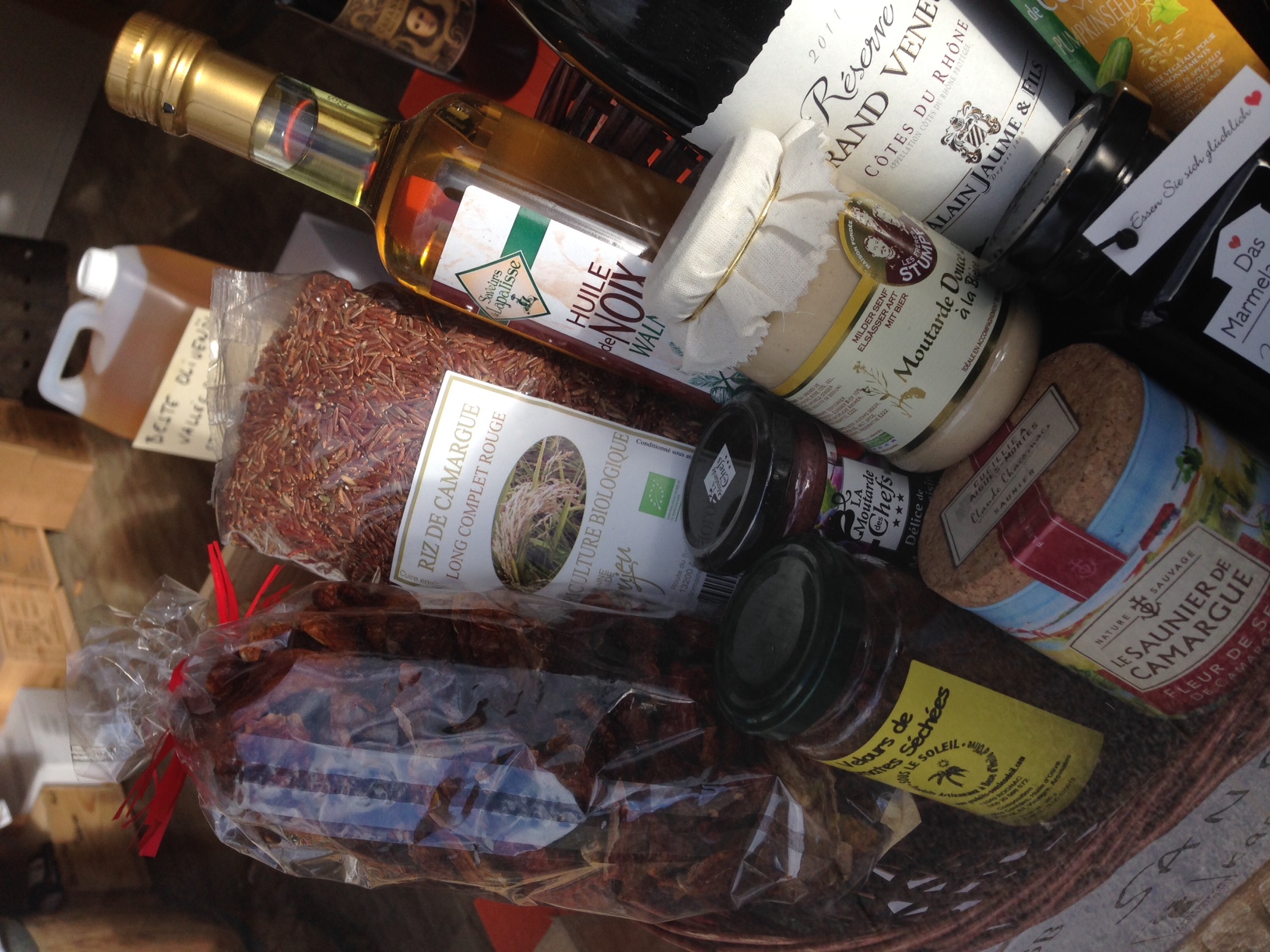 How far back into the mists of time, do you suppose, have the French versions of the fabled gnarled rustics of Sicily been nurturing the equally fabled red rice of the Camargue? The question occurred to me as I walked past a shop window in Bonn recently, and saw this delectable display of various products of that region, including said rice. Well, it turns out that although rice has been grown in the Camargue for centuries, this particular, trendily healthy variety is of somewhat more recent vintage.
A chance cross between the wild rice and a short grain rice was discovered in 1983 by a René Griotto (died 1989.) He found it growing at the foot of the Montmajor Abbey. Development of the cross was pursued in conjunction with the French “Institut national de la recherche agronomique” (INRA.) They’d grow plants, select seed from certain plants, then grow those, till finally they settled on the plant breed known today as Camargue Red Rice.
Wild rice? What wild rice grows in France? I asked my go-to guy for everything Oryza:
Must be weedy rice introduced with a crop. France is way outside the known limits of distribution of wild rice. 100 years ago a red rice introgression would have been rigorously weeded out. In the 1980s Europeans were becoming aware of the health benefits of non-white food. I wonder if they actually thought red rice = anti-oxidants = anti-cancer, which is today’s mantra.
Here’s some more from an FAO publication on weed management:
The seeds of most weedy biotypes of O. sativa and O. glaberrima have a pigmented pericarp resulting from the presence of a variable content of different antocyanins, cathekins and cathekolic tannins (Baldi, 1971).
The red pigmentation is a dominant character and is controlled by more than one gene (Leitao et al. 1972; Wirjahardja et al. 1983)
The red layer of the weed grains harvested with the crop should be removed with an extra milling but this operation results in broken grains and grade reduction (Smith, 1981; Diarra et al. 1985a, 1985b).
Weedy biotypes of O. sativa have been differentiated into indica or japonica types, on the basis of the morphological and physiological traits, isozymes, RFLP (Restriction Fragment Length Polymorphism), RAPD (Random Amplified Polymorphic DNA) and AFLP (Amplied Fragment Length Polymorphism) markers.
According to a study funded by the European Community, weeds collected in Mediterranean rice fields belonging to the japonica group and weeds from Brazil were close to the indica group (Ghesquière, 1999). In this study no specific allele of weeds were found which can serve as a diagnostic marker to easily determine the varietal origin of the weedy forms. Nevertheless, a great deal of evidence would seem to show that the primary origin of red rice can come from distant crosses between indica and japonica varieties.
Vaughan et al. (2001) pointed out that the several samples of weedy biotypes collected in the United States belong not only to the indica and japonica subspecies, but also to the O. rufipogon and O. nivara species.
Anyway, before you ask, I can’t find a reference to the red rice of the Camargue in any of the genebank databases that I know. It’s definitely not in IRRI. There’s no data at all on any rice collections in France on Eurisco, although other countries do have substantial collections of French rice, in particular Russia. WIEWS does list a number of important rice collections in France, but they seem to be international, with only some 9 samples from France itself. GRIN also has significant holdings of French rice, but nothing that I can see on Camargue Red Rice specifically, 1 at least going by passport information. We know INRA have been having trouble with their grape collection. Do they even have a collection of local rices? Or are they relying on those gnarled Camargue rustics, and clever niche marketing to hip, health-conscious foodies of course, 2 to keep them going?
Nibbles: Agroforestry slides, Sub1 slides, Fish slides, Fish in Neolithic, Silver bullets, Carbon credits, Camel domestication, Cuneiform barley
- All of the presentations from the World Congress on Agroforestry.
- Scuba rice in 13 slides.
- You got off easy on that last one. Here’s 55 slides on fish biodiversity and the food supply.
- Not much fish in the food supply of early farmers in Britain.
- New IFPRI book highlights technologies to beat hunger. Includes plant breeding. But no fish?
- Kenyan agroforestry organization gets C credits. Details sketchy though.
- The Bible got it wrong on camels. And that’s all I’m saying about that.
- Cuneiform tablets are so beautiful. Especially when they depict agricultural biodiversity. Via.
Exploring Polish processed foods
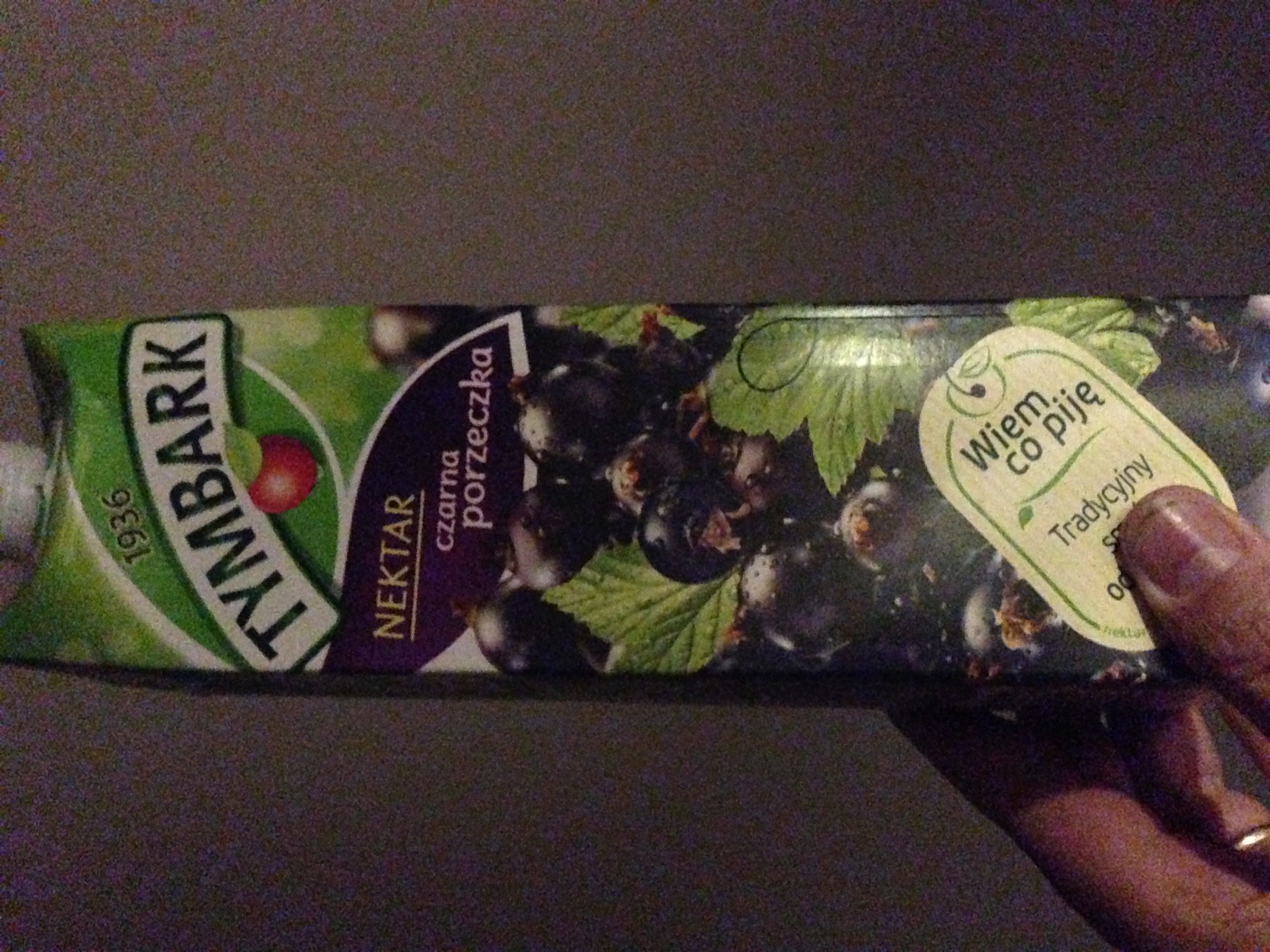 One of the fun things about visiting a new country is of course the food. There’s the formal cuisine, and the street food. 3 And the traditional markets with their food kiosks, and corner shops. But I also like to check out the supermarkets, both the big chains, and the smaller places. 4 I didn’t have much free time in Warsaw last week, just enough for a couple of visits to smallish supermarkets. But I can report that Poles seem to have an inordinate fondness for the juice of minor berries.
 Oh, and for unusual vegetable soups.
Nibbles: Texan blackeyed peas, Pest distributions, Better eucalypts, City gardens, Allopolyploidy, Chilean agroforestry, Sahel agroforestry
- Texas A&M builds better
mousetrapcowpea. - Huge survey of the distribution of crop pests.
- Spanish tree breeders assisting in the despoliation of the Ethiopian plateau. Totally unfair, I know, there’s plenty of reasons why improving eucalyptus production in Ethiopia is a good idea. But I just wish similar effort had gone into local trees.
- They increased the biodiversity of city gardens and nobody noticed. Wonder if it would have been the same in allotments. Meanwhile, however…
- It takes 4-5 million years for allopolyploids to become different enough for their hybrids to be sterile.
- Save the Espinal!
- More water wouldn’t help sorghum in the Sahel. Yes, you guessed it, the World Congress on Agroforestry is still going on.