- Freekeh is the new quinoa. What, the next environmental and social catastrophe for the Bolivian altiplano?
- Oh no, sorry, it’s teff that’s the new quinoa.
- Only a matter of time until African Chef gets hold of it then.
- And no doubt Inga edulis is not far behind.
- Let’s hope it doesn’t go the way of the McIntosh.
Get a move on with those CWR abstracts!
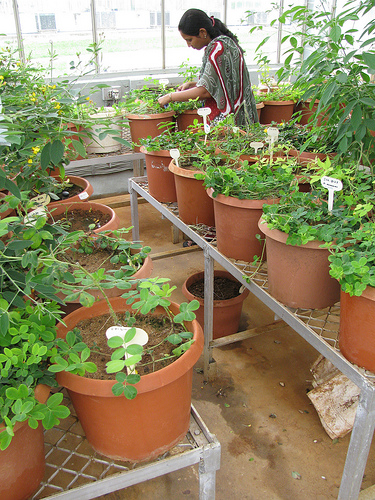 The deadline for submission of abstracts for the international conference on “Enhanced Genepool Utilization — Capturing wild relative and landrace diversity for crop improvement”, to be held at NIAB Innovation Farm, Cambridge, United Kingdom from 16-20 June 2014, is closing on the 29 January.
So what are you waiting for?
Nibbles: Bovine flatulence, New bananas, Cyperus, Pepper history, Ancient rice, Indian Act, Indians act, CIFOR achievements, Pooch podcast, Milk, Buzz, Commons, Sorghum sociology, Water spinach meme, AGRF
- The taxonomy of cow farts. Can’t improve on that title.
- What the hell is Hawaiian Plantain, and why is it needed in Panama?
- Ever eat a sedge?
- Bet they could do with some pepper.
- Ancient Japanese rice found. Let the DNA extraction begin.
- Indian farmers can now claim royalties on traditional varieties. What could possibly go wrong?
- How about paying them to preserve “traditional and fast disappearing millets“?
- Video on CIFOR’s greatest successes. I think the greatest failures would be more instructive.
- Self-consciously cool (but don’t let put you off) podcast on the domestication of the dog.
- The evolution of human lactose persistence, however, is not all about calcium.
- Today’s theory about honeybee deaths is sure to be discussed at today’s honeybee health summit.
- Can participatory mapping save the commons? Probably not, but fun nevertheless.
- Fun? How about the successful defence of a thesis on “The social structure of cultivated plants: the influence of exchanges, representations and practices on sorghum diversity in Mount Kenya’s people”.
- Keep calm and eat kangkung. Don’t you love it when one meme eats another?
- Say you want an African Green Revolution Forum … Well, you know, go to Maputo.
Joining up the dots
Four blog posts from the CGIAR today. Related, as you’ll see, but not connected. Leaving us to join up the dots. Because that’s what we do. You’re welcome, CGIAR.
- From ICRAF, to kick things off, a piece summarizing the editorial accompanying the special edition of the journal Current Opinion in Environmental Sustainability. The message is that the interaction between people and trees, in forests or agroforestry, is complicated and its study requires systemic approaches.
- Funnily enough, over at CIFOR there’s an example of just such a study, looking at the relationship between forest cover and children’s nutrition. Which encountered just the sort of problem alluded to above: “We were unable to figure out from our data whether people living near forests are collecting more nutritious foods from the forest, if they are cultivating them on farms and in agro-forests, or a combination.” Awkward.
- And so we come to the Landscapes for People, Food and Nature Initiative’s post on the use of mapping to look at ecosystem services. Including presumably the sort of ecosystem services the previous two pieces looked at.
- Funny though how it doesn’t mention CIAT’s work on using GIS to look at the level of forest protection actually enjoyed by Colombian forests in that country’s protected are system.
LATER: Ok, ok, the third one is not really from the CGIAR. Read the comment for more.
Brainfood: Tanzanian maize, ITK, Genebank value, Congolese bananas, Amaranth domestication, Ethiopian coffees, Dacryodes diversity, Apple diversity, Breeding pulses, Commons, Beet genetic structure, Restoring landscapes, Indian agrobiodiversity
- Modern maize varieties going local in the semi-arid zone in Tanzania. OPVs from the 80s are creolizing still, and that’s a good thing.
- Traditional Knowledge Systems, International Law and National Challenges: Marginalization or Emancipation? Well, it looks like it’s the former, but should be the latter. ‘Twas ever thus.
- Valuing insurance services emerging from a gene bank: The case of the Greek Gene Bank. Benefits are greater than costs. Phew.
- Banana genotype composition along the Uganda-Democratic Republic of Congo border: a gene pool mix for plantain and highland bananas. You can still find new stuff. And get funding to look for it, clearly.
- Relationships between the Weedy Amaranthus hybridus (Amaranthaceae) and the Grain Amaranths. Multiple domestications? And why not.
- Genetic Diversity Analysis of Some Ethiopian Specialty Coffee (Coffea arabica L.) Germplasm Accessions Based on Morphological Traits. As ever, useful variation was found. We await its arrival in our morning cup.
- Genetic diversity of Dacryodes buettneri (Engl.) H.J. Lam (Burseraceae), a timber tree in Central Africa. There is some. It could be important, yada yada.
- Malus sieversii: A Diverse Central Asian Apple Species in the USDA-ARS National Plant Germplasm System. The infra-specific taxa may not hold up.
- Exploiting Genomic Resources for Efficient Conservation and Use of Chickpea, Groundnut, and Pigeonpea Collections for Crop Improvement. It’s so close, these guys can taste it. When will we?
- Is genetic information a commons? Maybe it should be.
- Genetic structure and gene flow in Beta vulgaris subspecies maritima along the Atlantic coast of France. The latitudinal cline that wasn’t.
- Restoration of degraded agricultural terraces: Rebuilding landscape structure and process. Restoration is not enough, you need continuous management thereafter. Probably applies to the agricultural biodiversity too, when you think about it.
- Agro-biodiversity in rice–wheat-based agroecosystems of eastern Uttar Pradesh, India: implications for conservation and sustainable management. Resource-poor farmers are better at agrobiodiversity conservation than rich ones. ‘Twas ever thus.