- Evaluation of Genetic Diversity of Sichuan Common Wheat Landraces in China by SSR Markers. “Our results suggested that Sichuan common wheat landraces is a useful genetic resource for genetic research and wheat improvement.” When is anything not?
- Identification and evaluation of sorghum (Sorghum bicolor (l.) moench) germplasm from Eastern Kenya. “These untapped resources could be useful in crop improvement programmes and in food security.” See what I mean?
- Genetic assessment of maize landraces from former Yugoslavia. No, wait, don’t tell me… “The results revealed a significant genetic heterogeneity indicating that the analyzed landraces could be valuable sources of genetic variability.” There you go.
- The Role of Home Gardens in Household Food Security in Eastern Cape: A Case Study of Three Villages in Nkonkobe Municipality. People who keep home gardens eat and sell the stuff they grow in their home gardens. And yet they need to be empowered. Oh, and naturally “[f]indings of this study will be useful to governmental and non-governmental bodies involved in promoting food security in the rural households.”
- A modelling study of the role of marine protected areas in metapopulation genetic connectivity in Delaware Bay oysters. Gotta site your seed populations for restoration with care.
- Conservation Genetic Resources for Effective Species Survival (ConGRESS): Bridging the divide between conservation research and practice. An online tool for making decisions about conservation, including based on genetic data, such as the kind above. May even be applicable to agricultural biodiversity.
- A prioritized crop wild relative inventory to help underpin global food security. Well here’s one decision making tool that certainly is applicable to agrobiodiversity.
- The impact of agricultural practices on soil biota: A regional study. It’s not good.
- Sustainable agriculture: possible trajectories from mutualistic symbiosis and plant neodomestication. Gotta make use of those arbuscular mycorrhiza. Wonder if these guys have read the paper above though.
- Rethinking Land Grab Ontology. “Responsible investments in land acquisition” or “responsibly destroying the world’s peasantry”? Not sure why nobody looks at the agricultural biodiversity implications of all this.
- Extension of energy crops on surplus agricultural lands: A potentially viable option in developing countries while fossil fuel reserves are diminishing. Something to do on all that surplus land being sold off?
Addis Ababa airport agrobiodiversity
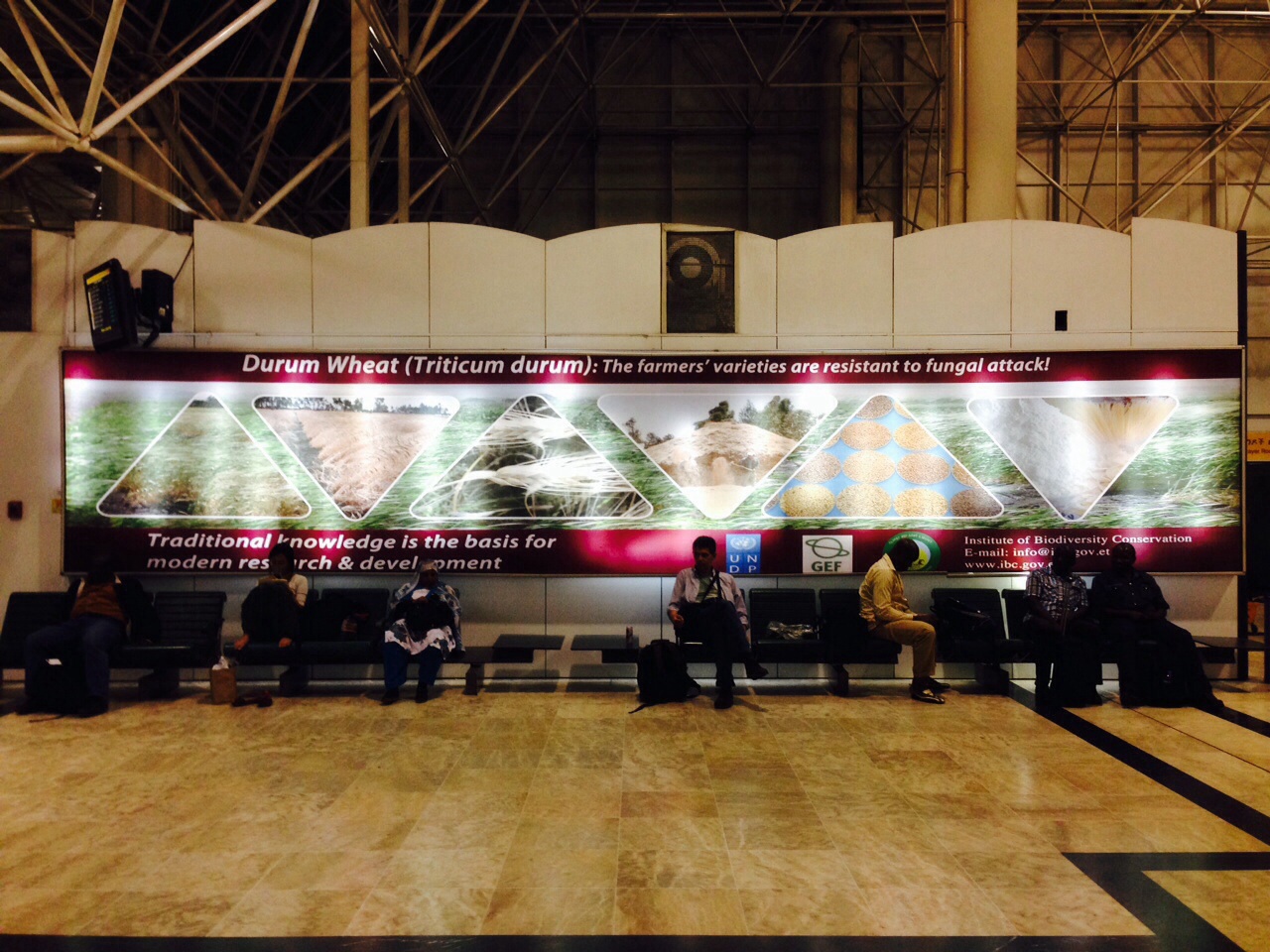
‘Nuff said.
Brainfood: Buckwheat crossing, Cedar restoration, Sustainable tapping, Indian goats, Indian horses, Kenyan yams, Lithuanian cranberry, Appalachian ethnobotany, AVRDC peppers, Chicken breeds
- Progress and prospects for interspecific hybridization in buckwheat and the genus Fagopyrum. Not easy.
- Mechanisms for the successful biological restoration of the threatened African pencilcedar (Juniperus procera Hochst. ex. Endl., Cupressaceae) in a degraded landscape. Needs help from local Acacia. Isn’t diversity wonderful?
- Tapping latex and alleles? The impacts of latex and bark harvesting on the genetic diversity of Himatanthus drasticus (Apocynaceae). Tapping latex leads to loss of genetic diversity, but they have a plan for sustainable harvesting.
- Analysis of genetic diversity in berari goat population of Maharashtra state. “Berari is not a recognized breed but a well established local population of goat which is yet to be fully explored for its phenotypic and genetic aspects.” So what would it take to recognize it? This paper?
- Molecular phylogeny of Indian horse breeds with special reference to Manipuri pony based on mitochondrial D-loop. It’s the most different of the 5 breeds of the sub-continent (yes, apparently only 5), and the most similar to the Thoroughbred.
- Estimation of genetic diversity of the Kenyan yam (Dioscorea spp.) using microsatellite markers. Most variation within provinces. And?
- Morphological and genetic diversity of European cranberry (Vaccinium oxycoccos L., Ericaceae) clones in Lithuanian reserves. Enough morphological variation to think about domestication; enough molecular marker variation to think about writing another paper.
- Down deep in the holler: chasing seeds and stories in southern Appalachia. It’s all about the friendships.
- Pepper (Capsicum spp.) Germplasm Dissemination by AVRDC – The World Vegetable Center: an Overview and Introspection. Here come the numbers: 8,165 accessions of Capsicum conserved, 11% of global total; 6,008 genebank accessions (20%) and 23,972 improved advanced lines (80%) distributed in 25 years; 51 open pollinated and hybrid cultivars of hot and sweet peppers commercialized by public and private sectors in South Asia, West Africa, Central Asia and the Caucasus since 2005.
- Genetic characterization of local Italian breeds of chickens undergoing in situ conservation. Breeds are breeds.
Nibbles: Apples, Aussie genebank, Ugandan coffee song, Biodiversity hotspots, CWR inventory, Ancient Amazon, Chestnut recovery, Mainstreaming nutrition
- Yet another blog post about heirloom apples. Why not heirloom, I don’t know, grains?
- Yet another genebank opens.
- On the other hand, can never have too many agrobiodiversity songs.
- Banks? someone mention banks? Biodiversity hotspots are like (some) banks. Too big to fail.
- Even crop wild relative hotspots?
- 1491: Amazon.
- 1493: New England. Hope Charles Mann won’t mind me borrowing his tropes.
- Interesting use of technology to deliver interesting presentation on mainstreaming of nutrition in agricultural development. Anyone know how it was done?
Nibbles: ITK book, Golden Rice, Indian census, School meals, Camels, Fermentation, CC comms, Eel aquaculture
- The Guide for the Perplexed Entering the Maze of Genetic Resources, Traditional Knowledge and Folklore. Great title.
- IRRI DG blogs about Golden Rice on World Sight Day. In other news, there’s a World Sight Day.
- Indian farmers ever more marginal.
- If they were in Africa, they’d be producing nutritious school meals.
- Book on camel biodiversity.
- Turns out Jeremy is part of a movement that he apparently didn’t even know existed.
- Are you involved in the UNFCCC agriculture negotiations? You’ll need this handy communications tool-kit. Agricultural biodiversity is in there somewhere.
- Not sure that eels are, but maybe they should be.