- UAE date palms to get FAO recognition. So they’ll be ok then. Phew!
- Unlike African agriculture, according to the IPCC.
- Or Israel’s wild plants. Though what they intend to do about that is hidden behind a paywall. Can anyone tell me the answer?
- The Australians know what to do. Build a new genebank…
- …and grown ginarmous brassicas.
- Pat Heslop-Harrison for his part thinks we should collect more wild Panicum. And who are we to argue with him?
- Hey, worst comes to worst, we can always build our own beer yeast.
Nibbles: Fiji lab, World Economic Plants, USDA garlic, Breeding conference, Borlaug Summit, Alex Morrell, Hayden Flour
- Fiji commissions tissue culture lab to get clean planting materials out to farmers.
- World Economic Plants: A Standard Reference finally out. But farmers probably knew all about them already.
- Speaking of USDA, here’s what they do to conserve garlic.
- Big conference in the UK on Breeding Plants for the Future. Seems like there’s one of these every week these days.
- Like at CIMMYT, for example, in remembrance of Dr Norman Borlaug.
- “Our germplasm – our genetic base here – is the best in the world. We dominate genetics in the industry.” I’d like to meet a seed industry guy who didn’t say that.
- Meanwhile, in Arizona: “We’re not trying to go back in time, but capturing an authentic time.” I’d like to meet this guy. And put him together with the guy above.
Quinoa misconceptions unmasked
Sure, the International Year of Quinoa is done, and our last substantial post on that iconic Andean pseudocereal was six months back, but the controversy over the environmental and socioeconomic impacts of its increased cultivation rumbles on, albeit at an intensity markedly less feverish than formerly. The latest salvo is a piece by Charlotte Ambrozek and Martin Zorrilla of the Department of International Agriculture and Rural Development, Cornell University, in collaboration with Bioversity International. Apparently the full article and references are available on request from Bioversity International’s economist, Dr Adam Drucker. We take the liberty of reproducing the article here (and adding a few links) because the only online version we can be sure to find, once it disappears from the page presenting whatever happens to be the latest issue of the SAVE Newsletter, will be a rather clunky PDF. We hope nobody is offended by any of that. We just want the piece to be as easily accessed as possible by as many readers as possible.
Agricultural biodiversity is a strategic asset, particularly for rural people. Agricultural biodiversity has a role in increasing agricultural sustainability, maintaining resilience at the landscape level, facilitating the ability of communities to adapt to a changing climate, improving their diets and nutritional outcomes, and increasing their food security. Diverse traditional crop species can have higher nutritional values than some major crops, as well as having multiple uses for the household. Considering that in 2010-2012 there were 870 million people who went hungry, 840 million who were obese and 2 billion who suffered from at least one micronutrient deficiency, as many tools as possible to tackle this triple malnutrition challenge of hunger, obesity and nutrient deficiencies are needed.
Agrobiodiversity conservation represents a strategic opportunity to address the malnutrition challenge. Bioversity International’s Payments for Agrobiodiversity Conservation Services scheme on quinoa in the Andes is an example of one such mechanism to conserve agricultural biodiversity and improve food security outcomes.
The scheme focused on quinoa as a case study example as increasing demand for a few varieties of the Andean staple is leading to the displacement of many other varieties and the loss of crop diversity. Its high nutritional status as a “superfood” even led NASA to decree it ideal for missions in space. Quinoa is now so popular that the United Nations named 2013 the International Year of Quinoa. Yet some impacts of quinoa’s popularity have become controversial in the popular press. A recent maelstrom of press articles on the The Quinoa Controversy was ignited by a provocative piece in The Guardian entitled “Can Vegans Stomach the Unpalatable Truth About Quinoa”.
The articles essentially argue that increased production of quinoa in Bolivia and Peru, the ancestral homeland of this Andean grain, has had negative social and environmental impacts on small farmers. This conclusion is based on alleged Bolivian government reports that showed that domestic quinoa consumption has decreased in recent years. Most authors attributed this drop to the price of quinoa, which has tripled in the past six years. Similarly, increased production and mechanization has been linked to ecosystem degradation and social conflict, particularly related to land access.
The “quinoa quandary” story was soon being carried by a dozen or so major news sites, and countless independent bloggers. We examined 42 such stories written between 2011-2013 in order to understand how the Western world interpreted this complex issue involving malnutrition, commodity markets, land degradation, and globalization.
Not only has the decreased-domestic-quinoa-consumption claim by the New York Times in 2011, been contradicted by later data suggesting that domestic consumption over the past four years has in fact tripled, but further misconceptions exist. The most common is that high price of quinoa was responsible for malnutrition and poverty in the Andes. High prices of quinoa increased incomes for farmers, and actually inspired a generation of rural poor who had moved to the city to return to farming. Less sensationalist press stories revealed that while malnutrition was occurring among some families, it was more likely due to cultural reasons. Quinoa in the Andes has traditionally been a poor person’s food; as farmer incomes increased so did their tendency to replace quinoa with more western processed foods.
Another element missing from almost every press report was the opinion of Bolivian and Peruvian journalists and academics. Interestingly, our survey of Andean press sources found a very different take on the controversy. One thing became particularly clear: Bolivians and Peruvians are not begging Americans to stop eating quinoa. Many do not see high quinoa prices as a serious threat, given the economic benefits to farmers and the country as a whole. Rather Andean critics were often incredulous, with some expressing suspicion at the attention that the issue has received in the United States. One Bolivian news source suggested some US sources were calling for increased North American quinoa production merely in order to stimulate United States domestic quinoa production for their own market. Of the Bolivian news sources that have called attention to high rates of malnutrition among farmers, many point out that domestic quinoa consumption was historically low, prior to its rise in popularity in the West (in part as a result of practices during the colonial period).
However, the most striking difference between Andean and Western perspectives on the controversy lies in the proposed solutions. American journalists and bloggers almost universally emphasize consumer choice and how it should change, distilling the complex problem to a binary choice: eat quinoa or don’t eat quinoa. Andean sources instead recommend solutions to be achieved through policy changes and collective action. Articles often call for the government to prioritize domestic consumption, attempt to popularize quinoa consumption and subsidize its consumption in school lunch programs. To many Bolivians and Peruvians, increased quinoa demand is unquestionably a positive outcome, while negative side-effects are the result of poor agricultural policy and a lack of market regulation.
Whether in Bolivia or the United States, the increased price and production of quinoa has generated a strong reaction. The bubbling controversy reveals much in terms of how we view our food system and the global economy. It tells us that we, as Westerners, understand remarkably little about how our choices as consumers actually affect producers in other countries. It plays into a Global North vs. Global South view on those choices, and how people see avenues for change. Yet ultimately it tells us that people care, they care about the food they eat, and they care about the people who don’t get enough food to eat. The real question is how to turn that concern into increased food security for developing country farmers based on sustainable agricultural practices.
More on TePuke rice in New Zealand
Attentive readers may remember a post from some years back about the return of TePuke rice from IRRI’s genebank to New Zealand. Via our friends at IRRI, here’s photographic proof from Tony Olsen, a local farmer, that he actually planted that variety at what would be a world record southern latitude for the crop (even further S than Rocha, in Uruguay)…
![5 Planting Rice 012[7]](https://agro.biodiver.se/wp-content/uploads/2014/03/5-Planting-Rice-0127.jpg)
…and that it actually grew, despite a not very sunny summer.
![7 Maturing[22]](https://agro.biodiver.se/wp-content/uploads/2014/03/7-Maturing22.jpg)
We wait to see whether there’s a decent harvest.
Incidentally, although IRRI was able to send Tony some seeds of TePuke, he says that:
A friend of mine helped me track down some TePuke Gold Rice seeds from the widow of the gentleman who supplied them to the NZ authorities that forwarded them to your institute in the 1970’s.
Which just goes to confirm that people really like holding on to their seeds.
Anyway, what with dire predictions about what will happen to rice yields in its Asian heartland, it might well be that places like New Zealand and Uruguay, now on the edge of the crop’s range, are going to feature much more prominently in the future. Maybe even parts of Japan, which has a young breed of farmers coming through who I’m sure are just itching to take on such upstarts.
Wild peanuts hotspot visited
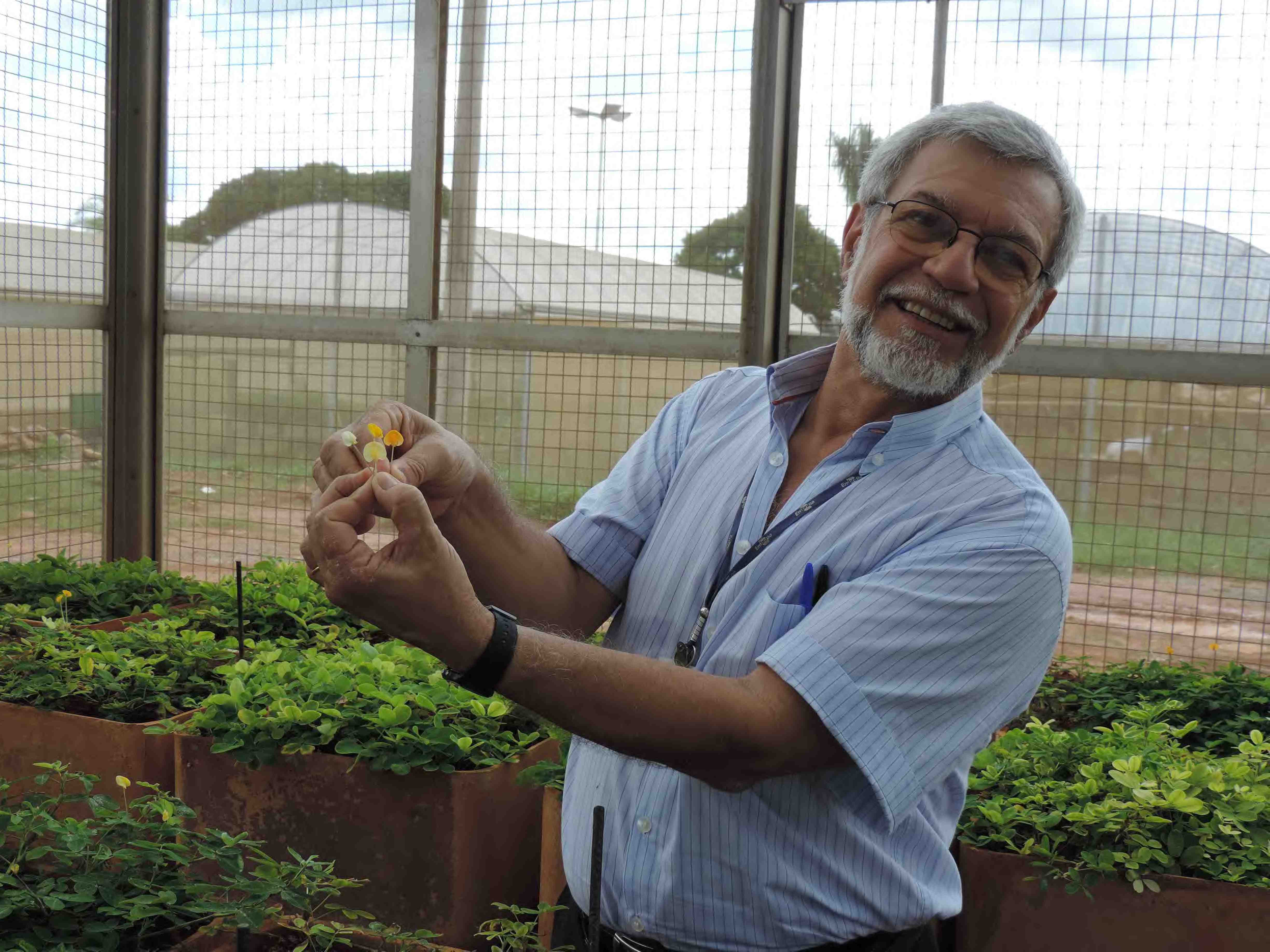 The light blogging during the past couple of weeks has been due to me travelling and Jeremy being submerged in work. We’re trying to get back into it, but things are still going to be a bit slow as we catch up. Just to tide you over for a while, though, here’s a quick taste of where I went. The guy on the right is Dr José Valls of Cenargen, which is part of Embrapa and houses the national plant genetic resources collection of Brazil. He’s showing us (that would be myself and Nora Castañeda of CIAT, who took the photo, which you can see better by clicking on it) the entire range of colour diversity in wild peanut flowers. He should know about that, because he is widely recognized as one of the world’s foremost authorities on these plants, and manages one of the world’s most important collections of Arachis diversity. And here’s a quick view of only part of it, in which you can probably see about 50 (out of a total of maybe 80) different wild relatives of the peanut.
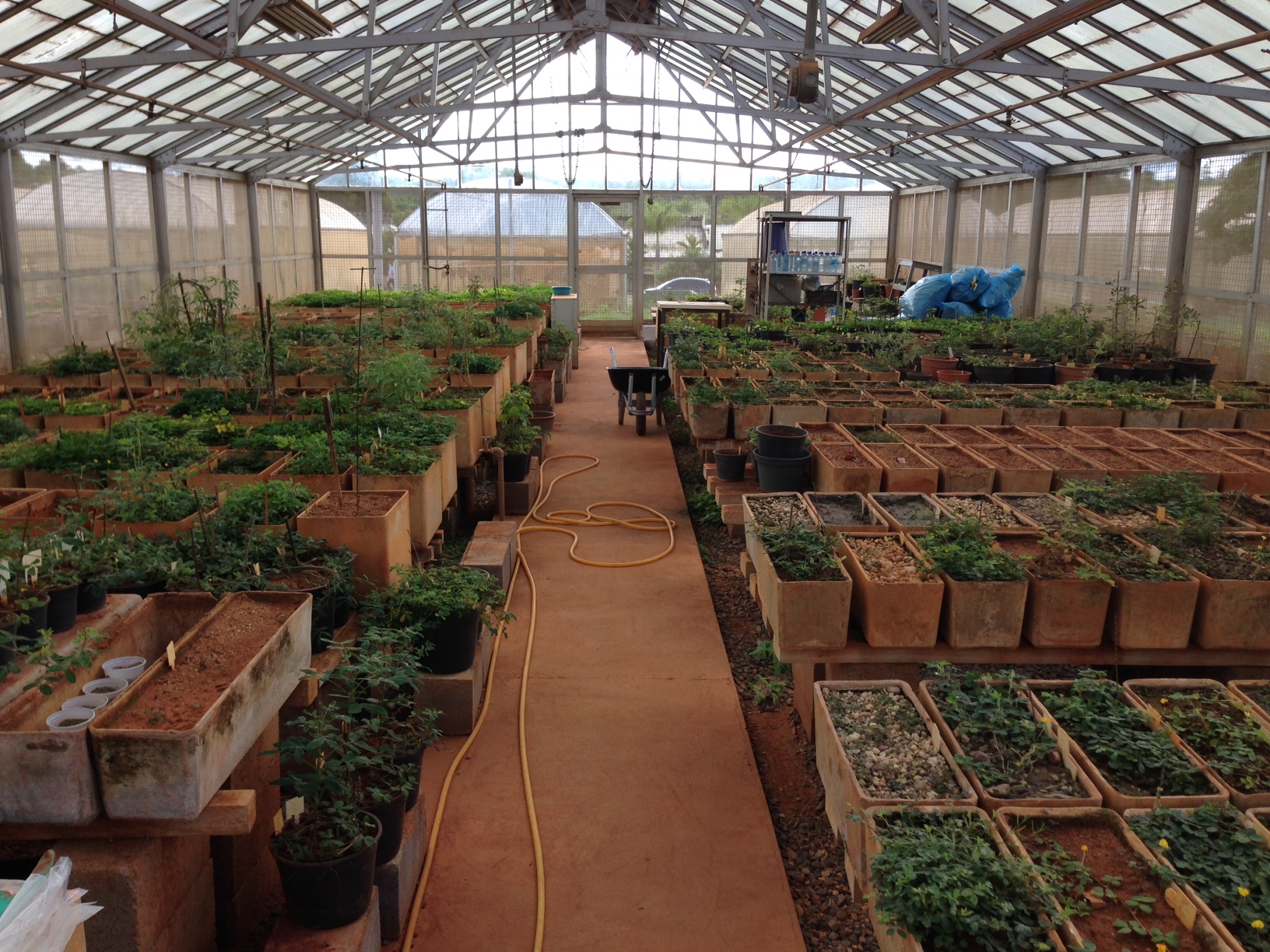
It is efforts such as those of José and a small band of like-minded peanut taxonomists, geneticists and breeders around the world that have led to the success of the peanut from the American South to East Timor, by way of Africa.
Incidentally, though I call, rather facetiously, José greenhouse a hotspot of agrobiodiversity in my title here, he pointed out to me that he thinks the centroid of wild Arachis species diversity is probably within walking distance of his desk in Brasilia. I think we have the data to test that…