- Some fabulous photos of maize diversity from CIMMYT. (IRRI says, I see your diverse maize, and raise you diverse rice.)
- Hope neither goes the way of that of some Andean roots and tubers in Bolivia. Or fruits in Central Asia. Though neither is doing terribly, in truth.
- And too bad you can’t monitor that the way you can forests. Or land use in general for that matter.
- World Agroforestry Centre calls for more, er, agroforestry. Will Defra listen?
- Maybe it’s too busy consulting on the Nagoya Protocol. Wonder how good that will be for agroforestry.
- I don’t care what anyone says, I like microwaves.
- Wait, we missed Hug a Taxonomist Day?
- And Persian New Year?
- De Schutter’s final report. Main message not lost on the Pacific island countries.
Brainfood: Carpathian landuse, Yield & biodiversity, Cajanus @ICRISAT, Wheat meddling, Grape acne, Safflower diversity, Mangosteen origins, Agroforestry and SDGs, Brazilian Gir
- Forest and agricultural land change in the Carpathian region—A meta-analysis of long-term patterns and drivers of change. Collapse of socialism bad for agriculture, good for forests. At the level of cover anyway, who knows what’s happened to diversity.
- Closing yield gaps: perils and possibilities for biodiversity conservation. Better yields potentially good for birds, but everyone needs to work together.
- The Wild Genepool of Pigeonpea at ICRISAT Genebank-Status and Distribution. There are still some gaps.
- Meddling Wheat Germplasm to Augment Grain Protein Content and Grain Yield. I just love that title.
- Interkingdom transfer of the acne causing agent, Propionibacterium acnes, from human to grapevine. First time ever, apparently, that a human pathogen attacks a crop. But do I have to start worrying about wine?
- Discrimination and genetic diversity of cultivated and wild safflowers (Carthamus spp.) using EST-microsatellites markers. C. palestinus is the closest.
- New evidence on the origin of mangosteen (Garcinia mangostana L.) based on morphology and ITS sequence. Not an interspecific hybrid after all.
- Knowledge gaps and research needs concerning agroforestry’s contribution to Sustainable Development Goals in Africa. Can agroforestry concepts and practices form an effective, efficient and fair pathway towards the achievement of many Sustainable Development Goals? Yes, but only if governance of food production is multi-sectoral and system-based.
- History, structure, and genetic diversity of Brazilian Gir cattle. Diversity is not as restricted as might be feared, so it can probably take a breeding programme with high selection intensity.
Nibbles: Genebanks trifecta, Marley Coffee, Sorghum noodles, Biofortification Q&A, African oils, Cow diversity, Coffee course, Fructose deconstructed, Vanuatu chocolate, Candy bar phylogenies, Japanese copycats, Charger beer
- CIP’s genebank in the limelight.
- Egypt’s genebank in the limelight.
- Australia’s genebank in the limelight. Limelight fast running out…
- Ah, but genebanks not the only ones with cool videos: farmers in the limelight.
- Yeah, it’s not just about the genebanks. Markets can help, I suppose. Especially if you have a famous name.
- As with coffee, so with sorghum. Biofortified or not. All we need now is an agribusiness incubator, and here it is, courtesy of ICRISAT. But what will Japanese farmers think?
- Same again for assorted African oils?
- The diversity of cows has been driven by markets too.
- Coffee 101 at UCDavis. Maybe they’ll invite Mr Marley to teach.
- You want fructose in that coffee? No, probably not.
- Maybe you prefer chocolate. From Vanuatu, natch. Looks like high quality stuff too, but even crap chocolate has its uses, like teaching taxonomy for instance.
- No, you’re more a Japanese bourbon person, aren’t you? Wait, do you need barley for that? I’m sure those young Japanese farmers will be all over this.
Globalized diets paper globalizes
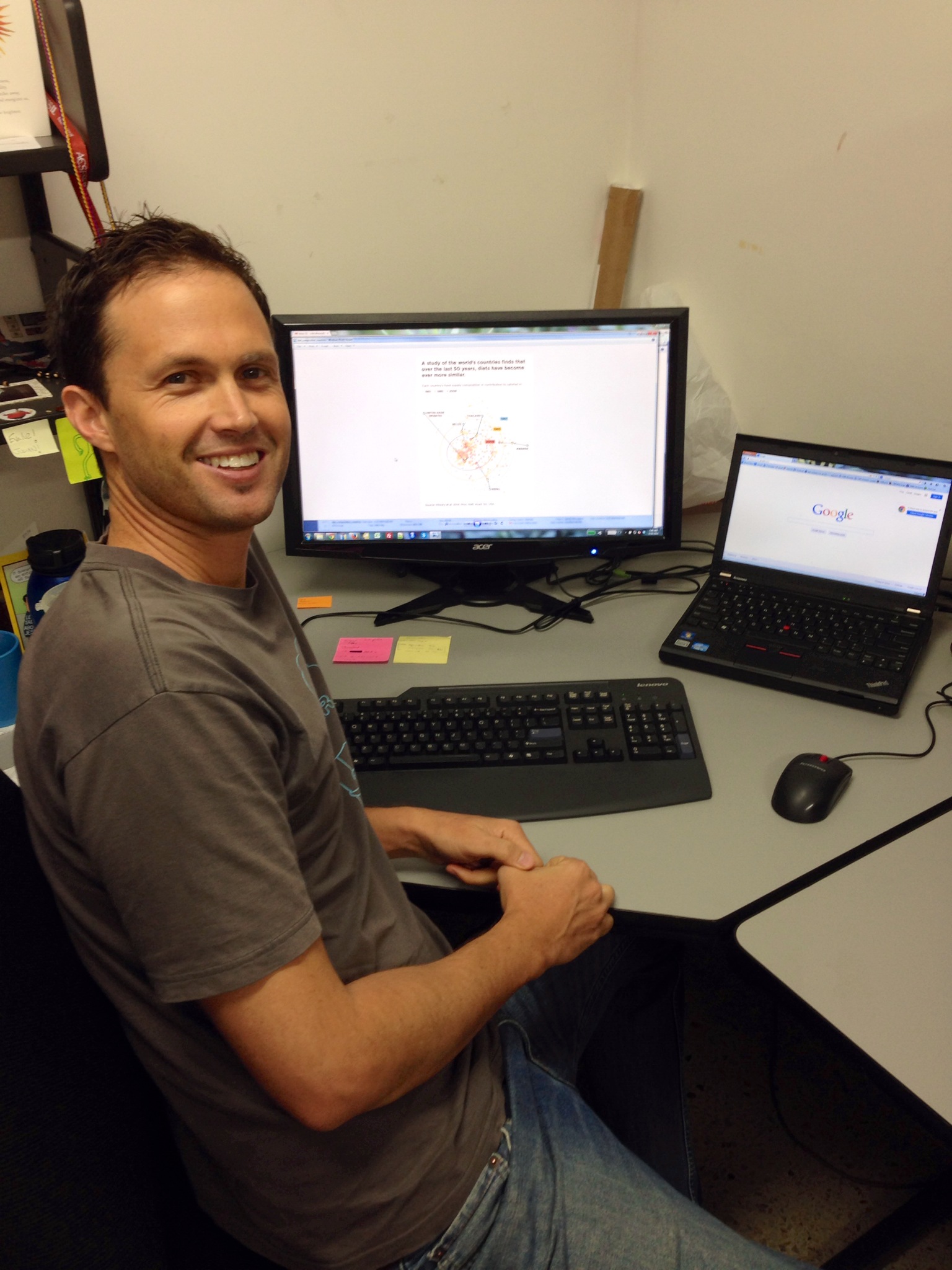 You may, unless of course you’ve been visiting Mars, have come across in the past couple of weeks coverage of Colin Khoury’s (along with co-authors) paper on “Increasing homogeneity in global food supplies and the implications for food security.” That’s Colin to the left in his office at CIAT, when I visited him last week. The paper has really caught the imagination of the media, and is now one of PNAS’s most attention-grabbing articles ever, in the top 5% of all articles in fact. One of the better write-ups was in NPR, but there’s lots, lots more, in multiple languages. Including a brief mention by World Bank VP Rachel Kyte and CGIAR Fund Council Chair at a Wageningen University event. But where did the idea for the study come from? Well, we are not prone to boasting here at the Agricultural Biodiversity Weblog, but please forgive us on this occasion if we point out that it is a post by Colin in these very pages about four years ago that marks the beginning of his journey to superstardom. From little acorns…
And let us not forget that we can do something about these trends.
Nibbles: Peanut history, Capsicum history, Sequencing history, Globalized rice, Sustainable salmon, Women & agriculture, Climate change & yields, Forest conservation, Bumblebee conservation
- Lots to catch up on, strap yourselves in.
- The South’s original peanut is the Carolina African runner, and it is in need of help.
- Saudi Aramco World does its usual class number, this time on chili peppers. And, in a similar vein, more than you probably want to know about Tabasco sauce.
- The evolution of DNA sequencing. In 76 slides, no less, but worth it.
- Japanese rice grown in Uruguay for U.S. hipsters. Gotta love globalization.
- Sustainable salmon at long last?
- Mind the gender gap.
- Latest modelling suggests 2% crop yield decline per decade, assuming modest 2 degree C rise in temperatures by 2050. The original paper. We are so screwed. (Well, Uruguayan rice growers and U.S. hipsters aren’t, not so much.) No, really. No, wait…
- You know, if we need supercomputers to tell us that forest corridors are good for seed dispersal, it’s no wonder we can’t stop global warming. Just kidding, I think it’s great that supercomputers get a break from climate models every once in a while. Oh, and isolated trees not entirely useless either.
- Native wild bumblebees also in trouble, not just honeybees.
- So did you miss us? Even more tomorrow to clear the decks.