- I need a drink.
- Or maybe some Viking ganja.
- I know I don’t need a VegiBee. But maybe you do.
- I guess we all need to write to the EU about the new seed law.
- Nobody needs another discussion of whether cloning is good or bad.
Drone targets Millennium Seed Bank
eBee results – and the best shot of the seed bank. pic.twitter.com/WG94HOgX3f
— KewGIS (@KewGIS) April 26, 2013
Pacific taro debuts in West Africa
Readers with a long memory and a thing for root crops may remember our various posts over the past couple of years about an outbreak of Taro Leaf Blight in West Africa, and the promise that resistant varieties from the Pacific may hold for combating the epidemic. Well, our friends at the International Network of Edible Aroids are doing something about it. They’ve just published photos of TLB-resistant varieties from the genebank of the Secretariat of the Pacific Community in Fiji being evaluated in Cameroon. Fingers crossed. And I’m sure collections of the local varieties are being made. Aren’t they?
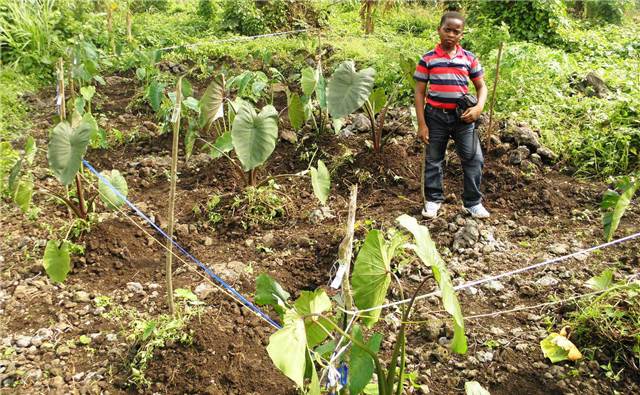
(Photo by Leke Walter Nkeabeng, Molecular Plant Virus Epidemiologist,
National Scientific Coordinator of Annual Crops, Yaounde, Cameroon,
reproduced by courtesy of the International Network of Edible Aroids)
Nibbles: African food, Cattle grazing, Young farmers, Seed policy, Traditional medicine, Litchis, Land use, Perennial sorghum
- Today’s Nibbles is a Kenya edition. Just because.
- But we’ll start with an African foodie revolution that is passing that country by.
- Cattle need diverse foods too, so don’t neglect those forbs, Kenyans.
- A young Kenyan turns to vegetable growing. Not, alas, of the traditional kind. Yet.
- Well, he better get a move on, because it says here people are after his seeds.
- Seeds are what the traditional medicine industry could do with.
- I guess there’s always litchis.
- Wonder what they’ll do to land use patterns.
- But will there ever be perennial sorghum?
The history of national flower collections in the UK
A Facebook post by Plant Heritage earlier today pointed me to a news item on their website to the effect that collections of Monarda and Nepeta have been added to its nation-wide programme of National Plant Collections.
The Collections based near Okehampton, Devon, have been put together by Fi Reddaway in her two acre garden on the edge of Dartmoor. She has used the development of the Collections to help her rehabilitate from ME diagnosed in 2004.
Good news in its own right, for various different reasons. But it also reminded me, coming so hot on the heels of yesterday’s post about UK genebanks, of an intriguingly similar reference I’d run across a few weeks ago on the website of the Cambridge University Botanic Garden:
Our National Collection of Tulipa (species only) is believed to be the only surviving collection in the country recognised under the Ministry of Agriculture’s special collection scheme that was introduced after the Second World War. The origins of the collection, however, go back much further and lie in a tragedy. William Dykes, master of Charterhouse School, keen amateur gardener and botanist, and Secretary of the Royal Horticultural Society (RHS), was a passionate collector of two bulbous genera, Tulipa and Iris. Sadly, in November 1925, only a week after receiving the Victoria Medal of Honour from the RHS, Dykes was killed in a motoring accident.
A sad story indeed, but what is this “Ministry of Agriculture … special collection scheme that was introduced after the Second World War”? I tweeted the reference to Prof. Brian Ford-Lloyd, who might be expected to know about plant genetic resources matters in the UK, and he had not heard of any such scheme, but pointed me in the general direction of the National Archives website.
Bingo! Or at least maybe. Because a little searching soon resulted in a reference to the document “National Species Collections of Flowers: grant to Royal Botanic Gardens, Kew“, dated 1948-1957. Now, I don’t have access to the document in question, so I’m not sure if this “National Species Collections of Flowers” thing is the same as the CU Botanic Garden’s “Ministry of Agriculture … special collection scheme” or indeed Plant Heritage’s “National Plant Collections” programme. Maybe someone out there can clarify the matter. And maybe even tell us if that tulip collection is indeed the last of its ilk.
In the meantime, I choose to marvel at the fact that in a post-war Britain beleaguered by rationing and grappling with all sorts of social problems, the Ministry of Agriculture supported the setting up of a National Species Collections of Flowers.