- 5th Global Botanic Gardens Congress coming up in Dunedin, New Zealand. Isn’t that somewhere near the Shire? And one garden’s engagement with agricultural biodiversity.
- “It’s 2050, and Australia’s bounteous wheat harvest has been saved.” You see, as a total amateur at this lark, I’d have started with that.
- Loren Rieseberg, interviewed.
- HarvestChoice using fancy remote sensing imagery to improve crop calendars, give themselves excuse to quote Byrds classic.
- European rye collection a little closer to reality.
- WorldVeg turns 40.
- Bellon and Ntandou-Bouzitou explore the tail. Talk about local innovation…
- Old friends talk about crop wild relatives.
Local Samoan banana variety a hit in NZ
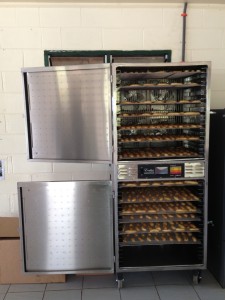 My friend and former colleague Stephen Hazelman of the Secretariat of the Pacific Community (SPC) has been telling me about his new toy, a drier that an NGO in Samoa called Women in Business Development Inc. is using to process a local banana variety for export to New Zealand. You can see it on the left, thanks to Stephen. Drying overcomes the need for quarantine treatments in NZ. They harvest from certified organic farmers, ripen the fruits for 4-7 days, peel, soak in lime juice to stop blackening, then put in the drier for 15-20 hours, cool and pack in nice yellow 50g packages for export. They are also looking at teas, cinnamon, other fruits like pineapple and mangos, and also vegetables.
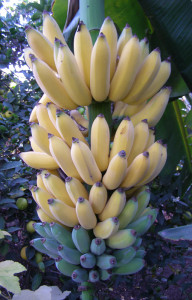 The variety involved is a small, sweet, high-altitude local type called Misi Luki. You can read all about its history and characteristics, and also see some pictures here. 1 It’s listed in ProMusa’s checklist of banana cultivars as an AAB type. If the banana were a neglected or underutilized species (NUS), Stephen could have reported on this under the “upgrading value chains” theme of the recent conference in Accra. But of course what works for weird and wonderful local landraces of the staples could also work for NUS. No news on whether Misi Luki is on any gourmet menus. But that’s another story…
Happy World Chocolate Day!
 The previous post about the International Treaty on ITPGRFA allows me to segue seamlessly to today’s World Cocoa and Chocolate Day event at the University of the West Indies in Trinidad. Seamlessly, I hear you ask? Stretching a point, surely. Well, no, because everyone knows that the International Cocoa Genebank, maintained at said institution’s Cocoa Research Centre, is one of the collections which are available in the Multilateral System of the Treaty under its Article 15. You can tour the place, you know. Anyway, I’m hoping one of my inside people will come through with some photos of the celebrations. Stay tuned.
Nibbles: Access to Seeds, Bunch of meetings, CGIAR on the job, Smartt obit, Soybean mysteries, Apple grafting, FAO food security report
- “The Access to Seeds Index measures the performance of the leading companies in the seed industry independently, which will result in the publication of a ranking every two years.” Will need to keep an eye on this. As no doubt also will the CGIAR…
- …which met in Lisbon to discuss the Generation Challenge Programme and presented on NUS at Tropentag, having moved on from the Science Forum in Bonn, which had a lot on nutrition. No doubt some of them will be in Lillehammer to discuss plant genetic resources and climate change. How do they keep on top of it all?
- And when they are not meeting, they are surveying the use of Gnetum, sampling goats, and making videos about their genebanks among many other worthwhile things…
- Speaking of the IRRI genebank, Mike Jackson’s obituary of his friend Dr Joe Smartt, “geneticist and renowned grain legume expert,” is online at GRACE, but behind a paywall. Fortunately, you can get a condensed version on Mike’s blog.
- Legumes, I hear you say? “Two big mysteries in soybeans have captured my attention.” And I’m sure that sentence captured yours. Corn+Soybean Digest reveals all.
- Time for dessert. I see your 300-variety mango of Malihabad and I raise you a 250-variety apple of Chidham.
- But lest we forget why we’re doing all this meeting and goat-sampling and fruit-grafting, here comes FAO’s latest report on food insecurity.
ITPGRFA GB5: Tying up the loose ends
As promised, here’s a pdf of the IISD report on the fifth session of the Governing Body of the International Treaty on Plant Genetic Resources for Food and Agriculture, which convened from 24-28 September 2013 in Muscat, Oman. And there’s also my storification.
The report echoes the view of Shakeel Bhatti, Secretary of the ITPGRFA, expressed in his closing statement, that the main achievement of the meeting was to agree a system to look into enhancing the working of the Multilater System for Access and Benefit Sharing.
Bhatti says meeting has enhanced functioning of MLS of @planttreaty, historical compromise #itgb5
— AgroBioDiverse (@AgroBioDiverse) September 28, 2013
Here’s the money quote:
Hailed as a major success by all involved in the Treaty processes, the launch of this new intersessional working group provides the opportunity for the Treaty and the agricultural sector as a whole to reposition themselves in the global framework of genetic resource governance with a view to more effectively contributing to global agricultural development and food security. The outcome of this new process will determine whether the Treaty will live up to the challenges and flourish, or whether it will wither away.
LATER: And that global framework just got a bit more complex.