- The latest genomic whiz-bangery.
- CIFOR’s Congo slideshow makes The Guardian. About as far from genomic whiz-bangery as you can get.
- Speaking of which… Very long talk by David Tilman. Almost certainly worth watching in its entirety. Eventually. It all depends on trade-offs. See what I did there?
- Agriculture stops expanding. Is it all that genomic whiz-bangery?
- U. of Delaware gets big Lima bean grant. Yes, Delaware. They got whiz-bangery in Delaware too.
- Meanwhile, Texan cotton breeder gets award. For a certain amount of whiz-bangery.
- Translocation and restoration: cool, but a last resort, whiz-bangery says.
- Support for the seed sector in S. Sudan. Any landraces? No whiz-bangery in sight.
- And likewise for the yam bean in Africa.
- Wonder whether that’ll be on the agenda at the First Food Security Futures Conference in April. Probably not.
- Nor, probably, will anyone be thinking too hard about agro-ecology; but you could be, with this handy-dandy introduction to holistic management.
- SEAVEG; no, not nori etc, but veg in SE Asia.
- Different animals need different kinds of fodder, ILRI shows how.
- Wishing success to the Indigenous Food and Agriculture Initiative launched at the University of Arkansas today.
Horticulture CRSP response on drying beads
Kent J. Bradford, Peetambar Dahal and Brenda Dawson of Horticulture CRSP have responded at length to the comments made by Robin Probert and Fiona Hay on their factsheet promoting the use of Zeolite as a possible alternative to silica gel to dry seeds. Many thanks to them all for taking the time to engage in this debate. Please read the rebuttal in full, it’s very detailed and will be of great interest to anyone who keeps seed healthy for a living. However, if I were to be forced to pick a couple of quotes as take-home messages, they would be these:
At present, drying beads are probably economical only for high-value vegetable seeds or germplasm repositories, but there are simple ways to utilize drying beads in forced-air drying systems that could be adaptable to larger seed or commodity volumes, such as in combination with large plastic grain bags that are coming into use.
…
We believe that drying beads should be of particular interest for seed banks in developing countries where power outages make continuous operation of refrigeration and dehumidification equipment problematic. We expect that drying beads combined with hermetic containers could largely replace dehumidification of large storage rooms in seed banks. Enclosing a small quantity of beads in foil packet or glass jar with a seed sample would be a great solution for local seed banks that may not have the drying equipment that Robin mentioned.
Which are not altogether dissimilar conclusions to the ones we originally came to, but as I say, read the whole thing and make up your own mind. It would be great to hear from anyone out there that has experience of using these drying beads, whether in a genebank or other context. If you do, or know anyone who does, leave a comment below.
Brainfood: Barley phylogeny, Strawberry smell, C4, European tree sap, Conservation anthropology, Seed systems, Profitability of diversity, Wheat breeding, Rice breeding, Forest conservation, Neolithic transition, Forest ecosystem services, Diversity and area
- Phylogenetic analysis in some Hordeum species (Triticeae; Poaceae) based on two single-copy nuclear genes encoding acetyl-CoA carboxylase. Divides up the Africa/Asia and American clades, but not perfectly.
- Journeys through aroma space: a novel approach towards the selection of aroma-enriched strawberry cultivars in breeding programmes. Breed a better smelling strawberry in this way, and the world will beat a path to your door.
- Strategies for engineering C4 photosynthesis. More than one way to skin a cat. But is it worth doing if you don’t eat cats?
- Uses of tree saps in northern and eastern parts of Europe. Not what it used to be.
- Resequencing rice genomes: an emerging new era of rice genomics. Maybe. But it would have been better if they had sequenced something other than Nipponbare originally.
- Toward conservational anthropology: addressing anthropocentric bias in anthropology. “Traditional practices” not always all that great.
- Seed exchange networks for agrobiodiversity conservation. A review. Farmers have to be “well connected” for conservation to work. But nobody really knows what that means.
- Landscape diversity and the resilience of agricultural returns: a portfolio analysis of land-use patterns and economic returns from lowland agriculture. Higher gross margin related positively to greater variance, negatively to diversity, in lowland UK, up to 12000 ha.
- Marker-assisted development and characterization of a set of Triticum aestivum lines carrying different introgressions from the T. timopheevii genome. Getting resistance out of wild relatives and into crops.
- Physical localization of a novel blue-grained gene derived from Thinopyrum bessarabicum. Getting blue pigments out of a wild relative and into wheat.
- Improvement of two traditional Basmati rice varieties for bacterial blight resistance and plant stature through morphological and marker-assisted selection. Getting blight resistance out of an improved variety to improve traditional ones.
- Maintaining or Abandoning African Rice: Lessons for Understanding Processes of Seed Innovation. Farmers play an important role in adopting and developing new varieties shock.
- Dynamic Conservation of Forest Genetic Resources in 33 European Countries. It happens.
- The impact of the Neolithic agricultural transition in Britain: a comparison of pollen-based land-cover and archaeological 14C date-inferred population change. Pollen and archaeology agree on dates, the rest is history.
- Higher levels of multiple ecosystem services are found in forests with more tree species. Swedish production forests, anyway. And more. And more.
PAGxxi tweetstorm of sorts
PAGxxi, billed as “The Largest Ag-Genomics Meeting in the World” is off and running in San Diego, with its full complement of social media bells and whistles. I’m quite enjoying the Twitter feed. Not the official one, mind you, which is pretty boring, but there’s a half a dozen or so people (so far) who are taking the hashtag very seriously. I hope they keep it up.
https://twitter.com/plgepts/status/290626742916378624
EarthStat has crop stats
Those of you last summer who followed a link in a post of ours on crop distribution mapping to
…the dataset of Monfreda et al. (2008), “Farming the planet: 2. Geographic distribution of crop areas, yields, physiological types, and net primary production in the year 2000″…
will have ended up on a file directory containing a whole bunch of crop-specific zip files, from which you could have eventually extracted the modeled distribution of, say, coffee:
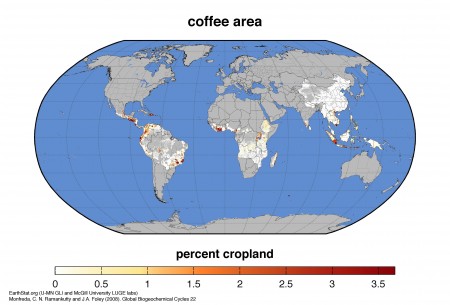
Or whatever. Nice, but all a bit fiddly. Well, now there’s a much nicer way of downloading the data in all kinds of useful forms, including Google Earth files. Though you do have to register.
I wonder if ICARDA used these data, or some others, to do their recent work on the impact of climate change on wheat in Central Asia. Difficult to tell from the blurb.