It will be a challenge and far more than a technical task to translate the book from Neo-Norwegian into English language, but we can hope that this will be done soon so many more readers can be inspired by the cultural dimensions of cereals and their diversity.
Axel Diederichsen’s wish at the end of his review last summer of Prof. Åsmund Bjørnstad’s magisterial Vårt Daglege Brød — Kornets Kulturhistorie has come true. Our Daily Bread — A History of the Cereals is out in English. And many more readers will indeed now be inspired.
Speaking of return on conservation actions, which we sort of were a couple of days back:
A new study has produced the first indicative estimate of the overall economic benefits provided by the Natura 2000 network. It suggests that the value could be currently between €200 and €300 billion per year, or 2% to 3% of the EU’s Gross Domestic Product.
That’s from one item in a special Thematic Issue of the European Commission’s news alert organ Science for Environment Policy which focuses on “Management and Monitoring of the NATURA 2000 Network,” (pdf) a network of protected areas that is described in the editorial introducing the issue as the “cornerstone of EU biodiversity policy.”
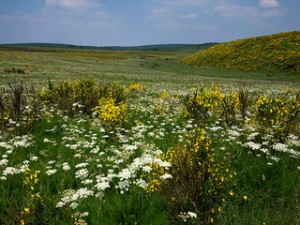
Natura 2000 site at Bärwurzwiese, Belgium. Photo made available under a CC license by Frank Vassen via Flickr.Here’s the table of contents the whet your appetite
What does ‘wilderness’ mean?
First EU-wide economic valuation of Natura 2000 network
Improved local management needed for the Natura 2000 network
Natura 2000 Case Study Hoge Kempen: from coal mining landscape to oasis of biodiversity
Improved communication about Natura 2000 may help resolve landowner conflicts
Ecotourism: protecting the nature of Natura 2000 in Latvia
Natura 2000 Case Study Slitere National Park: sustainable tourism in a Natura 2000 site
Natura 2000 Case Study Eurosite – Adaptive Management of Natura 2000 sites
Protected areas act as stepping stones for nature in the face of climate change
New Belgian approach to favourable conservation status for habitats and species of European interest
Sustaining the Natura 2000 network through LIFE
We’ve talked before about Natura 2000 in the context of conservation of crop wild relatives. I’m willing to bet that return on investment doesn’t take into account any species important in crop improvement that the network happens to be protecting. But if you know better, let us know.
Ultimately, researchers hope to get ancient DNA from well-dated bones. But “replicable DNA has been as rare as hen’s teeth,” Zeder says, thanks to contamination issues and tropical climes that degrade DNA. One team recently claimed to have mtDNA from an ancient Polynesian chicken bone in Chile — a dramatic find that would prove Polynesians reached the Americas before Columbus — but the find has been questioned as possibly contaminated (Science, 11 June 2010, p. 1344). Techniques are improving, however…
That cliff-hanger is a quote from a rather attractive Science spread enticingly entitled “In Search of the Wild Chicken,” reproduced a few days ago in an ILRI blog post. It’s a great story, but one wonders why there was not at least a mention of the recent paper in PLOSOne “Investigating the Global Dispersal of Chickens in Prehistory Using Ancient Mitochondrial DNA Signatures.” Those authors, after all, had 92 — count them!! — archaeological chicken bones to play with, and spun a convincing tale of “multiple prehistoric dispersals from a single Asian centre” from their analysis. Is there something of a rivalry developing in the highly competitive world of chicken DNA? Probably not, and no doubt we’ll be getting lots of cease and desist notices from the denizens of said world for even suggesting such a thing.
Just a very quick note to say that Crop Genetic Resources as a Global Commons: Challenges in International Law is available in Google Books. Edited by Michael Halewood, Isabel Lopez Noriega (both of Bioversity International) and Selim Louafi (formerly of the ITPGRFA), and with dozens of people contributing to 19 chapters ranging over the whole philosophy, history, design and context of the International Treaty, it’s a really important resource.