Chicken salad

Ultimately, researchers hope to get ancient DNA from well-dated bones. But “replicable DNA has been as rare as hen’s teeth,” Zeder says, thanks to contamination issues and tropical climes that degrade DNA. One team recently claimed to have mtDNA from an ancient Polynesian chicken bone in Chile — a dramatic find that would prove Polynesians reached the Americas before Columbus — but the find has been questioned as possibly contaminated (Science, 11 June 2010, p. 1344). Techniques are improving, however…

That cliff-hanger is a quote from a rather attractive Science spread enticingly entitled “In Search of the Wild Chicken,” reproduced a few days ago in an ILRI blog post. It’s a great story, but one wonders why there was not at least a mention of the recent paper in PLOSOne “Investigating the Global Dispersal of Chickens in Prehistory Using Ancient Mitochondrial DNA Signatures.” Those authors, after all, had 92 — count them!! — archaeological chicken bones to play with, and spun a convincing tale of “multiple prehistoric dispersals from a single Asian centre” from their analysis. Is there something of a rivalry developing in the highly competitive world of chicken DNA? Probably not, and no doubt we’ll be getting lots of cease and desist notices from the denizens of said world for even suggesting such a thing.

Crop Genetic Resources as a Global Commons book in the global commons

Just a very quick note to say that Crop Genetic Resources as a Global Commons: Challenges in International Law is available in Google Books. Edited by Michael Halewood, Isabel Lopez Noriega (both of Bioversity International) and Selim Louafi (formerly of the ITPGRFA), and with dozens of people contributing to 19 chapters ranging over the whole philosophy, history, design and context of the International Treaty, it’s a really important resource.

Nibbles: School genetics, Sigrid Heuer, Fungal sex, Rubber, Wine, James Scott, Sustainable diets meet, Food exhibit, EU and climate change

The future beckons

So let me get this right. In addition to Crops for the Future the International Organization and Crops for the Future the Research Centre, there is also Plants for a Future the, what is it, the Database? And, now, Plants for the Future, the European Technology Platform. Though I suspect this last has nothing to do with neglected and underutilized plants, unlike the others. Anyway, that’s all by way of introduction to the forthcoming “Crops for the XXI Century,” the International Seminar. Which is indeed mainly in the future. I mean the XXI century. Well, also the seminar, though not by much. It does sound like fun, not least because lots of old friends are going to be there, so it’s a pity we can’t be there, but hopefully one (or more) of them will tell us how it all went. Once it’s in the past. The seminar, not the XXI century.

The value of ICARDA

ICARDA is deservedly getting much traction with the press at the Doha climate change meeting with the report “Strategies for Combating Climate Change in Drylands Agriculture,” which it has produced in collaboration with the CGIAR Research Program on Climate Change, Agriculture and Food Security (CCAFS). A testament to great research over many years; and an open, active communications policy.

Particularly welcome to see the genebank’s role in climate change adaptation clearly highlighted in the report:

Releases of plant genetic materials from ICARDA’s gene banks, which host wild relatives of barley, wheat and legumes, has led to the development of crops with higher yields and greater resistance to a range of biotic stresses. Some varieties also offer large improvements in bread-making quality, nutritional value and other traits.

The document goes so far as to quantify the return on investment from breeding, which is something that you don’t see as often as you should:

That $850 million figure is not detailed further, but the suggestion is that it is built up from examples such as this, of which there are several more outlined in the report:

A drought tolerant variety of chick pea introduced in Turkey had such strong resistance that it was able to withstand the searing temperatures and rainfall scarcity of the 2007 drought. The ‘Gokce’ variety is now used for about 80% of the country’s chickpea production. With a yield advantage of 300 kg/ha over other varieties and world prices of over US$1000/t, this variety brought in an additional US$165 million for Turkish farmers in 2007 alone.

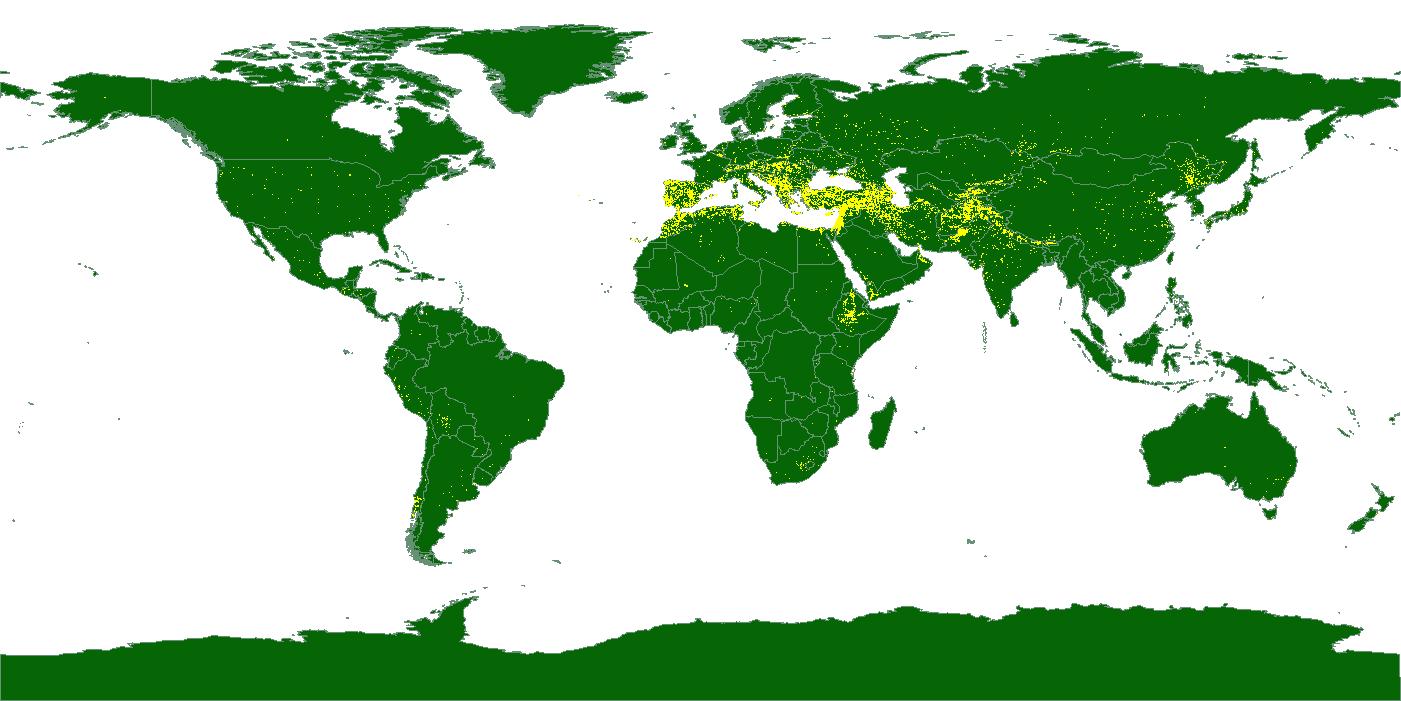
Obviously a significant achievement, and it seems churlish to ask whether it’s entirely a good thing for a country to rely on one variety for 80% of its production of a given crop. Anyway, it seems there are similar impact figures for livestock improvement too. It would be good eventually to see the breakdown by crop, and indeed livestock species, plus of course the level of investment that went into breeding efforts on each species to produce these new varieties and breeds. In the meantime, let’s remind ourselves of what a unique, vital resource the ICARDA genebank is by looking, courtesy of Genesys, at the geographic spread of the material it manages on behalf of the world under an agreement with the International Treaty on Plant Genetic Resources for Food and Agriculture (click to enbiggen), and that it, and the associated data, are, thankfully, safe.