- After yesterday’s thing on gum arabic, CIFOR’s blogger weighs in on frankincense and myrrh. Gums and resins renaissance, anyone?
- VoA on the ITPGRFA, with interview goodness.
- Soy sauce in bullet points.
- A Spanish food historian’s deconstruction of the Mediterranean diet deconstructed by Rachel Laudan.
- Fish in paddies: here comes the science.
- Côte d’Ivoire to revive cacao cultivation. By building a research centre?
- Pleasant, cultured and not so short foray into the history of the sugar industry in Kenya and Mauritius.
- You say sweet potato. I say yam.
- You say yam, so does Rhizowen, and yet … he’s talking about neither Ipomoea nor Manihot.
- Urban agriculture thriving in DR Congo.
How will we sustain a more populated planet?
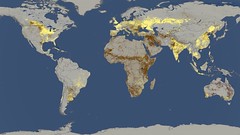
Worth a thousand words.
Groping for Ruoppolo’s grapes
Ever seen grapes like the ones in the painting? Just an oddity or widely consumed at the time?
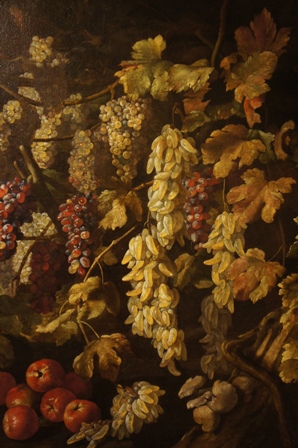 That was Michael, who was visiting the Museo de Bellas Artes in Sevilla a few weeks back, talking about Gianbattista Ruoppolo’s “Bodegón con uvas y manzanas.” Ruoppolo did quite a few fruity still lives, but this particular kind of grape is unusual in the oeuvre. Can we track it down?
Jeremy thought he had seen something similar recently in the market in Rome, and I did eventually manage to get a photo of it. The name here in Rome is “Pizzutello.”
But the “List of the grape varieties registered in the Member States of the European Union” says that there are synonyms. In particular, “Cornichon Blanc” is the primary name for this variety, and it is called other things in different countries.
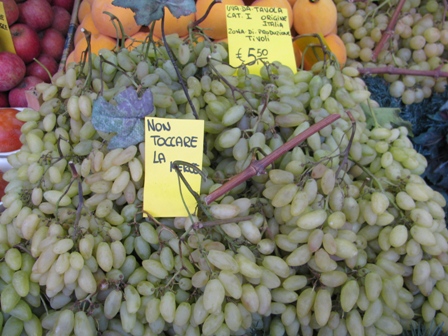
But it doesn’t look exactly right, does it? So I dived into the European Vitis Database. Because I hadn’t done so before, and I never turn down an opportunity to explore Genebank Database Hell. First, to tie down the defining trait of the variety, the funny shape of the berries. Here are the descriptor states for berry shape allowed by the database.
- 1=obloid
2=globose
3=broad ellipsoid
4=narrow ellipsoid
5=cylindric
6=obtuse ovoid
7=ovoid
8=obovoid
9=horn-shaped
10=finger shaped
Horn-shaped, I think, no? That’s how the Italian term “uva corna” translates. And that’s kind of the problem with “Pizzutello”: it doesn’t seem as horny as Ruoppolo’s grapes. So anyway let’s play it safe and look for both 9 and 10. You have to do this in “Advanced search” on the full descriptor list, because berry shape is in none of the more manageable sub-lists of priority descriptors, which is kind of surprising but let that pass.
So what you get is “Dedo de dama” from Portugal, “Heliotrop” from Slovakia and “Tsitsa Kaprei” from Moldova. No “Pizzutello” or “Cornichon” come up in the search, and although there are accessions of the latter in the database, I couldn’t find any photos. If you do a “Photo search” on “Dedo de dama”, you get this:
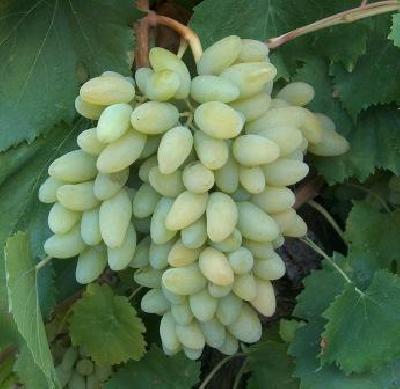
I’m allowed to use the photo if I acknowledge its source, which I am happy to do: this is a picture of accession PRT051-51209 at the Estaçao Vitivinicola Nacional, Quinta da Almoinha, Portugal, and I got it from the EU.Vitis database.
But is it the same as Ruoppolo’s? Or is “Pizzutello” closer? You tell me.
Nibbles: Gum arabic, Sago, Chilli, Apples
- Interview with the Secretary-General of Gum Arabic Council. In other news, there’s a Gum Arabic Council.
- Gosh, is that really all there is today?
- Ah yes, here’s something more, sago cultivation in Indonesia.
- And the ongoing search for the world’s hottest chilli pepper.
- Neil’s got apples in Himal Pradesh, an enriching response to climate change.
Happy birthday, ITPGRFA!
It’s only the 10th anniversary of the International Treaty on Plant Genetic Resources for Food and Agriculture? Feels like a lifetime…