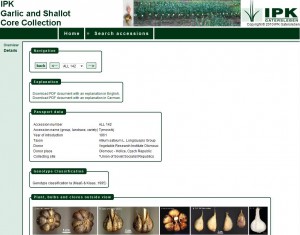
 A new paper in GRACE from our friends at IPK sent me scurrying to check out a new database. The snappily titled “The Garlic and Shallot Core Collection image database of IPK presenting two vegetatively maintained crops in the Federal ex situ genebank for agricultural and horticultural crops at Gatersleben, Germany,” by Christian Colmsee et al., describes the Garlic and Shallot Core Collection Database (GSCC). This database provides very nice photographs and morphological descriptor information on each accession in said core collection. You can get data on the whole collection, minus the photos, from IPK’s main database. And much the same minus the characterization data in Eurisco, but then you get all the other European Allium collections as well. 1 I haven’t found a way to search either the core collection or the full collection on the basis of specific characterization descriptors but who knows, maybe the photos are enough for most Allium germplasm users. Perhaps someone from IPK can drop us a comment on their future plans for these databases.
Nibbles: Chickens, Millet adoption, Specialty crops, World Food Day, Migrating forests, Vietnamese pheasants, Yews, High prices, Genebank tour, Climate change conference.
- Why did the Chinese chicken cross the road? To get a new date. For domestication, that is.
- The Indian Farmer is actually three, millet-wise.
- USDA wades into specialty crops. Wonder if one of them is baobab, and a factsheet is involved. Or “small scale grains” for that matter.
- “Life in the countryside is hard.” But fear not, FAO is on it.
- Forests are not migrating. Species are actually undergoing range contraction at both ends. Well that’s weird.
- The first pheasant extinction? Say it ain’t so.
- I like pictures of old trees. So sue me.
- Jess stops traffic.
- Tour a cocoa genebank. Could this catch on?
- International Conference on Climate Change and Food Security (ICCCFS). Not hot air.
The pomegranate in Armenia
The pomegranate is everywhere in Armenia. And I don’t mean just in the markets. A famous film is named after the fruit. Tea and wine are made from it. And its image features on everything from church walls to tourist souvenirs. I suppose it goes back to pre-Christian mythology, in which it was a symbol of fertility and abundance — something to do with the belief that each fruit contained exactly 365 seeds, perhaps. Anyway, here’s a compendium of pomegranate iconography from my recent trip. Couldn’t get much information on diversity, I’m afraid, how much there is of it and to what extent it is endangered. Something for the next time.

Featured: Nutritional data
Robin Hide says nutritional data on PNG crops is pretty readily available:
The ready availability of such information to villagers is a problem, but at least this information is no longer buried in inaccessible journals.
And she has the references to prove it. But what about those villagers?
Taking nutritional data to the PNG public #BAD11
I recently posted the following quote on the Biodiversity for Nutrition group.
Papua New Guinea’s taro and aibika are high in Iron and Zinc compounds which are important for human health but such nutritional information is not available for the public, says Nelson Simbiken, a PhD student at the Australian National University in Canberra.
The quote comes from a blog on PNG agriculture, and I must say I expected a strong reaction. I was not disappointed. This has just come in in reply from Wila Saweri-van Hulzen, who worked as a nutritionist in the Department of Health in PNG for some 20 years. 2
There is information on the nutrition composition of PNG foods. It may not be recent, and it may be applicable to small part of the country, but it is available.
Brand JC, Thomas DE and Hyndman D. Composition of the subsistence foods of the Wopkaimin people of Papua New Guinea. PNG Medical Journal 34:35-48, 1991.
It gives information on taro and Hibiscus manihot (or aibika).
Ohtsuka R, Kawabe T, Inaoka T, Suzuki T, Hongo T, Akimichi T, Sugahara T. Composition of local and purchased foods consumed by the Gidra in lowland Papua. Ecology of Food and Nutrition 15:159-169, 1984.
The Pacific Islands food composition tables, 2nd edition, FAO, Rome, 2004 used this information in its food composition tables. The difficulty is that these tables uses Fijian local food names, so the name edible hibiscus is used, rather than aibika. (Appendix VI lists aibika and refers to edible hibiscus.) The scientific name is Abelmoschus manihot or Hibiscus manihot.
The South Pacific Commission 3 in Noumea (New Caledonia) has published several booklets and leaflets with food composition information. A few are The Leaves We Eat, The Fruits We Eat, The Staples We Eat. Again, they use Fijian local names, so one has to figure out what the PNG name would be.
At the moment I have no internet access, so I am unable to read the newsletter.
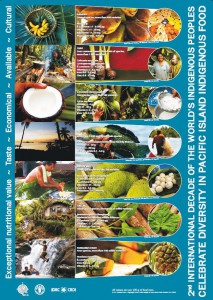 That’s surely correct. And I could add other sources. There are plenty of data on the nutritional composition of Pacific foods. But are these data available to “the public” in PNG? That, I think, was Mr Simbiken’s original point, and I think it’s a good one. The answer must be no, if the data are only published in obscure journals and under Fijian names. But I can’t believe that’s the case. I seem to remember seeing posters in tok pisin extolling the health virtues of various local foods. Someone please tell me I didn’t just imagine them.