- Rice yields and yield gaps in Southeast Asia: Past trends and future outlook. If average farmers became like best-yielding farmers that would meet 2050 needs, except in the Philippines, where some more structural stuff is needed.
- Method of evaluating diversity of carrot roots using a self-organizing map and image data. The sound you hear is that of butterflies being broken on wheels.
- Bioactive compounds from Capparis spinosa subsp. rupestris. Are pretty much the same as those in subsp. spinosa.
- Constitutive Overexpression of the OsNAS Gene Family Reveals Single-Gene Strategies for Effective Iron- and Zinc-Biofortification of Rice Endosperm. So that’s a good thing, right?
- Analysis of climate paths reveals potential limitations on species range shifts. Corridors not the answer. Or not the only answer. Or not the full answer.
- An updated review of Adansonia digitata: A commercially important African tree. Do baobab scientists not sometimes long for the Time Before Reviews, when they actually, you know, did stuff?
- Genetic diversity, population structure and relationships of Tunisian Thymus algeriensis Boiss. et Reut. and Thymus capitatus Hoffm. et Link. assessed by isozymes. Dad, what’s an isozyme? Ah, son, it’s a thing people used in the Time Before DNA. The two species are different, they need to be managed in different ways.
- Potential Impact of Biotechnology on Adaption of Agriculture to Climate Change: The Case of Drought Tolerant Rice Breeding in Asia. Kinda pointless: “in severe drought both the [drought tolerant] and the conventional varieties were either not planted or, if planted, did not yield”.
Nice cuppa tea
The National Maritime Museum has a new gallery entitled ‘Trade Routes’ on the East India Company. There’s a couple of really nice associated videos on agrobiodiversity themes: tea and spices. No word on whether opium is in the offing.
Seems like all that rice breeding was worth it after all
ACIAR has just published a huge study of the impact of IRRI’s rice breeding work in SE Asia. The press release has the key numbers:
- “Southeast Asian rice farmers are harvesting an extra US$1.46 billion worth of rice a year as a result of rice breeding.”
- “…IRRI’s research on improving rice varietal yield between 1985 and 2009 … [boosted] … rice yield by up to 13%.”
- “…IRRI’s improved rice varieties increased farmers’ returns by US$127 a hectare in southern Vietnam, $76 a hectare in Indonesia, and $52 a hectare in the Philippines.”
- “The annual impact of IRRI’s research in these three countries alone exceeded IRRI’s total budget since it was founded in 1960.”
But I guess the figure the Australians were really after is that in the final table:
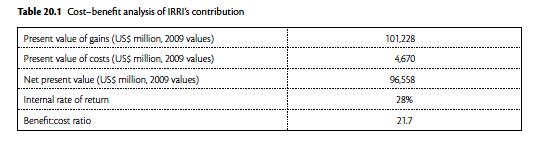
A pretty decent return.
Good to see the pioneering work of IRRI (and others) in documenting pedigree information in a usable way recognized — and indeed made use of. And good to see the International Network for Genetic Evaluation of Rice (INGER) and its use of the International Treaty’s multilateral access and benefit sharing system highlighted in the study as a model for germplasm exchange and use. Of course one would have loved to see the genebank’s role in producing the impact also recognized, rather than sort of tacitly taken for granted as usual, but maybe the data can be used to bring that out more in a follow-up.
I see another couple of opportunities for further research, actually. There is little in the study about the genetic nature of the improved varieties that are having all this impact. To what extent can their pedigrees be traced back to crop wild relatives, say? And, indeed, how many different parent lines have been involved in their development, and how genetically different were they? That will surely to some extent determine how sustainable these impressive impacts are likely to be.
To corridor or not to corridor
The fact that distribution change occurs predominantly through spatially restricted, local population processes suggests that the development of ecological networks may be an effective conservation strategy for plant species in the UK (Lawton et al. 2010). An ecological network comprises sites which collectively contain the diversity and area of habitat needed to support species and which have ecological connections between them. The UK is largely made up of semi-natural habitats shaped by human land use, and so consequently, much of the UK’s wildlife is restricted to small fragmented areas of high habitat quality. These can rarely be restored to large unbroken areas of natural habitat. However, making connections between them through wildlife corridors and smaller ‘stepping stone’ sites is a much more feasible option, which would improve species ability to track environmental change through short-range colonisation (Hilty, Lidicker & Merenlender 2006).
…constraints imposed by climatic variability, limited dispersal and low persistence may mean that even habitat corridors through high-quality habitat may not in themselves make range shifts possible. Additionally, corridors for species that show high uncertainty between climate paths under different GCMs are less likely to be effective.
These are from papers in Journal of Ecology and Ecology Letters published within days of each other, though admittedly one dealing with plant species in Britain the other with amphibians in the USA. So what’s a poor boy to do? Stop thinking there’s one solution for everything, I suppose. And get everything into ex situ just in case.
Featured: Linkages
Pat Heslop-Harrison can’t take it any more:
what are the problems? why is uptake of improved varieties slow? how are you coping with urbanization? who wants to be a farmer today?
Got the answer? An answer? Comment here.