Sorghum and ethnicity in Africa

Ever since I contributed to A methodological model for ecogeographic surveys of crops, and suggested that collectors should do this, I’ve been waiting for the time when it would be easy — or even possible — to map the distribution of conserved germplasm on top of cultural, ethnic or language boundaries. The problem has been that maps of such boundaries, 1 though available in various printed formats, have not been much digitized. Or at least I hadn’t come across them. Until I happened on a blog post about the Center for Geographic Analysis’ (Harvard University) WorldMap, an open source web mapping system. The layers provided include one called Ethnicity Felix 2001, which “consist of polygons and labels depicting ethnicity information based on the ‘People’s Atlas of Africa’ by Marc Felix and Charles Meur, Copyright 2001.” Perfect, I thought.
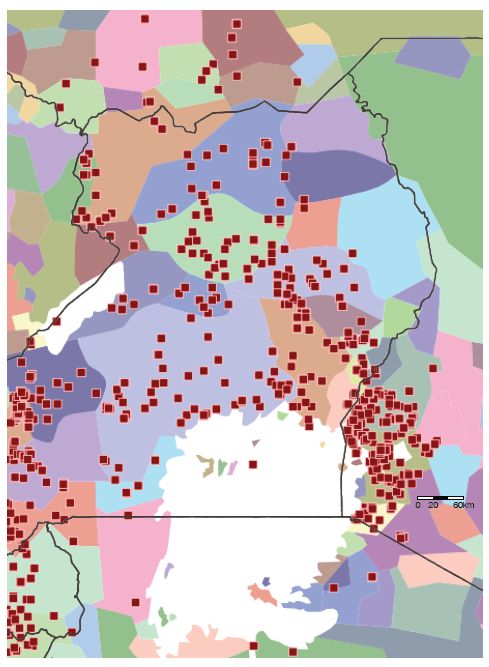
Sorghum accessions (Genesys) and ethnic groups in Uganda.
Well, not so fast. It was not altogether easy to download a shapefile of conserved African sorghum landraces from Genesys that would upload into WorldMap, plonk it on top of Ethnicity Felix 2001 and produce a shareable map. Not easy, but possible. It took some time and some divine intervention from Robert, but I do now have a map of African ethnic groups and sorghum collections that other people can have a look at. At left you have a snippet showing Uganda to whet your appetite. So now, in addition to things like ecogeographic gaps in collections, made possible by global climate surfaces, we can also begin to investigate cultural gaps.

Nibbles: Elm disease, Kew genebank, Maize domestication, Wildlife vs livestock, Medieval figs, Alternative food security, Spineless lulo, Mangos for Haiti, Aubergine breeding, Urban ag in Japan, West African research

Building a plant conservation toolkit

70 per cent of the genetic diversity of crops including their wild relatives and other socio-economically valuable plant species conserved, while respecting, preserving and maintaining associated indigenous and local knowledge.

That would be Target 9 of the Global Strategy for Plant Conservation, and we are all fully behind it, and all the others, of course. How to do it, though? Well, the new Plants 2020 website is planning to provide a toolkit in due course. 2 When? Well:

Please check back regularly for updates and new information.

Ugh. Yep. No RSS feed. Look, I know I’m nay-saying again, and that it’s really boring. But no RSS feed these days is just not on. I hope they’ll fix that soon because this will be an important resource, and I want to keep up to date without having to check back regularly.