After almost three years, the Ninth Session of the Governing Body of the International Treaty on Plant Genetic Resources for Food and Agriculture will finally meet physically again next week, in New Delhi. I’ll be there, and may be able to tweet and blog, depending on the rules. But for sure the great people at Earth Negotiations Bulletin will be there putting out their very perceptive daily digests.
Nibbles: Breadfruit, Seed Vault, Buckwheat, Rice, Pandanus, Pastoralists
- The beauty of breadfruit. Spoiler alert: resilience.
- The meaning of Svalbard. Spoiler alert: insurance.
- The history of pizzoccheri. Spoiler alert: contested.
- The paddy diversity of Assam. Spoiler alert: in situ.
- The latest NBPGR genebank. Spoiler alert: pandanus.
- The pastoralists of Sardinia. Spoiler alert: flexible.
Brainfood: Seed boundaries, Open Source Seeds, Chickpea evaluation, Central Asia homegardens, Teff evaluation, Wheat collection rationalization, Resurgent millets, Duplicates software, Cooking up “minor” crops
- Constructing Seed Boundaries: Foundation and Evolution of Scientific Conceptions and Practices of Crop Diversity from the Green Revolution to date. We need to put the knowledge, expertise, activities and needs of farmers at the centre of conservation and use of crop diversity.
- Open Source Seeds and the Revitalization of Local Knowledge. Open-source seeds is one way we can put the knowledge, expertise, activities and needs of farmers at the centre of conservation and use of crop diversity.
- Evaluation of Global Composite Collection Reveals Agronomically Superior Germplasm Accessions for Chickpea Improvement. We need detailed, multi-location, multi-year agronomic evaluation of chickpea diversity to figure out what diversity we should use to give farmers the diversity we think they will need.
- Home gardens of Central Asia: Reservoirs of diversity of fruit and nut tree species. We need homegardens.
- Data-driven, participatory characterization of farmer varieties discloses teff breeding potential under current and future climates. We need detailed, multi-location, multi-year agronomic evaluation of teff diversity done in collaboration with farmers to figure out what diversity we should use to give farmers the diversity they will need, and what they already have.
- Cultural Effects on Sorghum Varieties Grown, Traits Preferred, and Seed Management Practices in Northern Ethiopia. We need detailed, multi-location, multi-year studies of farmers’ sorghum diversity, practices and needs to figure out what diversity we should use to give farmers the diversity they will need, and what they already have.
- Metrics for optimum allocation of resources on the composition and characterization of crop collections: The CIMMYT wheat collection as a proof of concept. We could use genotyping and this fancy maths to figure out what to have in our wheat genebank collections so we can then figure out which diversity to use to give farmers the diversity we think they will need.
- From marginalized to miracle: critical bioregionalism, jungle farming and the move to millets in Karnataka, India. Forget wheat. We need local food activism. But critical local food activism.
- G-DIRT: a web server for identification and removal of duplicate germplasms based on identity-by-state analysis using single nucleotide polymorphism genotyping data. We need this fancy software to get rid of duplicates from our genebank collections so it’s cheaper to maintain them and ensure that they’re always around for people to use to get to farmers the diversity they need.
- “Famine Foods” and the Values of Biodiversity Preservation in Israel-Palestine. We need recipes.
Nibbles: Food security, CWR, Rice, Food crisis, Yams, Peanuts, Tuscan wine, SADC seeds, Lonely trees
- Handy primer on the effects of climate change and biodiversity on food security, courtesy of the House of Lords.
- Crop wild relatives could help with all three.
- Trouble brewing for rice. House of Lords nodding wisely.
- The trouble that brewed for wheat wasn’t quite as advertised. Spoiler alert: the price spike had to do with China buying up all it could. So is rice next then?
- No trouble brewing for yams now that they’re getting sequenced.
- Nor for peanuts in the Gambia, for different reasons.
- Sounds like everything is hunky dory for the Tuscan grape too.
- Good to see SADC is on the job.
- It may be too late for some trees though.
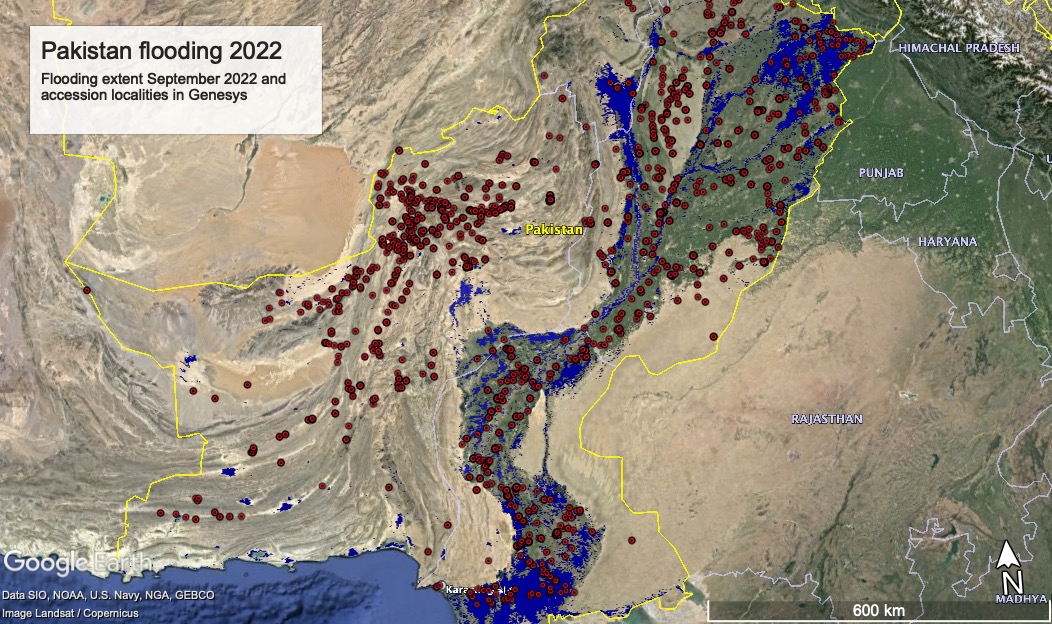
After the flood
Pakistans farmers are going to need seeds after the floodwater recede. That could include local landraces, if we start planning for it now. Here’s a map of the current extent of flooding, courtesy of UNITAR, plus the collecting localities of crop landraces conserved in genebanks around the world, according to Genesys.