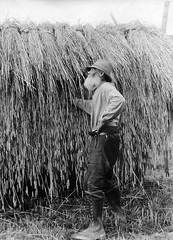
Just a great photo from the Swedish National Heritage Board, taken ca 1944, that I found on Flickr’s Economic Botany Pool.
Unlocking agriculture’s past to feed the future world
 That’s the title of a talk our friend and occasional contributor Jacob van Etten will give in the National Geographic store in Madrid next week, on the 28th to be precise. If you can’t be there in person, you can follow Jacob online. And if that doesn’t work, no doubt he’ll tell us here how it all went. I just hope he explains to National Geographic the difference between a potato and an oca. In fact, why not open with that, Jacob? That’ll grab their attention.
Using data to inform nutrition security policy
You only have a few more weeks to get your abstract in for the “International Scientific Symposium on Food & Nutrition Security Information: From valid measurement to effective decision-making” early next year. I like the sound of it. Here are the three topic areas:
1. Measuring and analyzing food and nutrition security to improve the availability and quality of information for decision making — advances made since the 2002 International Scientific Symposium.
2. Impact evaluation — understanding what works in humanitarian and development contexts to improve food and nutrition insecurity.
3. Food and nutrition security information — from evidence to policy impact.
Plenty of opportunities for agricultural biodiversity to make an appearance. I hope.
Nibbles: CGRFA13, Kuroiler chicken, CGIAR, God, Mozambique
- Three days down, one to go in Rome.
- Indian hybrid chickens set to take over Uganda.
- Latest from CGIAR restructuring: the 6 research programmes agreed thus far. So how you like our latest toy?
- 60-tonne God of Rain unearthed; drought continues.
- Mozambique Raises Production of Staple Foods by 22% a Year. Amazing. How? And for how long?
Never too late to link to old(ish) FAO nutrition factsheets
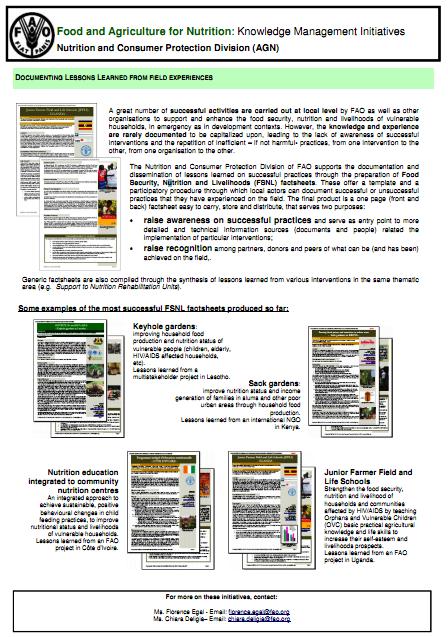 I’m ashamed to say I knew nothing about these rather nice-looking Food Security, Nutrition and Livelihoods (FSNL) factsheets from FAO. Until I came across a tweet today from a “social media enthusiast,” that is. Thanks, Gauri.