- National Organic Coalition suggests USDA’s National Institute for Food and Agriculture separate conventional and participatory breeding from anything involving DNA in considering projects for support.
- Second-guessing the Three Wise Men.
- Yet more on attempts to deconstruct ancient Roman medicines using DNA from tablets found in a shipwreck. Real Indiana Jones stuff.
- Botanic garden and genebank for drought-resistant plants to be established “in Asia’s largest wild fruit forest.” That would be in China. I really don’t know what to make of this. Really need to find out more. But why am I talking to myself?
- Brown (rice) is beautiful.
- Feedback from a genebank user. Kinda.
- Rooibos gets itself certified.
- The oldest cultivated tree on record.
- The taste of Massachusetts.
- “…strongly conservation-minded botanic gardens appear to be in the minority.” Easy, tiger. Will that new one in China (see above) feature in this minority?
- ILRI on an Aussie TV program on conserving local livestock breeds in Africa.
Quinoa phylogenetics unraveled
Our regular reader and occasional contributor Eve Emshwiller informs us that her student Brian Walsh has won the award for best student poster from the Economic Botany Section of the Botanical Society of America at Botany 2011 in St. Louis. Here’s the abstract. There’s some talk of the poster itself perhaps being made available online in due course. Fingers crossed.
Phylogeny of American Chenopodium species with focus on origins of the domesticated taxa.
The edible seeds of quinoa (Chenopodium quinoa, Amaranthaceae) have gained popularity worldwide, based on nutritional qualities and ease of growing. Most people do not know quinoa is one of four cultigens of Chenopodium domesticated in the Americas: C. quinoa and C. pallidicaule from South America, C. berlandieri ssp. nuttalliae from Mesoamerica, and the extinct C. berlandieri ssp. jonesianum recovered from archaeological sites throughout eastern North America. Despite nearly 100 years of debate researchers still do not agree on the relationship among these domesticates. Conflicting hypotheses have been proposed asserting whether cultigens were domesticated independently or represent introductions into neighboring regions. Alternative hypotheses suggest two, three, or four independent domestications of Chenopodium in the Americas, and proposed several putative wild progenitors of the cultigens. To investigate the relationships among cultigens of Chenopodium and assess potential wild progenitors, a phylogenetic framework of the genus emphasizing New World species is required. Phylogenetic analyses of DNA sequences of non-coding loci, both nuclear (SOS1 intron 17, COS at103, ITS) and plastid (trnQ-rps16, trnL-trnT, ndhJ-trnF-trnL, psbD-trnT, and psbM-ycf6), were conducted using parsimony, maximum likelihood, and Bayesian analyses. Taxon sampling includes 19 Chenopodium species from North and South America, with focus on the extant cultigens and subspecific taxa within C. berlandieri.
Findings include the following: Chenopodium pallidicaule is genetically distinct from other extant cultigens.
Sampled cultivars of the Mesoamerican cultigen, C. berlandieri ssp. nuttalliae, unite in a single subclade, nested within, but distinct from wild C. berlandieri.
Chenopodium quinoa is nested within the C. berlandieri complex, but not within the C. berlandieri ssp. nuttalliae clade. Interestingly, the southern-most range of wild C. berlandieri is southern Mexico, whereas quinoa is cultivated in Eduador, Peru, and Bolivia. These findings are consistent with independent domestications of the extant cultigens. Using nucleotide markers unique to C. berlandieri ssp. nuttalliae, ancient-DNA analyses will be conducted to determine the relationship of the extinct cultigen, C. berlandieri ssp. jonesianum.
Capt Bligh’s biopiracy medal to be sold
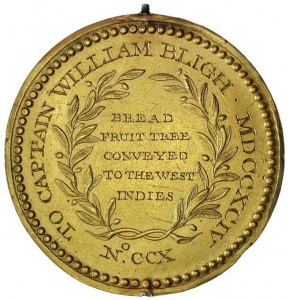 Speaking of breadfruit, two of Capt Bligh’s medals are up for auction. One of them was awarded by the Society for the Encouragement of Arts, Manufactures and Commerce, later the Royal Society of Arts, for taking breadfruit from Tahiti to the West Indies in 1794.
As you’ll remember, that enterprise did not start well. But Bligh did not let a little thing like a mutiny stop him, and threw in Blighia to boot.
By February 1793 the breadfruit mission had been accomplished. Bligh also took specimens of the ackee fruit (Genus Blighia) of Jamaica to England and introduced it to the Royal Society and provided specimens for the Royal Botanical Garden at Kew. The Genus Blighia, which consists of some four specimens of evergreen tropical shrubs and trees, is named in William Bligh’s honour. The most commonly cultivated of these is the Blighia sapida.
But would it have killed them to put breadfruit leaves on the thing, really? Or Blighia leaves for that matter.
Katherine’s monkey’s peanut
In the original the monkey is being offered a peanut.
Really? Well, it’s an innocent enough statement in most circumstances. But a little problematic if the monkey is being held by Katherine of Aragon in a portrait from the 1530s. Were there really peanuts, a South American crop, so easily available at Henry VIII’s court in England only forty years after Columbus? 1 It’s not inconceivable, but really?
Ok, so how did we get here? It all started with a podcast from the BBC History Magazine which came out in April 2009. 2 In it, Brett Dolman, the Curator of Collections at Hampton Court makes the peanut comment in an interview with the magazine’s editor about an exhibition of portraits of Henry’s wives that was on at the time, and which was featured in the magazine. You can hear it at about 8:40 minutes into the podcast.
What Dolman says is that the portrait of Katherine of Aragon they had in the exhibition, which I take to be the one on the Hampton Court website, 3 is a copy of an earlier painting. It is in the original that the monkey is being offered a peanut by the queen. In the copy, it is being offered a coin, but instead reaches for the crucifix at her neck. That’s apparently symbolic of Katherine’s belief in the sanctity of her marriage to Henry, and her refusal to accept money for a divorce.
Whatever. What we’re really interested is the original. The one with the peanut, remember? Well, I can’t be sure without too much more research than I can devote to this at the moment, but I think that original is probably “Katharine of Aragon with a monkey” (c1525) by Lucas Horenbout/Horenbolte, who was an official court painter. And here it is.
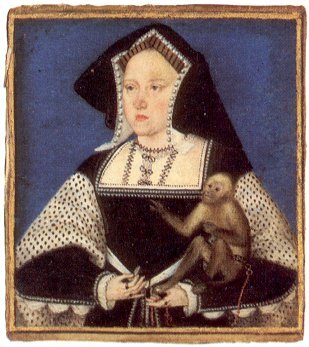
So is it a peanut? It’s difficult to tell, but I’m inclined to doubt it. The first European image of a peanut appears to come from a century later:
Another description of the Katherine portrait refers to “a scrap of food.” All in all, I’d go with that. And art historians of the world, I’m available for consultancies.
Feeding Pacific voyagers
A rainbow appeared in the sky, its end grounded firmly in the wharekai (food tent) set up and run by the wonderful people here. Small specks of the late afternoon sun drifted around us, light golden rain, as the skippers sat in counsel. “Basically,” Magnus was saying, “we go north for a while and then turn right.” Highly technical stuff only grasped fully by the trained mind. “Umm…yeah, okay.” We all agreed.
“Here” is Kaua’i, oldest of the Hawaiian islands, and the skippers and their crews of Pacific islanders are “sailing across the Pacific to renew our ties to the sea and its life-sustaining strength.” But they also needed something a little more solid in the way of sustenance, of course, hence the wharekai. And here’s what that looks like.
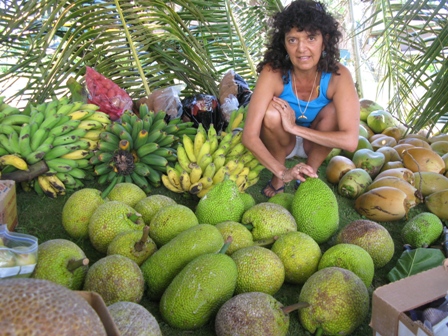
The photo comes from Angela Tillson of the Breadfruit Institute. I’ll let her tell the story.
Yes, the Breadfruit Institute donated about 20 breadfruit of different varieties for their voyage back to S.F. When they landed on Kauai, they were asking for breadfruit to eat and take with them. They were very happy since there were really no Hawaiian breadfruit fruiting this time of the year here. I took it down to their base camp on Hanalei Bay and as a Thank you for it, they let me go for a sail on the Samoan Canoe with the rest of the Hawaiian Helpers. What an honor and dream come true that was for me…!
You have no idea what a “HIGH” & “Bliss” state I’ve been since Sunday, with that mind blowing experience of leisurely talking to different
key crew members of the Vakas about their experiences, reasons, and
visions for this world crossing educational voyaging… And than finding out we could go sailing for Helping out with Breadfruit… We all 50 locals had a Blast time on such a perfect day… We were all in Heaven on Earth just like in ancient times, with only the basics… Seeing adults & kids faces light up in awe once boarding the canoes, watching everything the sailing crew did and listening to the incredible stories. WOW…