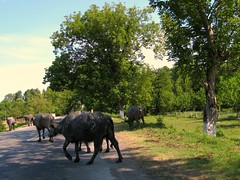
I have no doubt there are water buffaloes in Azerbaijan, though it did come as something of a surprise. I saw them and ate delicious cheese, butter and yoghurt made from their milk last week during my visit to the national genebank there. And there is stuff on the internet about them. But, frustratingly, no production data in FAOSTAT, though there are some head numbers from 1992 onwards. Nor is there any breed information at DAD-IS, though my hosts told me there was an active improvement programme involving crossing of the local breed with stock from other countries during Soviet times. Apparently, on independence the breeding farms were broken up and the animals were given out to the workers in lieu of wages. They seem to be doing just fine.
Roadside fruit diversity

In Azerbaijan.
Potato flesh colors
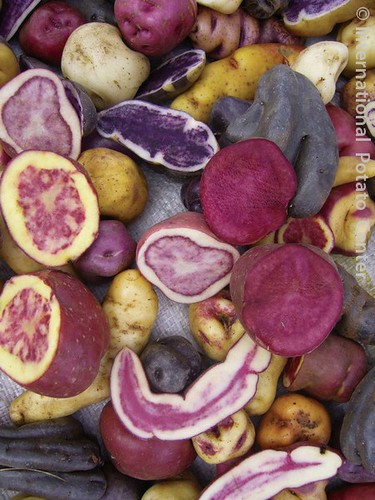
Potatoes’ flesh colors / El color de las pulpas en papas, a photo by CIP – International Potato Center on Flickr.
Great shot from CIP.
Brainfood: Tomato erosion, Cassava starch, Landscape diversity, American chestnut, Niche models, Dormancy genes, Herbarium collections, Indian livestock breeding, Banana breeding, Pollinators, Shattering gene, Participatory research
- The risks of success in quality vegetable markets: Possible genetic erosion in Marmande tomatoes (Solanum lycopersicum L.) and consumer dissatisfaction. Market takes the fun out of landraces.
- Genetic variability of root peel thickness and its influence in extractable starch from cassava (Manihot esculenta Crantz) roots. Starch content depends on dry matter content and peel thickness. About 1500 accessions from CIAT evaluated for the latter, so lots to play around with.
- A meta-analysis of crop pest and natural enemy response to landscape complexity. More landscape complexity means more natural enemies. Still no cure for cancer.
- American Chestnut past and future: Implications of restoration for resource pulses and consumer populations of eastern U.S. forests. Reintroduction of blight-resistant chestnut may have some weird effects on other species.
- Keep collecting: accurate species distribution modelling requires more collections than previously thought. Oh damn.
- Variation in seed dormancy quantitative trait loci in Arabidopsis thaliana originating from one site. Is due to two QTLs. Also flowering time. But no, I don’t understand that “In contrast…” at the end of the abstract either.
- Tracking origins of invasive herbivores through herbaria and archival DNA: the case of the horse-chestnut leaf miner. Another use for old herbarium specimens: finding evidence of pests.
- Animal breeding in India – a time for reflection, and action. The reflection is that genetic improvement has stagnated, so the action needed includes better phenotypic record keeping, more attention to local diversity and community-breeding programmes.
- Performance of micropropagation-induced off-type of East African highland banana (Musa AAA – East Africa). A promising avenue for improvement, the off-types yield more better bananas, a month later.
- Pollination services in the UK: How important are honeybees? Not as important as you might think!
- The same regulatory point mutation changed seed-dispersal structures in evolution and domestication. Cabbage-family fruit development and rice shattering share the same single point mutation.
- Participatory research and on-farm management of agricultural biodiversity in Europe. By Michel “Pimpert”. That should be Pimbert. Old news, but worth mentioning.
Nibbles: FAO, Spirituality, ASARECA, Land use, Conservation agriculture, REDD, Colombian beans, Immigrant cooking, Exploding watermelons, AnGR
- Calestous Juma gives new FAO head some advice: find a role, build on what farmers do and know, engage civil society, help governments prioritize, and slash bureaucracy.
- Religion and conservation: friends of enemies?
- Eastern Africa Agricultural Productivity Project seems to be mainly about setting up regional centres of excellence in dairy, cassava, rice and wheat. Maybe ASARECA should ask for some advice from Prof. Juma?
- Land use map of the UK. Let the mash-upping begin.
- Training in sustainable conservation agriculture in India and Mexico. But how really sustainable is the whole thing if based on modern varieties? Oh, and Brazil too.
- Saving the Amazon for $33 a month.Or maybe just a buck?
- Local cooking a long way from home, Part I; from Colombia to Washington DC.
- Local cooking a long way from home, Part II; from everywhere to New York’s Lower East Side.
- Don’t worry, exploding watermelons are perfectly safe, and legal.
- FAO updates its webpage on “Implementing the Global Plan of Action for Animal Genetic Resources” and documents the fact by providing a time stamp. Jeremy chuffed.