- The CGIAR spatial crowd get it together? Not holding my breath.
- So tell me about that biodiversity-poverty link. Well, more research is, ahem, needed. Wet, for want of a better word.
- All the different kinds of “spots” for livestock diseases. How did they cope with the poor data? And have the various hotspots and coldspots been considered in drawing up the new research priorities for livestock?
- UNDP stumps up $4 million to plan biodiversity management in Romania. Including agrobiodiversity? Not holding my breath.
- A socio-economic impact analysis of cultural diversity in cities does not consider agriculture at all. There’s a PhD there for someone.
- IUCN’s plans for the Iraqi marshes. Thesiger unavailable for comment.
- If it can be done with amphibians, why the hell can’t it be done with agricultural biodiversity?
- Biojoy swamps Bioversity as Biohappiness book is launched.
- Yeah but was there any of this? And if not, why not? Via NWFP-Digest-L.
Can biodiversity research change the future of agriculture?
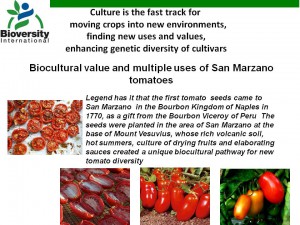 Our friend, colleague and, apparently, occasional reader Pablo Eyzaguirre, an anthropologist at Bioversity International, by all accounts gave a barnstorming performance in an internal seminar recently, but alas all that is available of it at the moment for those of us who were not there is his PowerPoint presentation, whose title we have stolen for this post. That is, of course, better than nothing, and I’m certainly not complaining. 1
It’s worth going through the whole thing, imagining Pablo in full flood. But if one were to boil his argument down to essentials, something that I feel sure Pablo himself would abhor, it might go something like this, and I use Pablo’s own words from the slides, only slightly re-arranged:
- You cannot solve problems with the same mentality that created them: intensification through simplification and increased inputs.
- Agrobiodiversity provides an answer as a source of inputs to address the problems arising from simplification of agriculture and depletion of the natural resource base.
- But diverse traditional agricultural systems are also crucibles for the development of innovative new ways of producing food linking agriculture more responsively to consumers and emerging movements on food culture, health and territory, and building on synergies among crop varieties, species and breeds, wild and cultivated spaces.
- So where can we find, and scale out, the new models for bio-intensification and increased resilience in agriculture? Where local institutions and knowledge systems exist to embed, govern and transmit the value and potential of their agricultural biodiversity and biocultural landscapes to young people and allies in conservation and development.
Well, there’s much more to the presentation than that, of course, and lots of wonderful examples to reinforce each point. Go check it out for yourself. And Pablo, if you’re reading this, maybe you’d like to write a summary for your fellow readers?
The question it leaves me with is this: with no agrobiodiversity “megaprogramme” in the CGIAR, will there be enough of the “alternative” mentality around to take up Pablo’s gauntlet?
Safeguarding tangible agricultural heritage
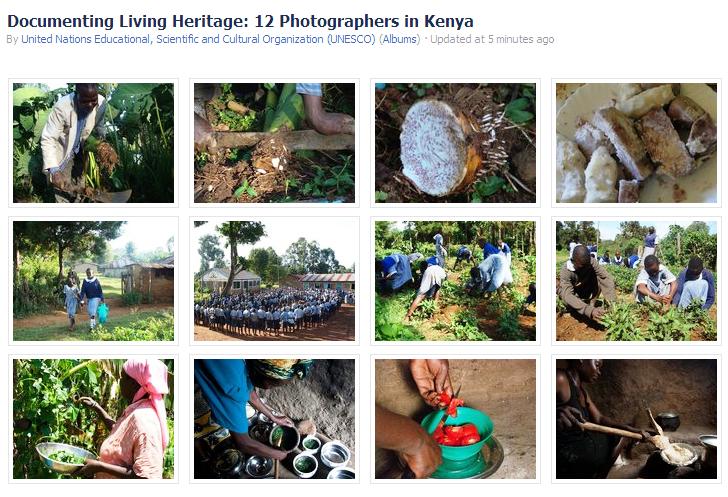 There’s a great set of pictures of Kenyan traditional crops and food preparation on UNESCO’s Facebook page, in their Documenting Living Heritage series. This is part of an exhibition currently on at UNESCO’s HQ in Paris to raise awareness of the 2003 Convention for the Safeguarding of Intangible Cultural Heritage. I doubt there’s a photograph of the Gene Bank of Kenya, but that surely contributes to that goal too.
Organic practitioners meet, and meet again
The European Consortium for Organic Plant Breeding (ECO-PB) has announced two up-coming meetings. One is dedicated to the European organic seed regime and the other one is a celebration of ECO-PB’s 10 year anniversary.
That’s what we said a couple of days ago. And it’s all still true and everything. I just bring it up again because we have heard from our reader Matthew about an Organic Seed Growers Conference on January 19-21, 2012, in Port Townsend, WA.
The Organic Seed Growers Conference is recognized as the only event of its kind in North America, bringing together hundreds of farmers, seed production and distribution companies, researchers, plant breeders, pathologists, and university extension in two days of informative presentations, panel discussions, and networking events. There are also farm visits and short courses prior to the two-day conference.
Sounds like fun. As ever, we’d love to hear from any participants.
Feria del Elote
From CIMMYT’s Flickr feed:
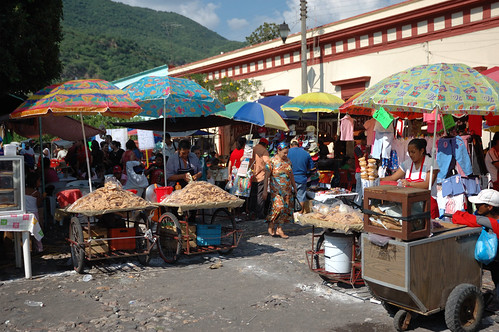
Carts selling tacos made with maize tortillas (traditional Mexican flatbreads) in Jala, Nayarit, on the Pacific coast of Mexico, during the town’s annual two-week Feria del Elote, or maize ear festival. Tortillas are a staple food in Mexico, and are commonly filled to make tacos. For more about maize in Jala, see CIMMYT’s August 2007 e-news story “Pride and pragmatism sustain a giant Mexican maize,” available online.
Photo credit: Eloise Phipps/CIMMYT.