Vegetable starter kits for Thailand

A short piece in AVRDC’s latest monthly newsletter tells the story of how that institute is producing thousands of “vegetable seed kits” with support from the government of Taiwan and handing them over to a university and the army in Thailand for distribution to people affected by flooding and landslides in a couple of different regions of that country.
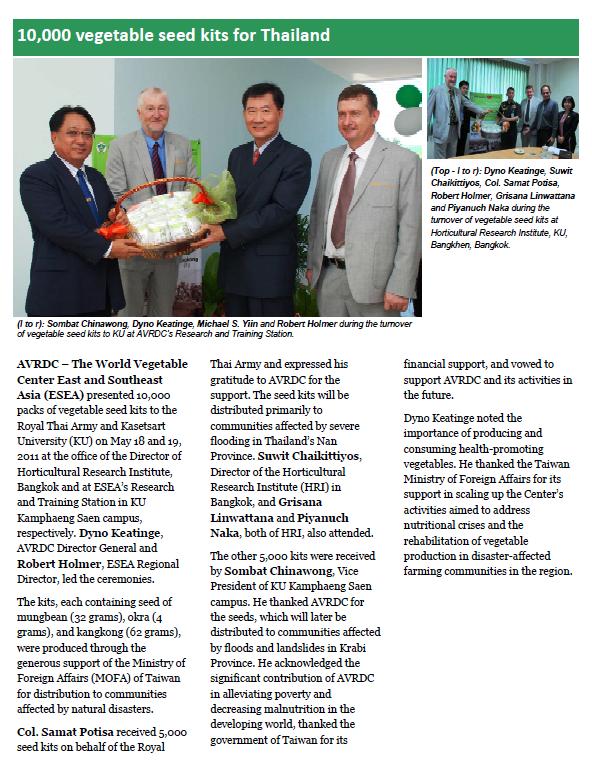
It’s an interesting idea, but as usual the article left me wanting to know more. Like how were the varieties of mungbean, okra and kangkong chosen? In fact, how were the crops chosen? And did all the thousands of kits have the same varieties? And, more fundamentally, how did AVRDC know that vegetable seeds were needed in the first place? Seed provision in the wake of disasters is a complicated business.

Climate change good for mother-in-law shock

I won’t beat around the (tea) bush. CIAT’s work on what will happen to the suitability for tea of the areas where the crop is currently grown in Kenya was kinda worrying. Tea is the mother-in-law’s main source of income. No need to fret, however. I gave the lat/longs of the MIL’s spread to our friends at CIAT (it’s the little blue dot at the bottom of the map) and when they ran it through their Maxent models it turns out that the “good” tea suitability of today (yellow on the map) will increase to “very good” by 2020 (green) and even beyond that by 2050. Phew! Many thanks to Anton and Andy at CIAT for saving me some sleepless nights. Perhaps you can do China next?

The spread of agriculture in print

Three ahead-of-print papers on the spread of agriculture in Current Anthropology:

Things are hectic at the moment, so the penetrating summary and free-wheeling synthesis you’ve come to expect will have to wait. Unless of course you want to do them. The papers are free to access, after all…