- Gary Nabhan on the West Bank wall.
- Tilapia not so bad after all?
- Yet another example of crowdsourcing in science.
- Yet another approach to breeding for (mild) drought tolerance.
- Yet another reason why natural history collections are so important.
Diverse lawns are smarter lawns
 There’s been a lot of talk lately about the demise of the Great American Lawn. Or at least its metamorphosis into something a little more sustainable. Even the White House lawn is not immune to re-development. But a recent post on the Native Plants mailing list of the Plant Conservation Alliance points to what may be the beginnings of a backlash. Here’s what Mark Simmons had to say in response to an article in the Star Tribune entitled Goodbye to Grass (Mark’s comments are reproduced here with his permission):
I really like my lawn – my low maintenance, species-rich, drought-adapted native lawn.
While I agree that lawns can be replaced with alternative vegetation, I think that the lawn is entitled to a place in the American landscape and we should be careful of following the current fashion of demonizing turf. It’s not the lawn that’s the problem is how lawns are manufactured. We take a usually single non-native species that’s been bred to rely on a life-support system of water, fertilizer, pesticides herbicides, and a crazy mowing regimen. If you look at native short grasslands around the world its clear that, in contrast, they are low nutrient, species-rich, systems which are at ecological quasi-equilibrium usually maintained by grazing and or fire. Here at the Lady Bird Johnson Wildflower Center we adopted an ecological approach to turf by testing different mixes of native turf grasses and against a commonly-used non-native turf lawn species (bermudagrass) and measured performance. The multispecies native mix needs less mowing, had less weeds and was a denser, finer (better looking) turf. The results were just published in the journal Ecological Engineering. Sure it can go drought-dormant and brown in summer if it’s not watered. But if that may be an acceptable alternative to no lawn at all.
My young children can’t play baseball in gravel and agaves. And I want to sink a beer on a Saturday evening bare foot in soft, cool turf. Let’s keep doing lawns, just do them smart.
Bananas on TV and the blogosphere
In Africa, political parties must stop using real banana leaves as their symbol at rallies or on buses…
Why? Pat Heslop-Harrison explains the reason, and much more, in a great new post at AoB Blog. The occasion is the 13 May edition of the BBC TV programme The One Show, which included an interview with Dr Heslop-Harrison by journalist, food critic and TV personality Jay Rayner. With links to a couple of freely available Annals of Botany papers and a presentation too.
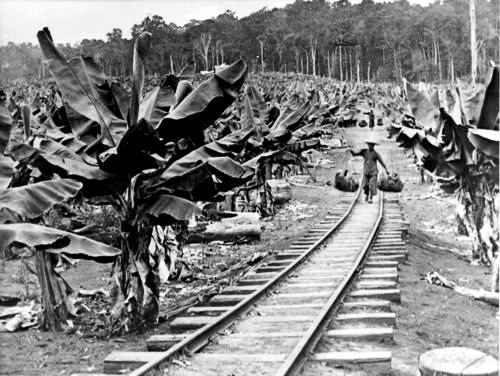
LATER: Let’s not forget the importance of banana for brewing beer in parts of Africa.
Yale announces “Open Access” policy
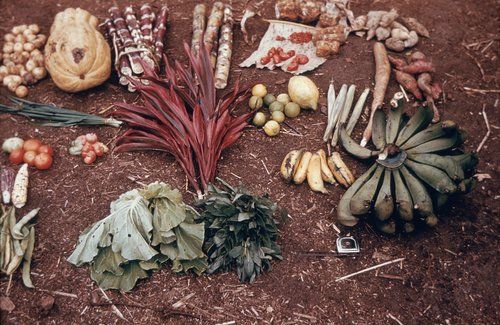
We are happy to celebrate the announcement by Yale University that it is allowing “free access to online images of millions of objects housed in Yale’s museums, archives, and libraries” by reproducing this slide of
Produce of the native agriculture showing bananas, lemons, sweet potatoes, manioc, peppers, sugar cane, squash, lettuce, a spinach type of green, tomatoes, onion, potatoes, maize, and beans. In the center of the picture there is a plant used in black magic (red colored). 1954. Kamu Valley. Kapauku. (Mr. Leopold Pospisil’s collection of slides on the Kapauku Papuans of New Guinea.)
Plenty more in there of agrobiodiversity interest.
Landraces on display at JIC
The second issue of the e-newsletter of the Germplasm Resources Unit of the John Innes Centre (JIC), for Spring 2011, is out. It comes with a nice name-check for the Agricultural Biodiversity Weblog, for which we are very grateful. Always happy to spread news about genebanks.
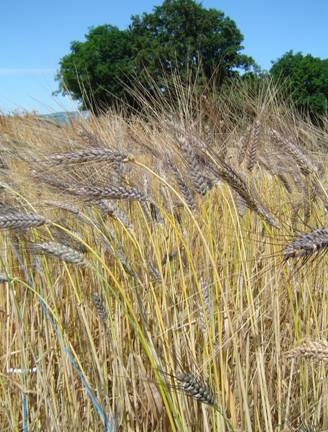 On this occasion, I was particularly taken with the piece on the demonstration plot for heritage wheats, including landraces. This on the left, for example, is Blue Cone, “an old wheat cultivated often in the 17th Century through to the 1930’s.” The piece struck me because as I read it I had just finished writing yesterday’s post about things that can be done to promote the on-farm management of landraces such as Blue Cone. One of those things, according to the paper I summarized in the post, is to re-introduce materials from ex situ collections. Clearly, the demonstration plots at John Innes are part of such an effort:
As previously, the plots will be available for viewing by prior appointment either as individual or group visits. In addition, an open day will be organised where interested parties will have the opportunity to view the plots with a view to identifying any material of potential interest that they might care to grow and evaluate for themselves. This initiative will be publicised in the farming and local press. Anyone interested is encouraged to contact us to arrange viewing and inspection of the material with a view to requesting small quantities for their own evaluation following harvesting and processing.