- Fiji looking for better sugarcane. Not a moment too soon, with the EU subsidies going and all.
- Collecting the very valuable caterpillar mushroom in China’s protected areas. Illegal, but whachagonnado?
- The honeybees of the Saharan oases are isolated. Well, actually, not all of them, which I guess qualifies as a surprise.
- Can you tell different vodka brands apart? Here’s why. Maybe. Sounds a bit flaky to me.
- A global review of cotton genetic resources.
- Ploughing up the African savannah is gonna solve all our problems, apparently.
- Organic Seed Alliance launches a youtube channel. Oh goody, there’s how to breed organic carrots!
Conservation as a puzzle
I really like the conceit behind Antonio Briceño’s photographs of conservation in Rwanda. The missing piece, as so often, is people.
How many plants feed the world?
A first (of many, we hope) guest post from our friend and colleague Colin Khoury.
In the field of conservation of plant genetic resources, it is commonly stated that a very limited number of plant species feed the world. 1 A number of publications, especially in the 1970’s and 1980’s, provided different angles on how many crops or species provide just how much of the human diet. And there are a lot of ways to try to answer the question. Most of the publications end up with numbers around 7, or 15, or 20, or 30 crops that feed the world. Prescott-Allen and Prescott-Allen (1990) found global aggregate statistical data unsatisfactory in telling the full story for peoples of all countries:
Crops such as fonio, Digitaria exilis Stapf, and quinoa, Chenopodium quinoa Willd., are lost in global production data; but to conclude that they are unimportant is to conclude that the people of Guinea, Gambia, and Bolivia who rely on them are unimportant.
Instead, they worked with national level Food Balance Sheets from FAO, and looked at the question in four ways to determine just how many species make up 90% of the total intake of food weight, calories, protein and fat in each country.
The result is “85 species commodities and 28 general commodities contribute 90% of national per capita supplies of food plants.” After a bit of tinkering, they come up with this final statement: “the total number of species commodities is 82. These consist of 103 species. Fifty-six of the species commodities, consisting of 75 species, account for 5% or more of the national supply of a nutritional category in at least one country.”
Still confused? Well, it’s a difficult question to answer. And answers are often underestimates, as statistical data rarely account well for local markets, home production, etc. Prescott-Allen and Prescott-Allen provide some interesting food for thought 2 in working with statistics at the national level, and in doing so perhaps include more species/crops than studies working with global aggregate data.
Has much changed since 1990? A full re-run of their analysis, country by country, is still to be done. But what happens when we aggregate the country statistics from the latest Food Balance Sheets (2007)? Again including the four categories (weight, calories, protein, fat), and counting those crops and food products that comprise 90% of the diet, we find that about 25 crops/species, plus about 7 general commodities, do the job (not listed in any particular order of importance):
Apples
Bananas/ Plantains
Beans
Barley
Cassava
Coconut
Cottonseed
Grapes
Groundnuts
Maize
Millet
Olive Oil
Onions
Oranges, Mandarines
Palm Oil
Potatoes
Rape and Mustard Oil
Rice (Milled Equivalent)
Sorghum
Soyabeans
Sugar Cane
Sunflowerseed Oil
Sweet Potatoes
Tomatoes
Wheat
Beverages, Alcoholic
Beverages, Fermented
Fruits, Other
Oilcrops Oil, Other
Pulses, Other
Sweeteners, Other
Vegetables, Other
A further note, if the alcoholic beverages happened to have caught your eye: 3
Average alcohol consumption (= beer + beverages, alcoholic + wine + beverages, fermented) = 70 kcal/cap/day = 3% total calories from plant sources. Alcohol consumption is much higher in some countries, such as the Czech Republic: 282 kcal/cap/day, or 11.9% of total calories from plant foods.
Here’s the top 10 countries in providing calories from alcohol: Luxembourg, Ireland, Estonia, Czech Republic, Portugal, Austria, Germany, Lithuania, Bosnia and Herzegovina, Hungary. No surprises there.
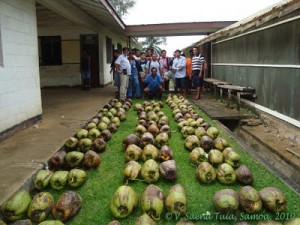
Looking for Niu Afa
You have been following the Adventures of Roland in Samoa, have you not?
Nibbles: Agricultural landscapes, Seed banks, Maize genetics, Food diversity, Ancient food, Micronutrients status report, Seed systems, Punjab Agricultural University, Arable land, Dutch elm disease
- “Priortizing restoration across agricultural landscapes.” Nothing to do with agriculture, though.
- “Gene banks to rescue local crops.” Nothing to do with genebanks, though.
- “‘Psychedelic’ maize may help increase crop and biofuel yields.” Nothing to do with LSD, though.
- Scotland gets a national genebank. Well, not really, but anyway.
- Malawi schoolchildren sing about food diversity. No, really.
- Homo erectus ate fish as part of a pretty diverse diet. Had to wait about 2 million years for chips.
- Report for 10-Year Strategy for Reduction of Vitamin & Mineral Deficiencies. “…activities to enhance dietary diversification are an attractive option for improving micronutrient status, but these have proved difficult to evaluate.” Ouch.
- “Integrating Genetic Resource Conservation and Sustainable Development into Strategies to Increase the Robustness of Seed Systems.” You’ll need to pay to find out how, though. I’ll try to get a pdf, some of the authors are friends.
- The role of Punjab Agricultural University in the Green Revolution. And in genetic erosion?
- Enough arable land to feed world, says new French study. But not here, say Indians.
- Reviving the elm in Britain one sapling at a time. How long till the next disaster, though, with such a narrow genetic base?