- Aussies in a fluster about saving the dingo.
- Malaysia conserves a bunch of things in vitro.
- Cities good for TB resistance.
- Peruvian palm has 17 different uses.
- Mexican ceremony drives fish evolution.
- Today’s thing-that-made-us-human is: pets.
- Today’s new take on Pavlovsk: literature.
- Domestication in action: Elderberry improved.
- Urban ag in context, from Liverpool to Lagos.
- Pepper cultivation driven my masochism.
Pavlovsk must go to the ball!
Fred Pearce, “one of Britain’s finest science writers” according to Wikipedia, justified that assessment with what was really quite a good piece on Pavlovsk yesterday. Unlike others, he got everything pretty much right. Well, almost everything. Pavlovsk is not, of course, a seed bank, as the title of the piece suggests, but that mistake is probably down to a subeditor at The Guardian. Particularly impressive was how he tracked down an old report from a USDA germplasm scientist who visited the place in 1975. 1 I’ll leave you with a nice quote:
Crop diversity has always been the Cinderella of conservation, even though the hundreds of thousands of crop varieties bred by farmers and scientists over several millennia represent a hugely important resource.
Nibbles: European plant conservation, Homegardens, Anthropogenic vegetation, Soil Association, Wheat and heat, Coconut meet, Pavlovsk beatdown, Plant species numbers, Vegetation and climate change, Genebank software
- How is Europe doing at saving its threatened plants? Paper and website available. How many crop wild relatives are threatened in Europe? I think it should be possible to work it out…
- Bioversity colleagues summarize their work on homegardens.
- Introduced plants can be useful too!
- Soil Association continues to quibble about need to double food supply.
- ICARDA looks for heat-beating wheat.
- “Coconut Biodiversity for Prosperity” meet coming up soon in Kerala. Local press excited.
- Jeremy sets the world straight on Pavlovsk.
- Kew et al. set the world straight on how many plants there are in the world. Jury still out on the number of crop wild relatives.
- Vulnerability of vegetation to climate change varies around the world. Well there’s a thing now. Nice maps.
- If you’re running a livestock cryobank I’ve got the software for you.
Getting the most out of wild tomatoes
 Where should breeders look for traits like drought resistance among the landraces and wild relatives of crops? The FIGS crowd says: in dry places, of course. And they have a point. But it may not be as simple as that, as a recent paper on wild tomatoes shows. 2
The authors looked at the diversity of two genes implicated in drought tolerance, nucleotide by nucleotide, in three populations of each of two closely related wild tomato species from the arid coastal areas of central Peru to northern Chile. Annual precipitation at the collecting sites ranged from 5 to 235 mm. As another recent paper put it, the tomato genepool “has both the requisite genetic tools and ecological diversity to address the genetics of drought responses, both for plant breeding and evolutionary perspectives.” Here’s where the populations came from: 1-3 are Solanum peruvianum, 4-6 are S. chilense.
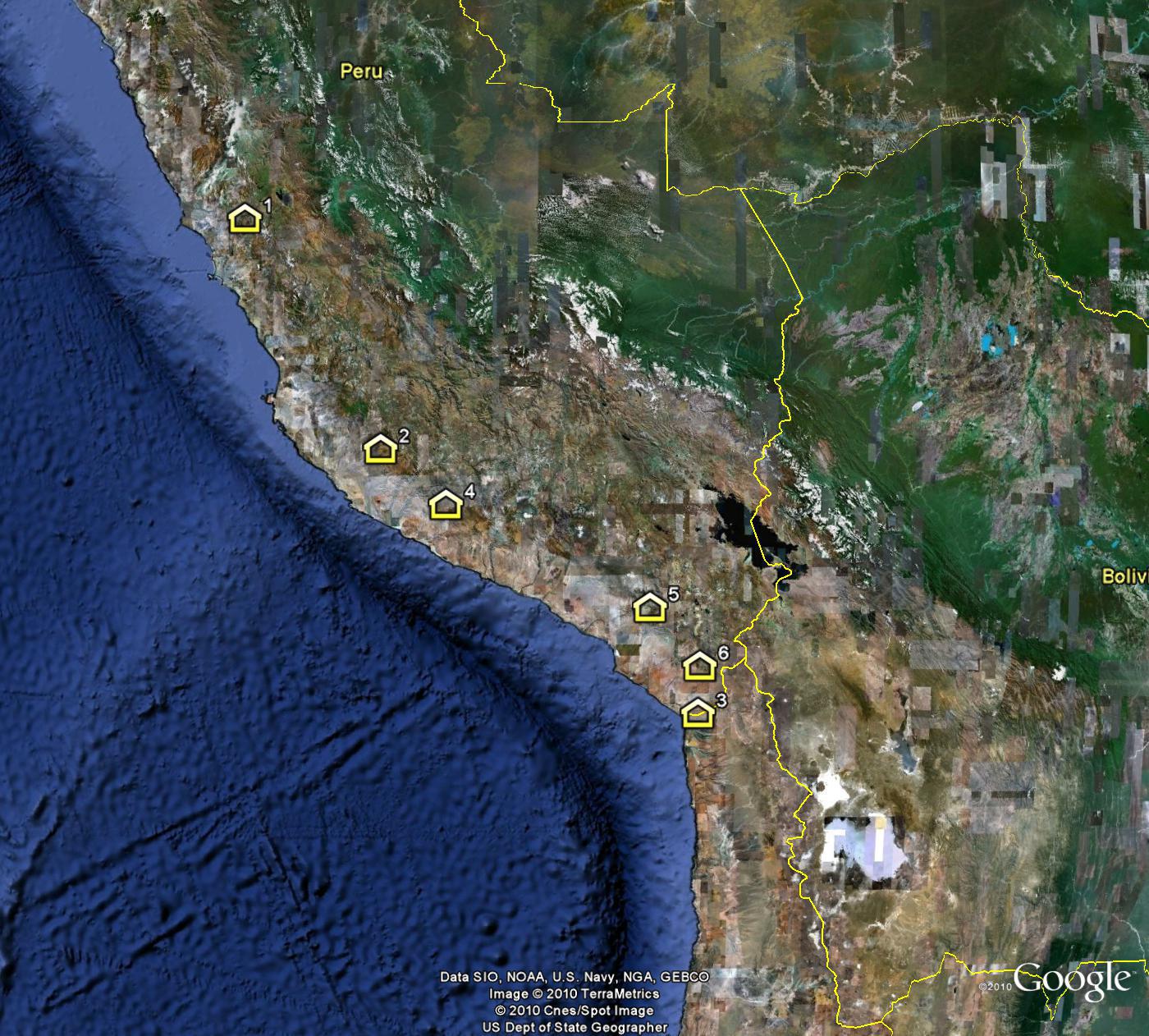
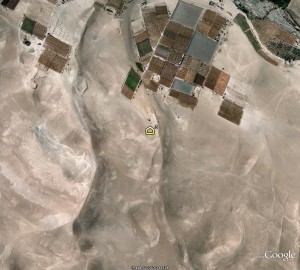
These places are pretty dry. Here’s what a close-up of the driest (number 3) looks like:
Anyway, Hui Xia et al. found evidence of purifying or stabilizing selection at one gene, called LeNCED1. So far so good. But they also found a pattern of variation at the other gene, pLC30-15, in one of the populations (number 4, S. chilense from Quicacha in southern Peru) which they interpreted as evidence of diversifying selection, where “two alleles compete against each other in the fixation process.”
Now, that would arguably be a more interesting population for a breeder to investigate than any of the others, but the observation “is difficult to explain based on the environmental variables of the populations investigated.” Ouch, say the FIGS crowd! 3 But is it perhaps that the authors just considered average rainfall, and not how variable rainfall was at the site, from year to year? The best they can suggest by way of explanation is that S. chilense is an endemic with a very narrow ecological amplitude. In contrast, S. peruvianum is more of a generalist, with larger, expanding populations, found in both dry and mesic locations: “this may not be favourable for the occurrence of adaptive evolution, either because phenotypic plasticity can be promoted rather than local adaptation or because beneficial mutations are more likely recruited from the higher genetic standing variation.”
So, target dry areas for adaptation to drought tolerance, by all means, but the environment is not all, and some wild species may be more useful than others in providing interesting diversity depending on their ecological strategies and population dynamics.
A reprieve for the cerrado
Stung into action by our forceful prose and righteous indignation, the Brazilian government has decided to save what’s left of the cerrado.