Mapping Species Distributions previewed

Dag Endresen introduces Mapping Species Distributions by Janet Franklin, just published by Cambridge University Press.

Species Distribution Modeling (SDM) has really found its way into the scientific literature of late. It has moved from its origin in ecology, to a wider use in life sciences, including also recently data analysis in agriculture. Andy Jarvis, for one, has recently done some excellent studies of crop diversity with MaxEnt. I have not yet read this book, but have ordered it from my favorite online bookshop. Here’s why.

The book introduces the theory and the fundamentals of SDM and proceeds with a deeper description of the many different data analysis methods that has been applied. The list of methods is long (and still growing). However, it seems this book gives comprehensive guidelines for selecting the appropriate method for your own SDM study. I believe that Janet Franklin, the author, teaches species distribution modeling with the free open source R statistical analysis software. We can perhaps hope to find also some few examples of how to apply the described methods with the R package.

The books seems, however, much more focused on the understanding of the ecological principles for SDM and species-environment relationships. The large section on the SDM methods aims to provide us with an understanding of the assumptions and limitations for the models and predictions. I hope this will help to relieve the kind of “black-box” mystery I sometimes feel for many of the SDM methods. We shall see.

Janet Franklin has long experience of biogeography, with appointments as professor of both Geography and Biology.

Nibbles: Breeding, Vegetables, Early agriculture, Breeding course, Nabhan, Gardens, Sequencing twice, er no, once.

Breeders not so bad after all

ResearchBlogging.orgSpeaking of evil plant breeders:

It is generally thought that continuous selection among crosses of genetically related cultivars has led to a narrowing of the genetic base of the crops on which modern agriculture is based, contributing to the genetic erosion of the crop gene pools on which breeding is based.

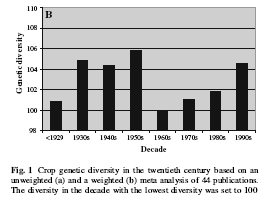
But this may be another faulty meta-narrative. At least that’s what a group of researchers from the Dutch genebank say, as a result of a meta-analysis of 44 genetic diversity studies of the varieties of 8 crops released in successive decades. 1 This is the result:

trend

The meta analysis demonstrated that overall in the long run no substantial reduction in the regional diversity of crop varieties released by plant breeders has taken place.

Of course, that says nothing about the relative frequency at which these varieties have been grown by farmers, also an important aspect of overall diversity, along with how different the varieties are. Anyway, that decrease in the 60’s was only about 6%, and that has been reversed since then. How? Because of genebanks, say the authors.

In the 1960s and 1970s the introduction of the new Green Revolution-type cultivars for the major staple crops led to concerns on the disappearance of the world’s varietal wealth of crop plants. The widely shared concerns ultimately resulted in the establishment of a worldwide network of international genebanks hosted by the CGIAR research centres. The seed samples stored in these genebanks facilitated access of the world’s crop diversity to plant breeders world wide. It seems likely that the easy access to crop diversity provided by the genebanks, improved communication among breeders and easier exchange of seeds were factors contributing to the reversal of the initial trend in diversity reduction as observed in this meta analysis. Also the increased use of crop wild relatives for breeding and in recent years the use of synthetic wheats will have contributed to the observed diversity increase.

Well, it will be interesting to see, in due course, whether the restrictions on access which followed the Convention on Biological Diversity, had an effect, and whether the International Treaty on PGRFA eventually set the world to rights. As it was designed to do.